Landlord Insights
Limited Company Buy-to-Let Mortgages in 2026: What Companies House Charges Show Letting Agents

November 9, 2026

Companies holding between one and four properties accounted for 57% of the charges registered against property-owning companies in England and Wales in the first seven months of 2026. Across 2023 as a whole, the figure was 52%.
A recent Landlord Today report predicted a rise in buy-to-let remortgaging in 2027. To see what the lending records already show, Propalt analysed Companies House charges against property-owning companies with Estate Agent Today, which published the findings in its feature The story behind the stories: Shining a light on the changing property finance market. The 57% figure comes from that analysis.
For letting agents, many of whose landlords run modest portfolios, the useful question is narrower: what do limited company buy-to-let mortgages in 2026 say about the landlords you manage for, and the ones you want to win?
A charge is the security a lender takes over a company's assets, and for a property company that usually means a mortgage over one or more of its properties. Under sections 859A and 859H of the Companies Act 2006, a charge that is not delivered to Companies House within 21 days of its creation is void against a liquidator, administrator or creditor of the company. Lenders therefore register almost every charge they take, which makes the register a fairly complete record of company borrowing secured on property.
It has limits, and the figures below should be read with them in mind:
The data is still useful. The register shows where borrowing activity is happening and which lenders are taking the security. It does not show amounts.
Smaller companies, and in growing numbers. Propalt's analysis found:
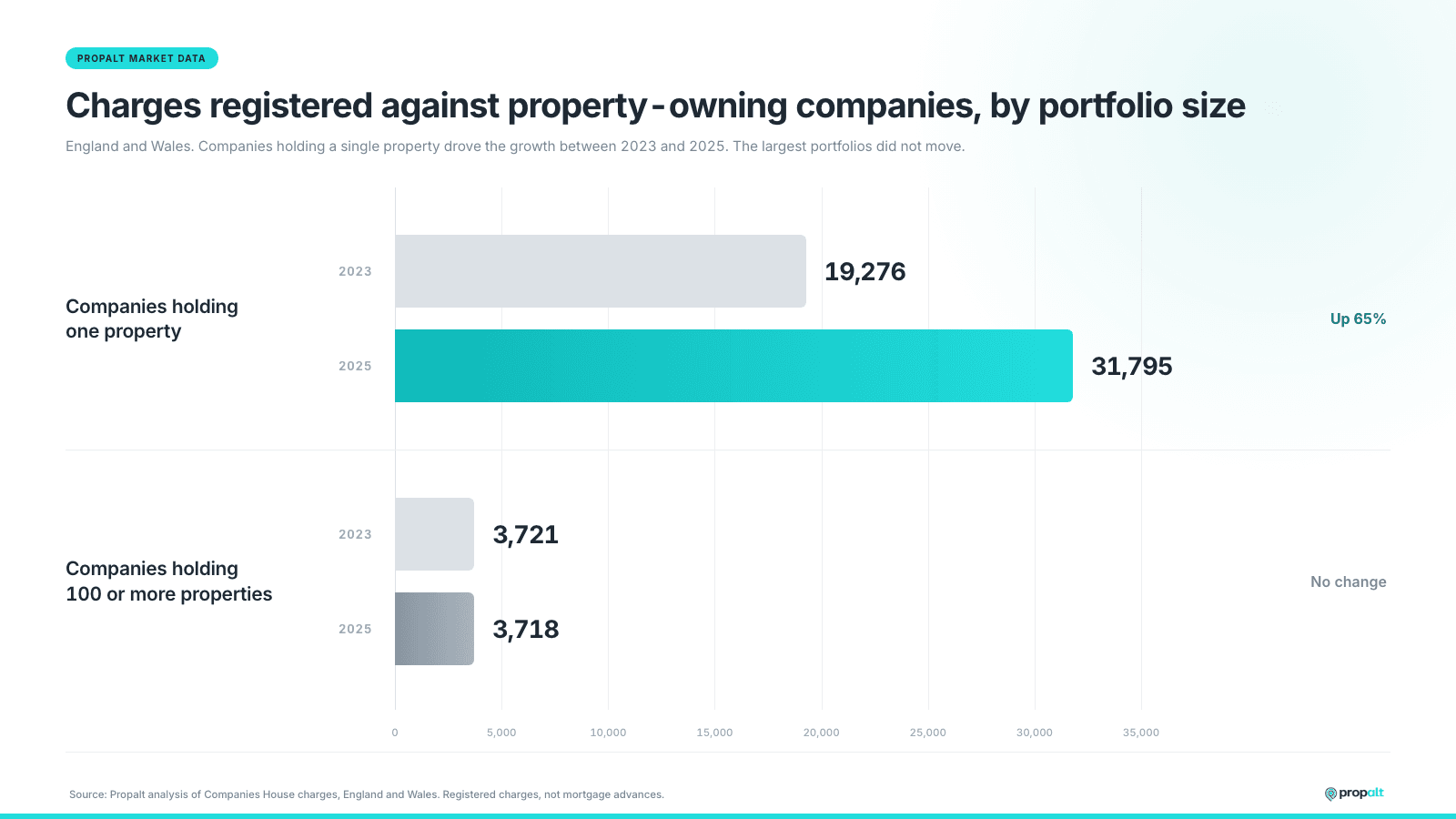
The average number of charges per company stayed at about 1.9 in both 2024 and 2025. The growth came from more companies borrowing. Each company borrowed about as often as before.
"Charge activity is growing fastest among landlords with one to four properties, the same landlords many letting agents manage for."
This sits awkwardly beside the familiar story of landlords leaving the sector. Our article on landlords selling up covers the exit side, and it is real. The charge data does not prove that more landlords are entering the market. It does show that a large and growing group of small landlords are actively financing property through companies, and each of those charges marks a recent decision about a portfolio.
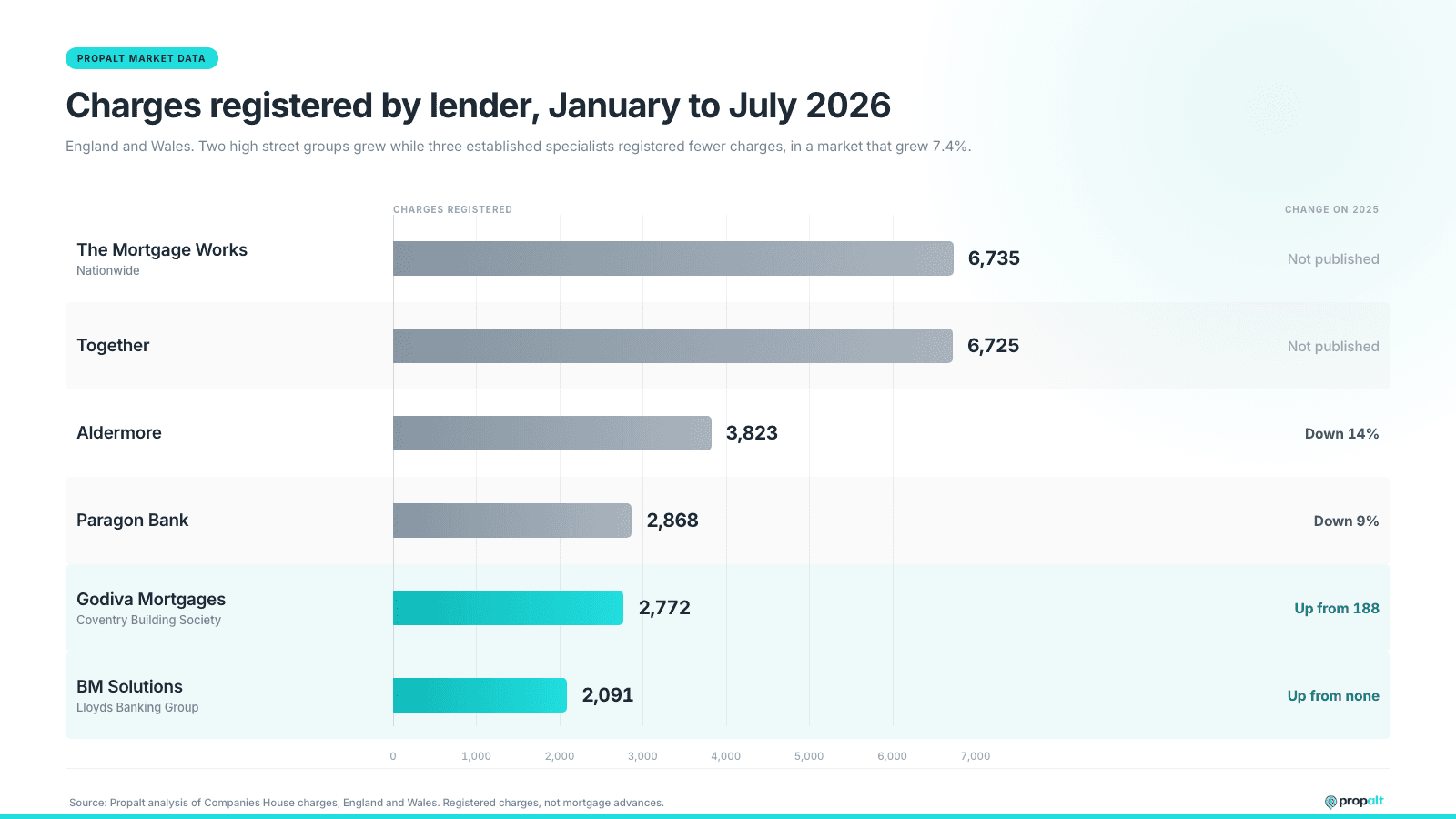
Two high street groups grew sharply in 2026 while several established specialist lenders registered fewer charges. Charges registered against property-owning companies, January to July 2026:
| Lender | Charges, Jan to Jul 2026 | Change on Jan to Jul 2025 |
|---|---|---|
| The Mortgage Works (Nationwide) | 6,735 | Not published |
| Together | 6,725 | Not published |
| Aldermore | 3,823 | Down 14% |
| Paragon Bank | 2,868 | Down 9% |
| Godiva Mortgages (Coventry Building Society) | 2,772 | Up from 188 |
| BM Solutions (Lloyds Banking Group) | 2,091 | Up from none |
The Mortgage Works remained the largest single lender, just ahead of Together. OSB Group (Precise Mortgages, Kent Reliance) registered 8% fewer charges; its total was not published. BM Solutions launched its digital limited company proposition for brokers in July 2025. A year later it was among the ten largest lenders by registered charges. Godiva, Coventry Building Society's buy-to-let brand, went from 188 charges to 2,772 over the same comparison. Between them the two brands accounted for 6.4% of charges in the period, and Lloyds Banking Group as a whole (Lloyds Bank plus BM Solutions) reached 3,738, fourth among lender groups on Propalt's figures.
Over the same months, Aldermore, Paragon and OSB Group all registered fewer charges while the market grew 7.4%. The data does not say why. It cannot show whether the newer entrants are pricing more keenly or whether borrowers are switching lender at remortgage, and agents should not present it to landlords as proof of either.
A charge marks a moment when a landlord was making decisions. A company that has just bought, refinanced or moved properties into a company structure has reviewed its costs, and management fees are one of them. A company registering its first charge may be a landlord who has just set up, possibly with no agent yet. It may also be an existing landlord moving properties into a company.
The lender pattern matters for a second reason. When high street groups compete hard for small company landlords, refinancing gets easier for exactly the landlords who are thinking about whether to keep, grow or sell. If the predicted 2027 remortgage wave arrives, many of those landlords will review the rest of their arrangements at the same time.
"A new charge on a landlord company is a dated record that someone recently made a decision about their portfolio."
Four practical steps, in the order most agencies would take them:
In Propalt's Audience Builder, the Lenders & Charges filter lists charges registered against companies, with the lender, the date each charge was created and how many charges the company holds. Filter by lender or charge anniversary, add the Portfolios filter to keep only portfolio landlords, then send a letter campaign to the owners. It is a direct way to grow your lettings book from landlords who have just made a decision about their portfolio.
📌 KEY TAKEAWAY
Charges registered against limited company landlords grew in 2025 and again in early 2026, and smaller companies drove that growth. Landlords with one to four properties accounted for 57% of charges from January to July 2026, and single-property companies registered 65% more charges in 2025 than in 2023. Two high street groups, Lloyds through BM Solutions and Coventry through Godiva, grew sharply while Aldermore, Paragon and OSB registered fewer charges. The register counts charges. It does not show loan amounts, and it cannot separate purchases from refinancing. Each charge still marks a landlord who recently made a decision about their portfolio, and that is when a letting agent's approach is most likely to be heard.
SOURCES & DATA REFERENCES

As HMO's provide the greatest yield out of the most of the investments we have bought together the most powerful set of HMO data in the UK.

Why are portfolio landlords different to accidental landlords and why should you care ?

Explore effective UK property management strategies, including rent setting, maintenance, and choosing between DIY and professional services.