Landlord Insights
What Is a Title Plan? Title Plan vs Title Register for Agents

November 18, 2026

HM Land Registry sells two documents for every registered property in England and Wales, each for £7 as of November 2026. The title register is a written record of who owns the land and what affects it. The Land Registry title plan is a map extract showing where the land is. Most people who search for one need the other as well.
For an agent, the difference matters before the first conversation with a vendor or landlord. The register tells you who can sign, whether there is a lender, and what they paid. The plan tells you whether the garden, the parking space or the strip at the side is part of what they are selling.
So which document answers which question, and what can neither of them tell you?
The title register is text; the title plan is a map. HM Land Registry's search service describes the register as showing the title number, the owner, "how much the property was last sold for", whether there is a mortgage, and any covenants and easements. It describes the plan as showing "the property's location and general boundaries".
| Title register | Title plan | |
|---|---|---|
| Format | Written entries in three parts (A, B, C) | Ordnance Survey map extract |
| Shows | Description, tenure, owners, price paid, restrictions, mortgages, covenants, leases | Extent of the registered land, edged in red, with references to rights and covenants |
| Answers | Who owns it, who can sell it, what binds it | Where it is and roughly how far it goes |
| Cost to download | £7 | £7 |
| Proof of ownership? | No, only an official copy (£11 by post) | No, only an official copy |
You can see a free property summary first. It shows the address, the description, the tenure and whether restrictive covenants or easements exist, but not the owner.
It shows three registers, labelled A, B and C. HM Land Registry's guide, last updated in September 2026, sets out what sits in each.
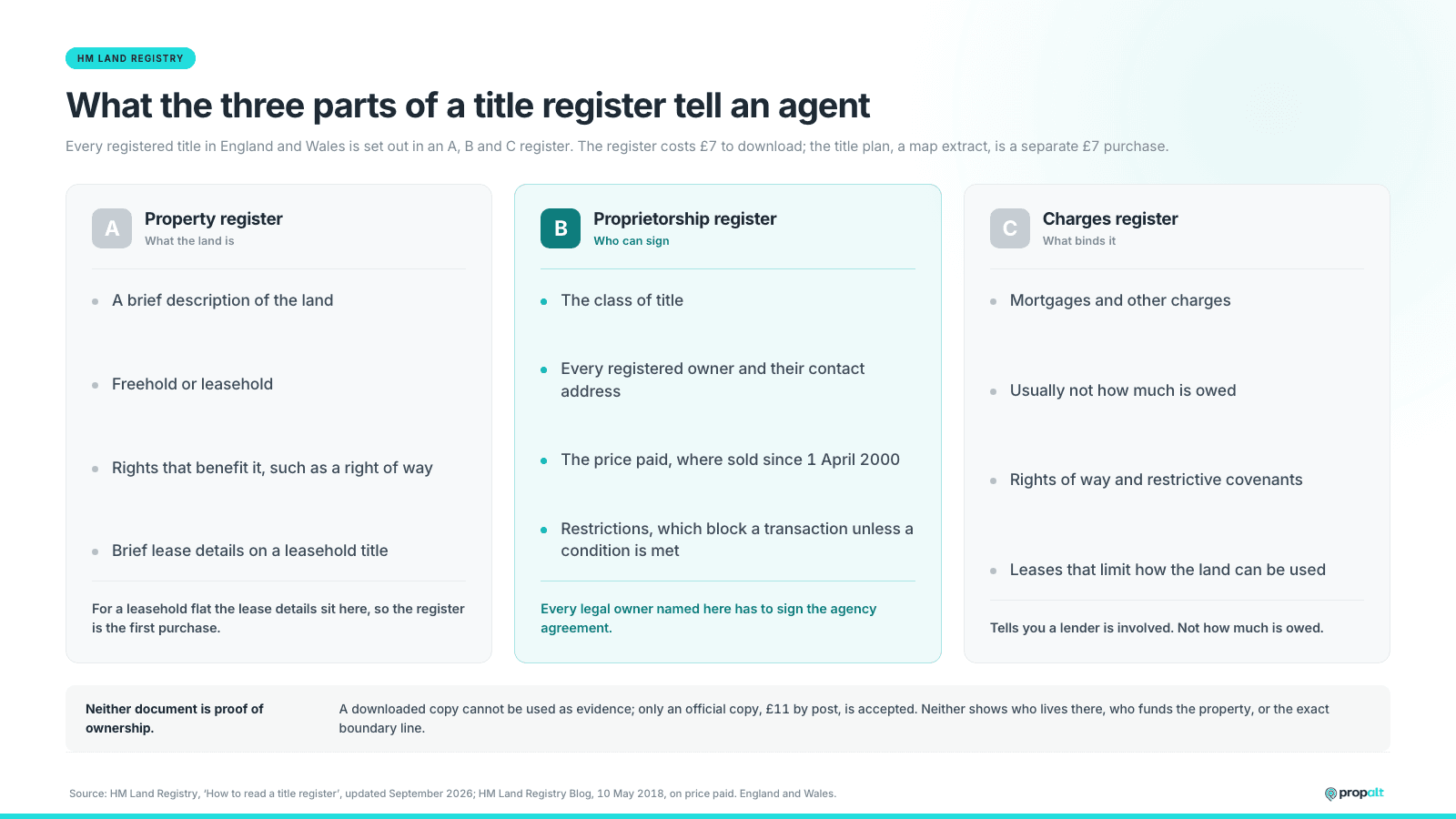
Three entries are worth reading closely before an appraisal. The B register names every legal owner, so a property held by two people needs both on the agency agreement. The B register also lists restrictions, which stop certain transactions being registered unless a condition is met, for example a lender's consent. And the C register tells you whether a lender is involved, though not how much is owed.
The register tells you who can sign. The plan tells you what they are signing for.
A title plan is an extract of the Ordnance Survey map with the registered land edged in red. HM Land Registry's guide is direct about its limits: "You cannot treat the red edging on a title plan as identifying the exact position of a legal boundary."
The plan follows walls, hedges and fences where it can, but it is limited by the scale of the map, and measurements scaled from it are not reliable. Coloured tints and letters on the plan are references, explained in the register: in HM Land Registry's sample, land tinted blue is subject to restrictive covenants. Green edging marks land removed from the title, usually part of a garden sold off.
For most residential instructions, the plan answers practical questions quickly. Does the title include the garage block, the rear access or the parking bay? Has part of the garden been sold? Where the answer matters to value, the vendor's conveyancer and, if needed, a surveyor settle it.
Usually the register, and the plan when land is part of the value. A practical sequence:
For a leasehold flat, the register is where the lease details sit, so it is the first purchase. Our guide to how to find out who owns a property in the UK covers the search itself, including land with no clear address.
Neither shows who lives there, who funds the property, or the exact boundary line. The register shows legal owners on the date and time of the download; it does not show beneficial interests behind a trust or the people who control a company owner.
Neither is proof of ownership either. HM Land Registry says downloaded copies "cannot be used as proof of ownership"; an official copy, at £11 by post, is the version accepted as evidence. And for land that has never been registered, there is no register or plan to buy.
Reading one title register tells you about one property. Propalt is built for agents who want to find the owners most likely to sell or let across a whole area, and reach them first.
📌 KEY TAKEAWAY
The title register, at £7, names the owners, the price paid since 2000, restrictions and any lender; the title plan, also £7, shows the extent of the land but not its exact boundary. Agents preparing an appraisal usually need the register first and the plan when land is part of the value, and neither replaces an official copy where proof is needed. Propalt is built on the principle that agents should walk into an appraisal already knowing who owns the property.
SOURCES & DATA REFERENCES

As HMO's provide the greatest yield out of the most of the investments we have bought together the most powerful set of HMO data in the UK.

Why are portfolio landlords different to accidental landlords and why should you care ?

Explore effective UK property management strategies, including rent setting, maintenance, and choosing between DIY and professional services.