Tutorials
Property Valuation Software for Estate Agents: What to Look For

November 18, 2026

The market appraisal is where an instruction is won or lost. The vendor has usually invited two or three agents, looked at the online estimates and formed a view of the price before anyone arrives. The agent who walks in with the clearest evidence, and leaves a report the vendor can read again that evening, starts ahead.
Property valuation software exists to make that preparation fast. The question for an agency is what it should actually do, and where its numbers stop.
What should estate agents expect from property valuation software, and how does it help win instructions?
Give you the evidence for a price in minutes, in a form you can show the vendor. Five things matter:
| Capability | Why it matters at the appraisal |
|---|---|
| Sold comparables | The evidence a vendor and a buyer's surveyor will both look at |
| Listing history | What the property and its neighbours were marketed at, reduced to and withdrawn from |
| Automated valuation (AVM) | A starting figure to test your own view against |
| Area and risk data | Flood, mining, schools, transport and local market activity, ready for questions |
| An editable report | Your price, your words and your evidence, sent to the vendor after the visit |
The listing history is the part online estimates usually leave out. A neighbouring house that sat for six months and was withdrawn tells a vendor more about an ambitious asking price than any average.
No, and the software does not change that. RICS distinguishes an agent's advice on price for marketing from a formal valuation: its UK commercial agency standard says such advice "is not a formal valuation of the property", and non-valuation opinions must make clear they are not a valuation. A formal Red Book valuation is carried out by a qualified valuer, usually with a full inspection.
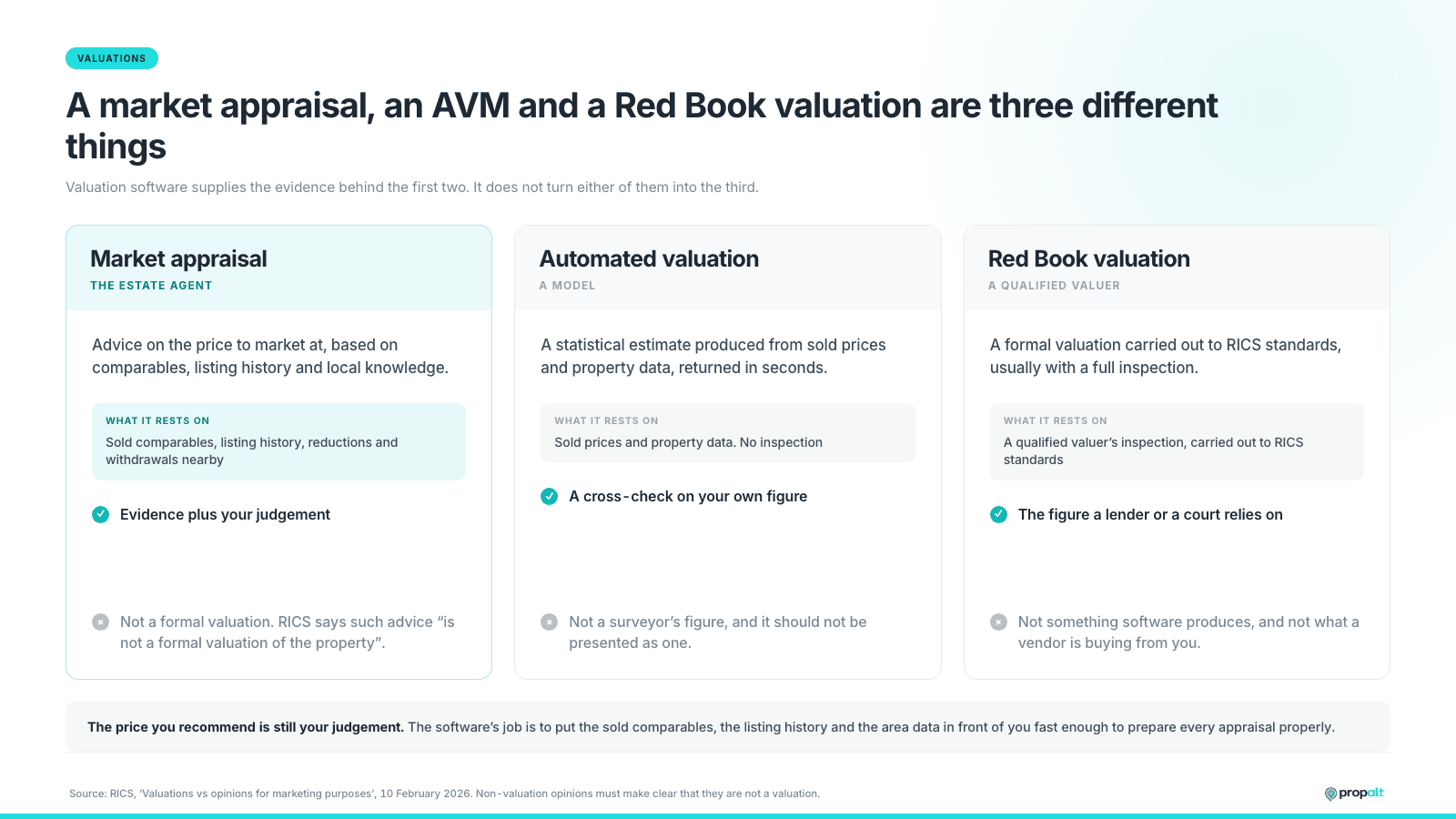
An automated valuation model is a third thing again: a statistical estimate from sold prices and property data, useful as a cross-check. It is not a surveyor's figure and should not be presented as one.
Software gives you the evidence. The price you recommend is still your judgement.
Enough for the vendor to understand your price without you in the room. A practical structure:
National Trading Standards' material information guidance requires listings to include price, tenure and council tax (Part A), the property's type, construction, rooms, utilities and parking (Part B), and matters such as flood risk or restrictive covenants where they apply (Part C). Gathering them at the appraisal saves a second visit.
By saving the research time and by putting you in front of vendors earlier. Preparation that used to take an hour of searching portals takes minutes, so you can book more appraisals in a week. The bigger gain comes before the appraisal is booked: reaching owners who are likely to sell before they call another agent.
How Propalt helps estate agents win instructions
Our guides to marketing for estate agents and direct mail for estate agents cover the prospecting side.
📌 KEY TAKEAWAY
Property valuation software should give an estate agent sold comparables, listing history, an AVM, area data and an editable report, fast enough to prepare every appraisal properly. It supports a market appraisal; it does not turn one into a RICS valuation. The instructions are won earlier, by reaching likely sellers first, and Propalt combines pre-valuation research and editable reports with Audience Builder so you can win more instructions without hours of prospecting.
SOURCES & DATA REFERENCES

Kieran explains how to find and target portfolio landlords using Propalt. See how to analyse portfolios and connect with decision makers in your area using Direct Mail and LinkedIn.

Whats happens when you measure the ROI from you marketing efforts over an entire year? Industry trainer and Propalt user Perry Power shares with us the results from his direct mail campaigns measured over the calendar year.

Looking to boost your conversion rates or unlock new instructions? A Buyer Letter or Home Finding service campaign could be your ace in the hole.