Estate Agency Marketing
The Rule of Seven: Why Estate Agents Need Repeat Touchpoints

November 5, 2026

The rule of seven says a prospect needs to see your message seven times before they act. Estate agents hear it often, and it is a useful reminder that one letter is rarely enough.
It is also not a law. Nobody has published a study showing that seven exposures is the point at which homeowners book a valuation. The number is a marketing heuristic with a long and murky history, and the research on advertising frequency points to something less tidy.
So where did the rule of seven come from, what does the evidence say, and how should an agency plan repeat touchpoints that win instructions?
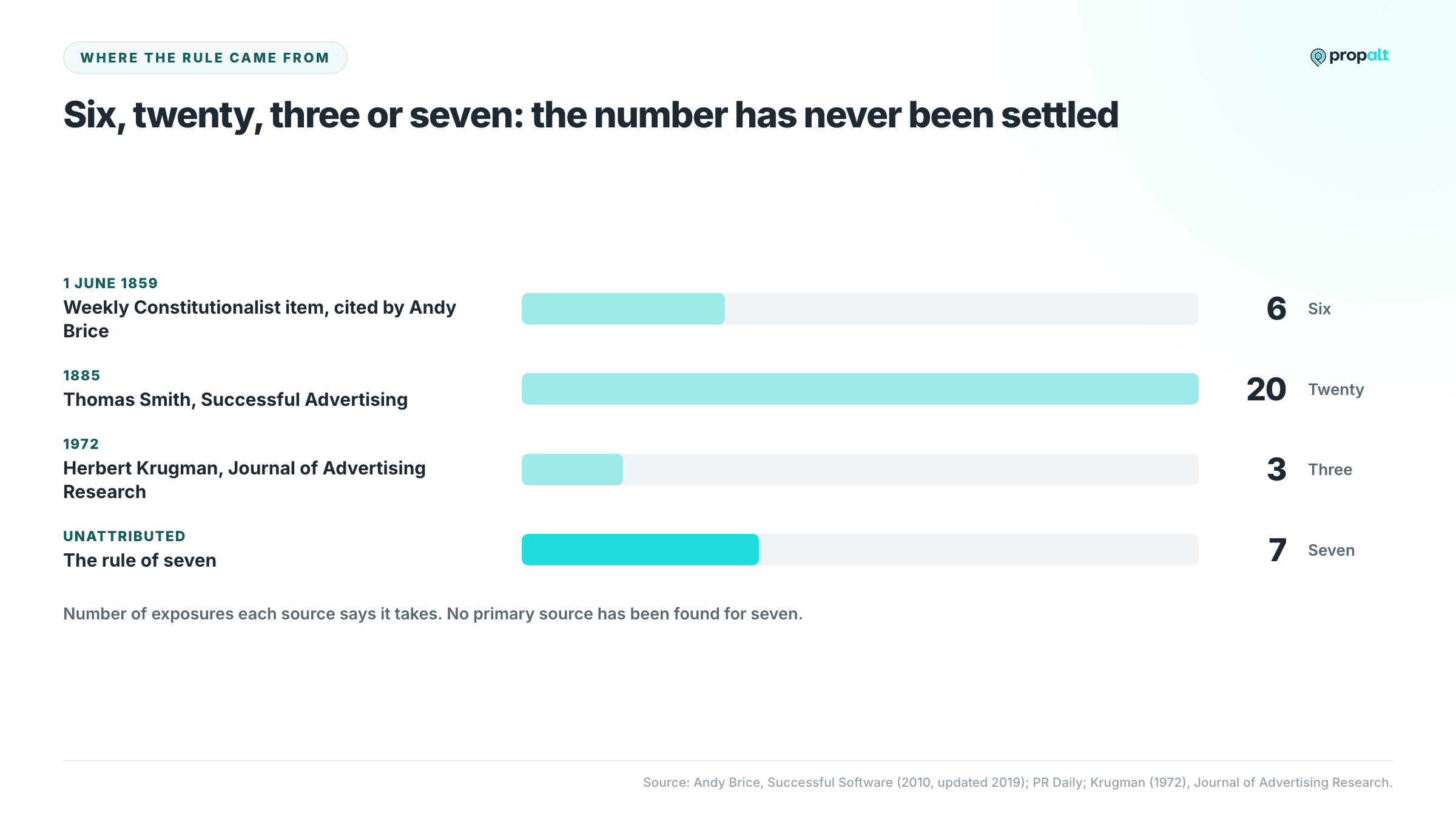
No one knows for certain. The idea that repetition drives response is old, but the number has moved around:
| Source | Date | Number of exposures |
|---|---|---|
| Item in the Weekly Constitutionalist newspaper, cited by marketing blogger Andy Brice | 1 June 1859 | Six ("the sixth time he buys") |
| Thomas Smith, Successful Advertising | 1885 | Twenty, in a step-by-step sequence |
| Herbert Krugman, "Why three exposures may be enough", Journal of Advertising Research | 1972 | Three |
| Rule of seven | Unattributed | Seven |
The rule of seven is often credited to 1930s Hollywood studios, who supposedly found that a film needed seven adverts to fill seats. We could not find a primary source for that story, and Andy Brice, who has looked for the rule's origin since 2010, found no study that supports the number seven. One suggestion he records is that the figure was borrowed from the "seven items" limit of short-term memory, a separate idea from advertising frequency.
"Treat the rule of seven as a reminder to keep going, and judge each touch by the new fact it brings."
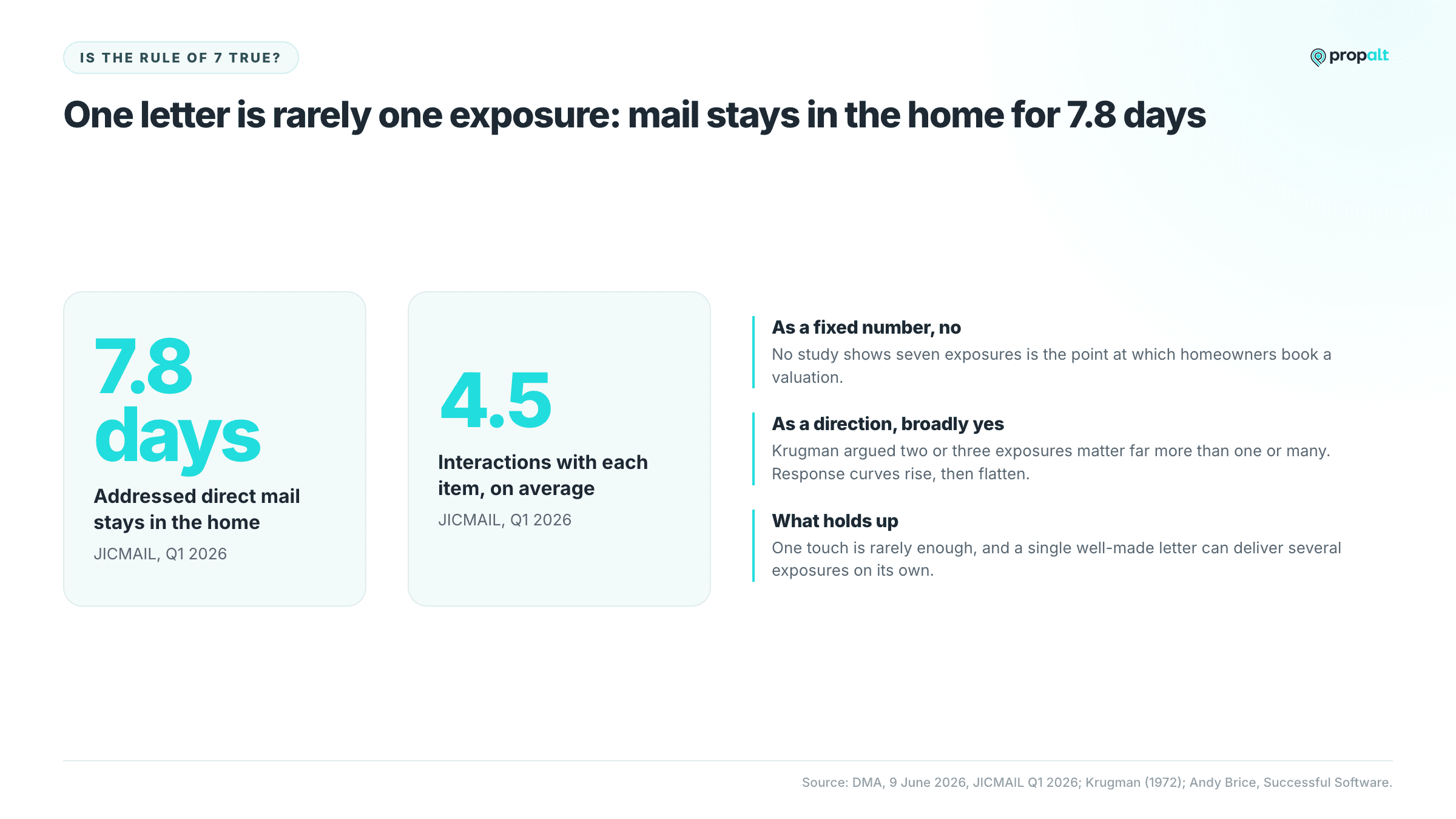
As a fixed number, no. As a direction, broadly yes: repetition helps, up to a point.
Krugman's 1972 work argued that two or three exposures matter far more than one or many, and the papers Brice reviewed found response curves that rise and then flatten, with diminishing returns from each extra exposure. That is a long way from a threshold at seven.
What does hold up is that one touch is rarely enough, and that mail gets more than one look per item. JICMAIL's Q1 2026 data, published by the DMA on 9 June 2026, shows addressed direct mail staying in the home for 7.8 days with 4.5 interactions on average. A single well-made letter can deliver several exposures on its own.
For estate agents, the useful reading of the marketing rule of 7 is this: owners decide to move on their own timetable, so your name needs to be familiar when that moment arrives. How many touches that takes depends on the owner, the trigger and how good each touch is.
Plan by trigger, give each touch a new fact, and decide in advance when to stop. A useful structure for estate agent canvassing:
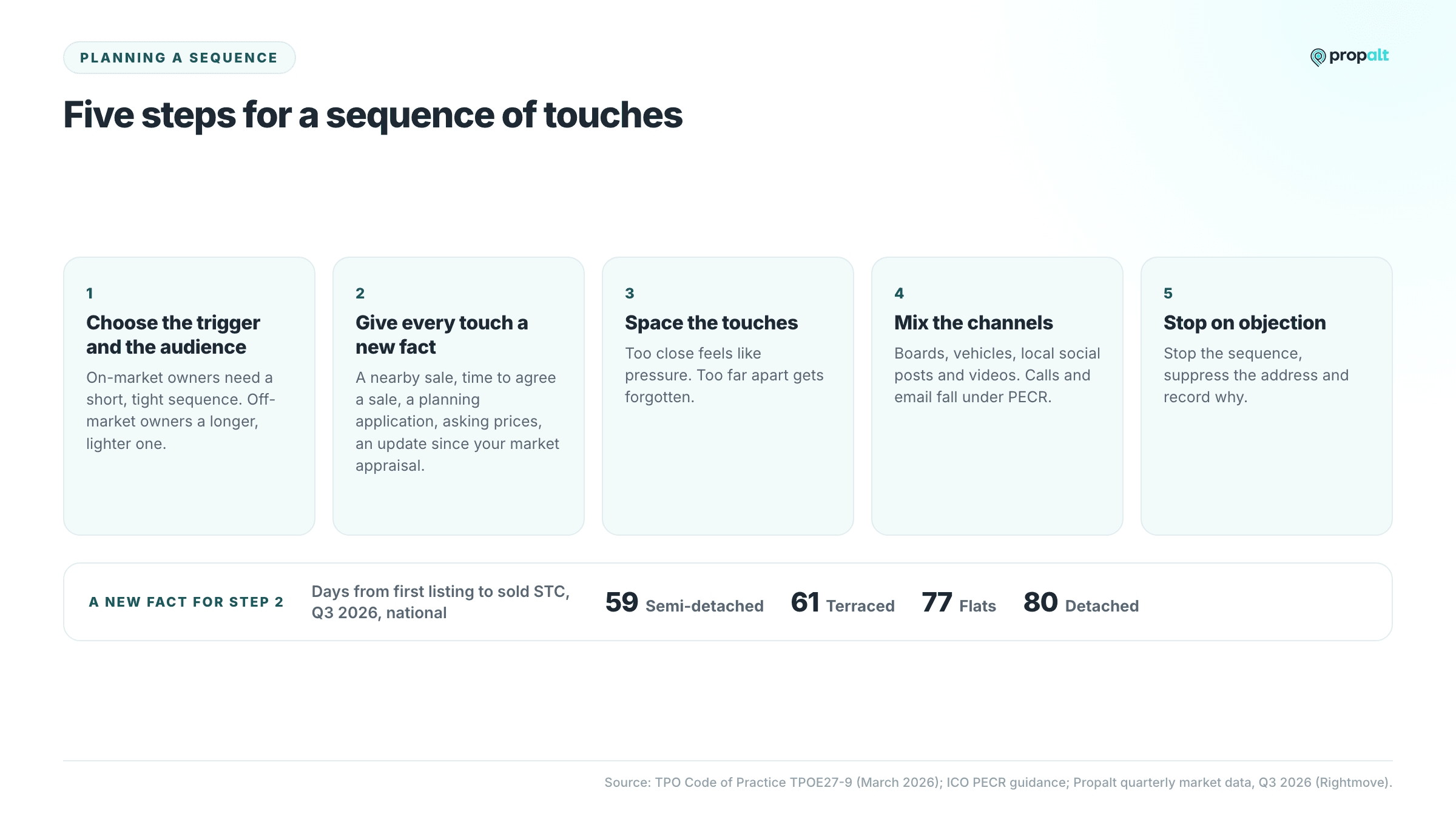
1. Choose the trigger and the audience. Separate on-market from off-market owners. On-market vendors (long time on market, reduced, withdrawn) can move quickly and need a short, tight sequence. Off-market owners need a longer, lighter one built on local news. Match the content to the property: two-bed terrace owners hear about two-bed terrace sales.
2. Give every touch a new fact. Repeating the same letter four times trains the owner to ignore you. Each letter should carry something they did not know:
Local market data supplies facts like these. In Q3 2026, semi-detached homes nationally took 59 days from first listing to sold STC, terraced homes 61 days, flats 77 days and detached homes 80 days (Propalt, Q3 2026). Our guide to turning a new listing into a four-letter campaign shows one local sale carrying a whole sequence.
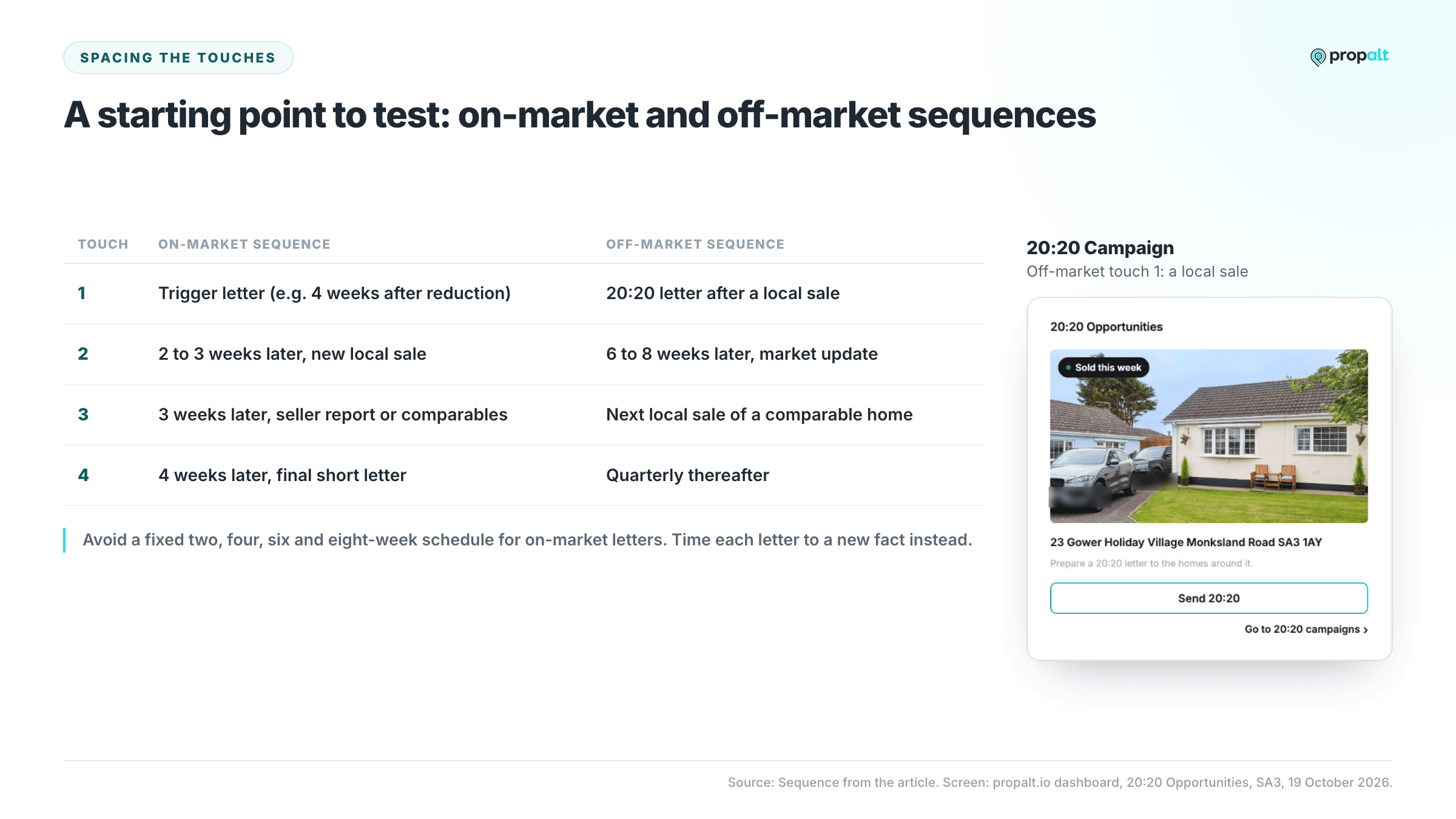
3. Space the touches. Sequences that are too close feel like pressure, and too far apart get forgotten. A starting point to test and adjust:
| Touch | On-market sequence | Off-market sequence |
|---|---|---|
| 1 | Trigger letter (e.g. 4 weeks after reduction) | 20:20 letter after a local sale |
| 2 | 2 to 3 weeks later, new local sale | 6 to 8 weeks later, market update |
| 3 | 3 weeks later, seller report or comparables | Next local sale of a comparable home |
| 4 | 4 weeks later, final short letter | Quarterly thereafter |
Avoid a fixed two, four, six and eight-week schedule for on-market letters. Time each letter to a new fact instead. Our guide to on-market canvassing covers timing in detail.
4. Mix the channels. Letters are only one touch. Sale boards, branded vehicles, local social posts and market update videos all add familiarity. Marketing calls and emails to individuals are covered by PECR: screen calls against the Telephone Preference Service, and get the owner's consent before you send marketing email.
5. Stop on objection. The TPO Code of Practice for Residential Estate Agents (TPOE27-9, March 2026) requires you to act promptly if a consumer asks you to stop canvassing them (clause 3f), and clause 5b bans repeatedly trying to gain instructions in a way likely to cause offence. The ICO treats the right to object to direct marketing as absolute, with one calendar month to respond. Stop the sequence, suppress the address, and record why. Stop too when the owner instructs you, or instructs someone else and tells you so.
Longer than most agencies expect. A letter can produce a market appraisal within a week or a year later, and an agency whose name is already familiar locally starts with an advantage. Some owners keep a letter for months before they call.
That is why consistency matters more than any single campaign. Build a marketing calendar for the year, keep the off-market sequences running through quieter months, and judge results over twelve months.
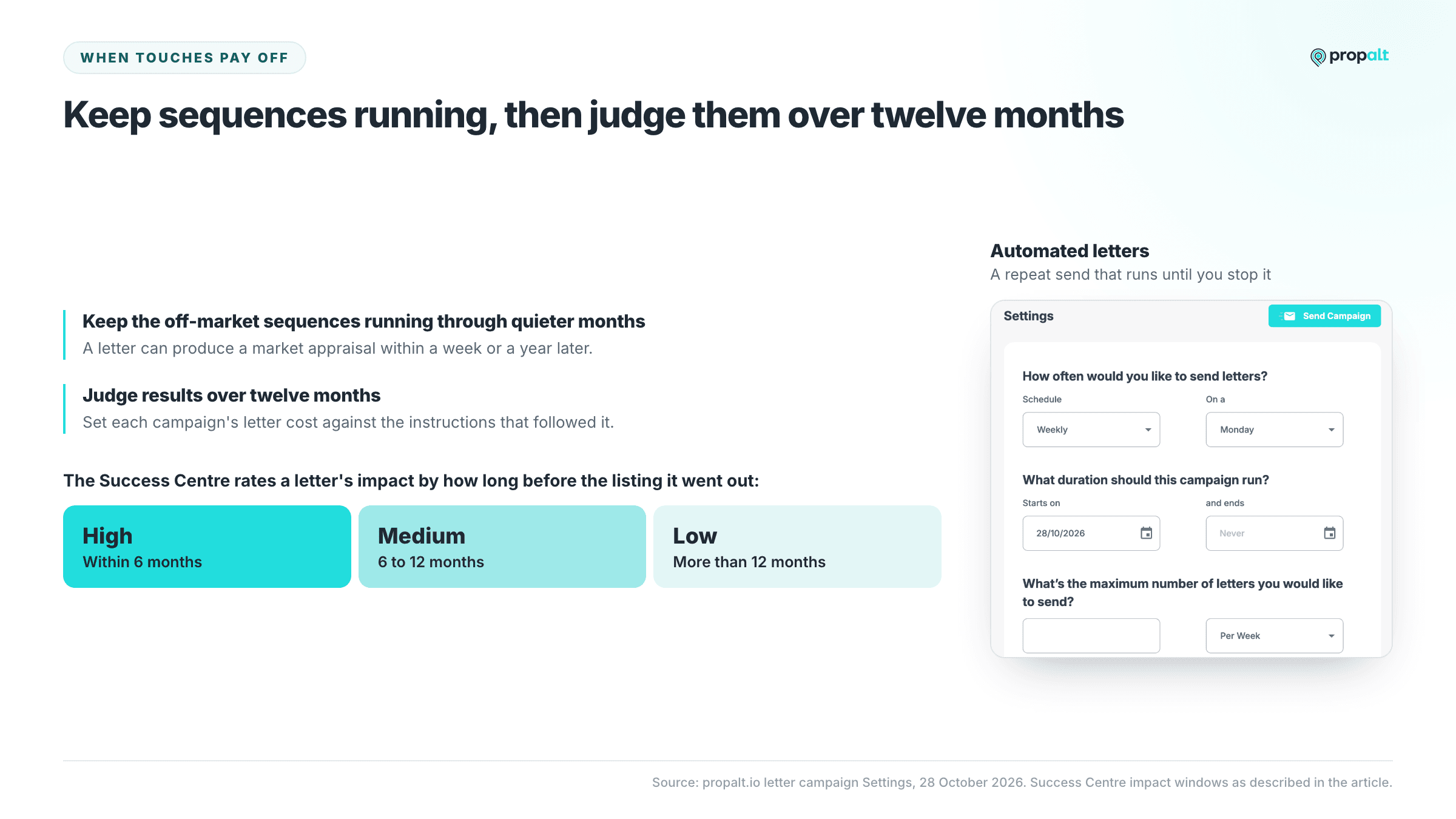
To judge a year of sequences, you need to see which instructions followed them. The Success Centre matches your own new sale and rental listings against the letters you sent through Propalt, marking each match Exact or Broad and rating its impact High (letter within 6 months of the listing), Medium (6 to 12 months) or Low (more than 12 months). That shows which campaigns came before new instructions, so you can set each campaign's letter cost against them. Our article on direct mail returns for estate agents explains why targeting decides those returns.
Start with the letters that earn their place. Our canvassing letter templates give you five ready-made first touches, creating a 20:20 direct mail campaign covers the off-market sequence, canvassing with seller reports is a strong third touch for the homes you want most, and direct mail for estate agents sets out postage costs and how to measure return.
Rule of seven marketing is a heuristic with no verified origin: earlier writers used six or twenty, Krugman's 1972 research argued three, and frequency studies show diminishing returns. The lasting lesson for estate agents is that one letter is rarely enough. Plan each sequence by trigger, give every touch a new local fact, space touches so they neither crowd nor fade, mix channels within PECR, and stop at the first objection. Propalt's automated letters run those sequences as Automation campaigns that can be paused and restarted, with Campaign History showing every letter, mailout and cost per campaign.

How to canvass homes already on the market within the TPO code: which signals to use, when to write around sole agency terms, and what to say.

As we approach the summer holidays and the annual exodus of homeowners to sunnier climates, one thing remains certain for estate agents: September matters.

Direct mail works best when it’s consistent - but that doesn’t mean blasting the same message to everyone. The smartest agents use Lead Magnets on their canvassing letters to reveal who’s curious about moving, before they even pick up the phone.