Landlord Insights

Awaab's Law and Private Landlords: What's Confirmed and What Isn't

Kieran Slinger
by Kieran Slinger |
October 28, 2026
Awaab's Law and Private Landlords: What's Confirmed and What Isn't

Awaab's Law and Private Landlords: What's Confirmed and What Isn't

Awaab's Law does not apply to private landlords yet. As of October 2026 it binds social landlords only, and has done since 27 October 2025. For the private rented sector, the government opened a consultation on 9 October 2026 that closes on 18 December 2026, and it describes 2027 as the earliest feasible start.

That gap matters, because much of the coverage you will see treats private landlords as already covered. They are not. What is confirmed is the power to extend the law, set out in the Renters' Rights Act 2025, and a set of proposed timescales that are still open for comment.

So what exactly is confirmed for private landlords, what is only proposed, and what should managing agents put in place before the rules are final?

What is Awaab's Law?

Awaab's Law sets legal deadlines for landlords to investigate and fix hazards. It is named after Awaab Ishak, who died in 2020 aged two from a lung condition caused by mould in his family's social rented home. GOV.UK guidance says his parents reported the mould to their landlord many times over three years.

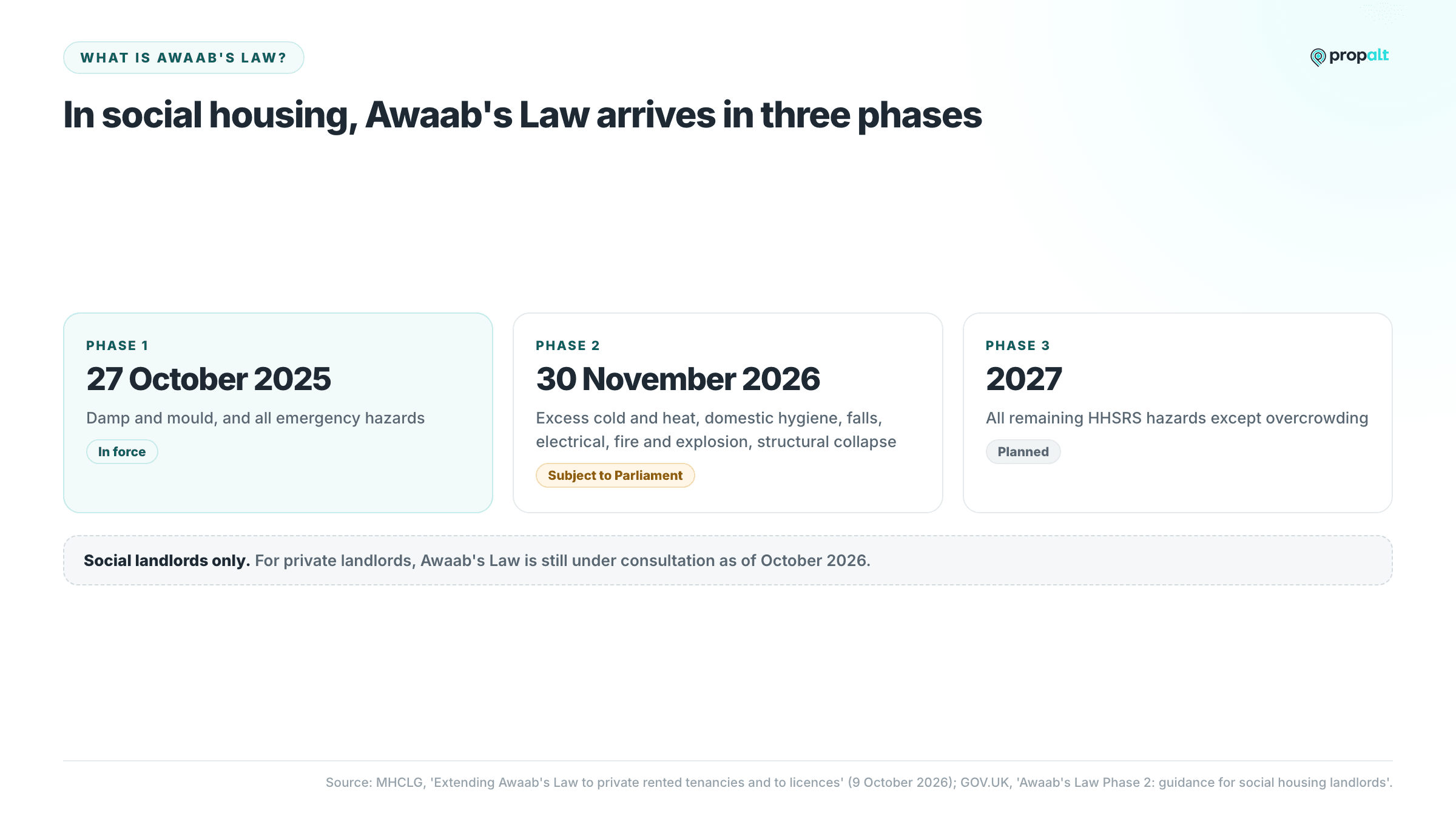
In social housing, the law works in phases:

PhaseHazards coveredDate
Phase 1Damp and mould, and all emergency hazards27 October 2025, in force
Phase 2Excess cold and heat, domestic hygiene, falls, electrical, fire and explosion, structural collapse30 November 2026, subject to Parliament
Phase 3All remaining HHSRS hazards except overcrowding2027

Three phases of Awaab's Law for social landlords: 27 October 2025, 30 November 2026 subject to Parliament, and 2027.

For significant damp and mould hazards, social landlords must investigate within 10 working days of a report, give the tenant a written summary within 3 working days of the investigation if further work is needed, and make the home safe within 5 working days. Emergency hazards must be investigated and made safe within 24 hours. Further work must start within 12 weeks at the latest, and if the home cannot be made safe in time, the landlord must offer somewhere else to stay.
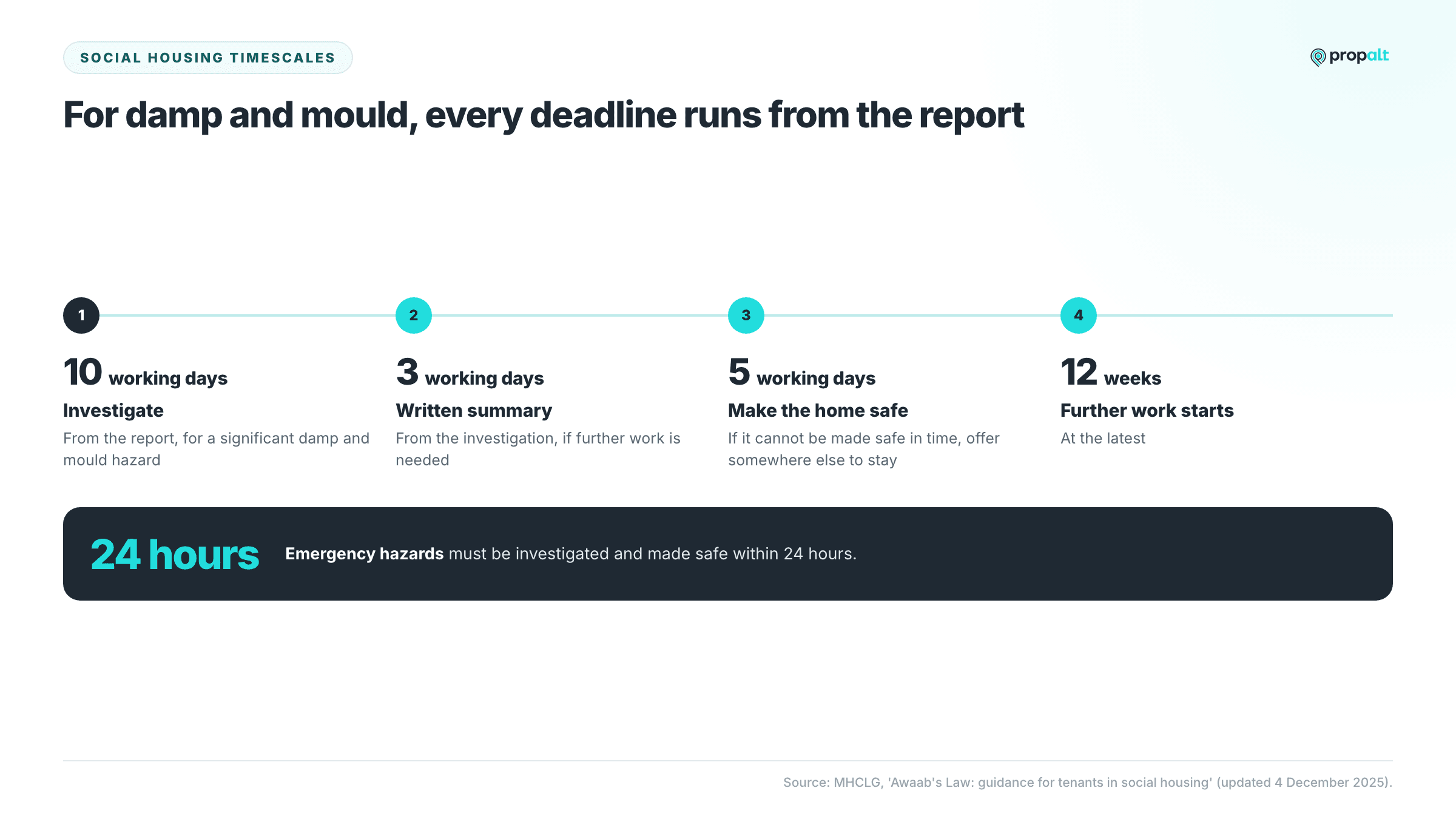
Social housing damp and mould deadlines: investigate in 10 working days, written summary in 3, make safe in 5, further work within 12 weeks, emergencies in 24 hours.

Does Awaab's Law apply to private landlords yet?

No. Here is the position as of 26 October 2026.
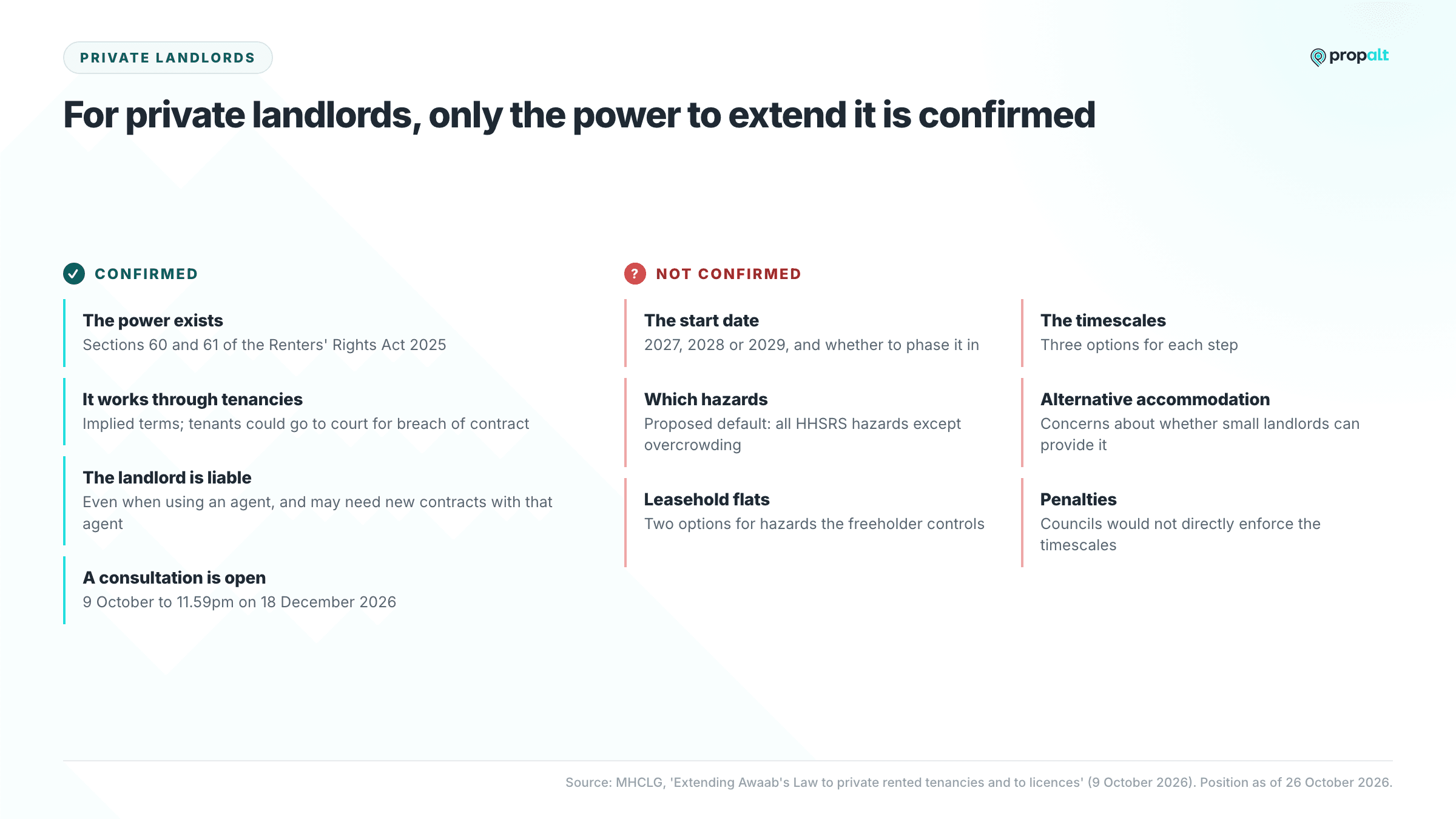
Two lists of what is confirmed and what is not yet confirmed about Awaab's Law for private landlords.

Confirmed:

  • The power exists. Section 60 of the Renters' Rights Act 2025 lets the government apply Awaab's Law to private tenancies. Section 61 does the same for accommodation occupied under licence. The consultation covers three types: supported housing, temporary accommodation for homeless households and care leaver accommodation.
  • It will work through tenancies. The requirements would be implied terms in each tenancy. Tenants could take the landlord to court for breach of contract, and courts could order repairs, compensation or costs.
  • The landlord is liable. The consultation says a landlord who uses an agent remains liable, and may need new contracts with that agent.
  • A consultation is open. Published 9 October 2026, closing 11.59pm on 18 December 2026.

Not confirmed:

  • The start date. The consultation asks whether it should be 2027, 2028 or 2029, and whether to phase it in.
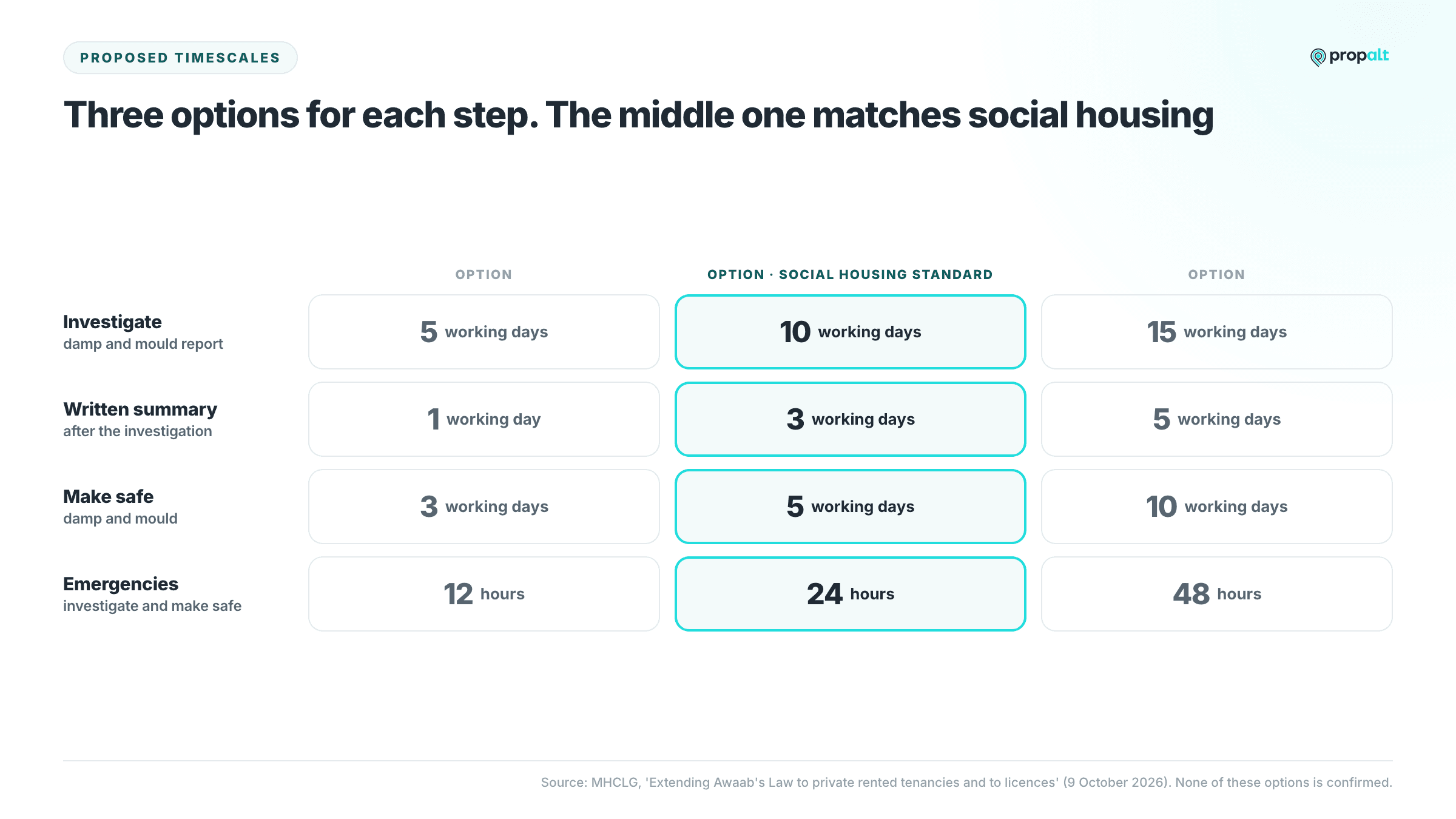
  • The timescales. For each step, the government offers three options: investigation within 5, 10 or 15 working days; written summary within 1, 3 or 5; making safe within 3, 5 or 10; emergencies within 12, 24 or 48 hours.
  • Which hazards. The proposed default is all HHSRS hazards except overcrowding.
  • Alternative accommodation. The government has raised concerns about whether small landlords can provide it and is seeking views.
  • Leasehold flats. Two options are on the table for hazards the freeholder controls.
  • Penalties. The consultation says councils would not directly enforce the Awaab's Law timescales. It does not say whether breaches would carry a financial penalty.

The three proposed timescale options for each Awaab's Law step, with the middle option matching the social housing standard.

The law that will apply to private landlords is written in outline only. The duty to deal with serious hazards already exists.

What already applies to damp and mould in private rented homes?

Private landlords are not waiting in a vacuum. Several duties are already live:

  • HHSRS enforcement. Councils assess damp and mould under the Housing Health and Safety Rating System and can act on serious hazards. Since June 2026, councils can issue a civil penalty of up to £7,000 for failing to address Category 1 hazards.
  • Decent Homes Standard. The government has confirmed the standard will apply to private rented homes from 2035, with a legal duty to meet it.
  • Ombudsman route. Once landlords join the Private Rented Sector Landlord Ombudsman, expected in 2028, tenants will have a cheaper complaint route than court. The consultation asks whether the ombudsman's start should affect when Awaab's Law applies.
  • Section 8 reality. With Section 21 abolished from 1 May 2026, a landlord cannot end a tenancy to avoid a repair complaint without a valid ground.

The local housing stock shows why this matters. In Coventry's CV2 district, terraced houses make up 15,947 of the 28,641 homes with a Propalt valuation, the most common construction age band is 1950 to 1966, and 47 terraced homes listed to let there on Rightmove and Zoopla on 26 October 2026 had an EPC of D or below.
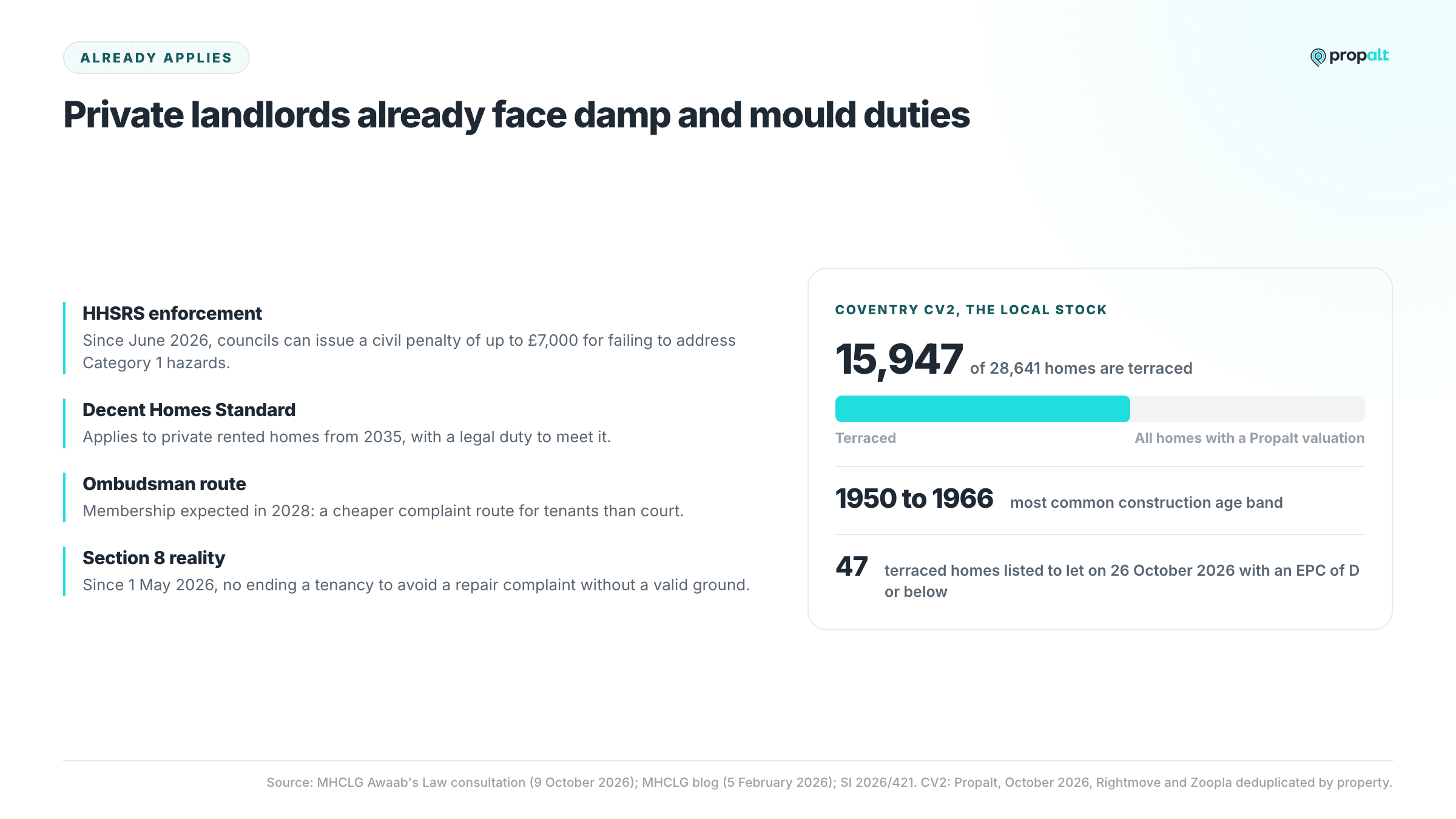
Four damp and mould duties that already apply to private landlords, beside Coventry CV2 housing stock figures.

What should agents do about damp and mould reports now?

Build the process to the social housing standard. It is the government's stated starting point, and the middle option in every proposed timescale matches it.
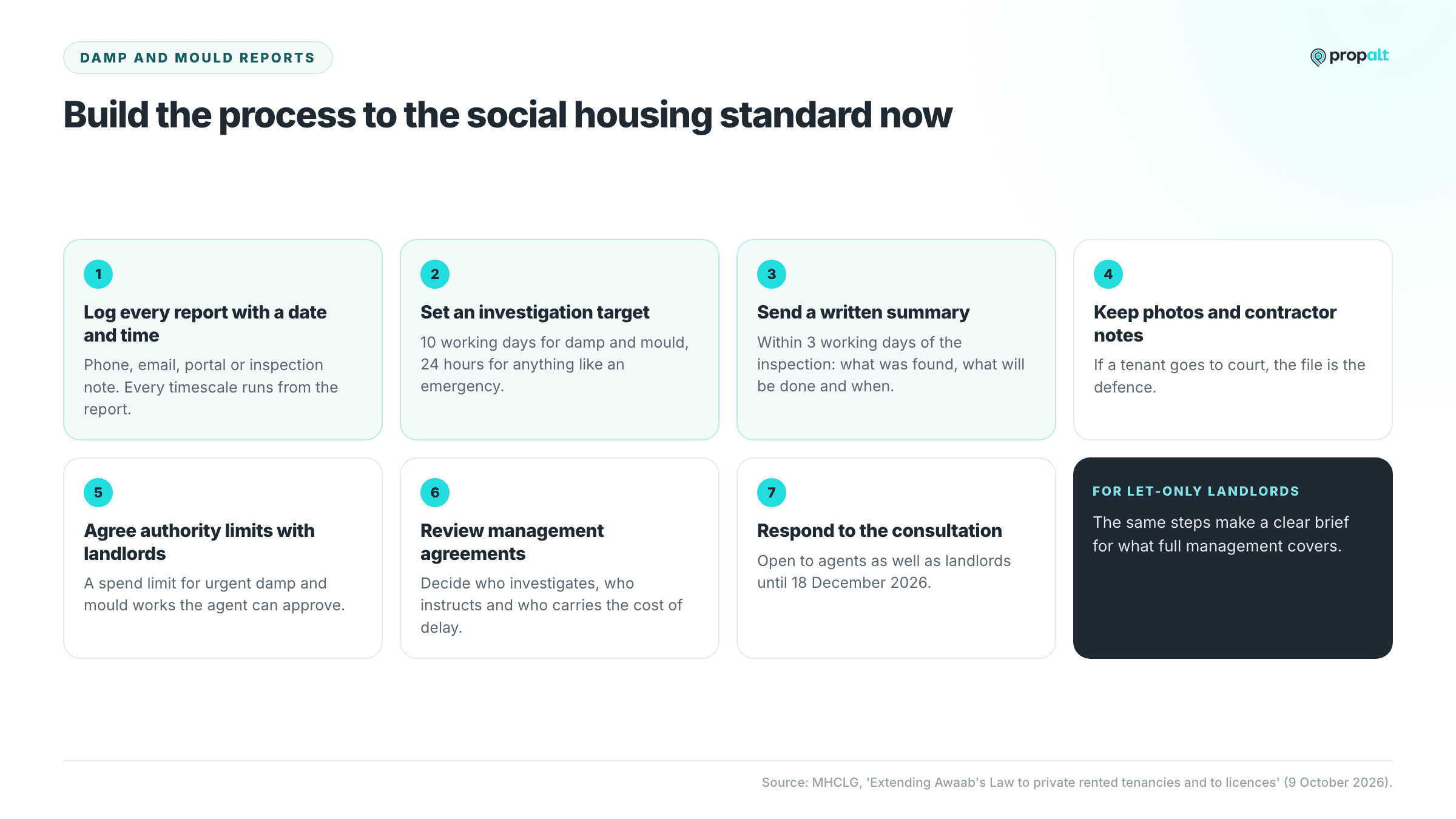
  1. Log every report with a date and time. Phone, email, portal or inspection note. Every Awaab's Law timescale runs from the report.
  2. Set an investigation target. Aim for 10 working days for damp and mould and 24 hours for anything that looks like an emergency.
  3. Send a written summary. Within 3 working days of the inspection: what was found, what will be done and when.
  4. Keep photos and contractor notes. If a tenant goes to court, the file is the defence.
  5. Agree authority limits with landlords. Set a spend limit for urgent damp and mould works the agent can approve without waiting.
  6. Review management agreements. The consultation flags that landlords may need new agent contracts. Decide now who investigates, who instructs and who carries the cost of delay.
  7. Respond to the consultation. It is open to agents as well as landlords until 18 December 2026.

Seven steps for agents handling damp and mould reports to the social housing standard.

For let-only landlords, the same steps make a clear brief for what full management covers, and why it may be worth the fee once the timescales become law.

How does this affect conversations with self-managing landlords?

It gives you a specific, dated subject to write about. A self-managing landlord with an older terraced house and no reporting process faces a likely legal deadline for responses from 2027 at the earliest, plus a £7,000 Category 1 hazard penalty that already exists.

Avoid scaring them with dates that are not set. The credible message is narrower: here is what the government has proposed, here is when it could start, and here is how we already handle reports to that standard.

In Propalt, the Landlords and Let Renewal audiences in Audience Builder build that list, for example rented homes due for renewal from this month up to five months ahead, and "Create campaign" sends their owners a letter. Our guide to writing a prospecting letter covers the wording, and the rule of seven explains why one letter is rarely enough.

Propalt Audience Builder Landlords audience and Create campaign button, beside the three-part message for self-managing landlords.

Agents who say clearly what is not yet confirmed will be believed when they say what is.

For the full timeline of the Act, see The Renters' Rights Act 2025: Every Key Date for Landlords and Letting Agents. For building the list of landlords to contact, see our guide to finding new landlords, or, if your team uses AI assistants, our propalt.ai guide to landlord prospecting with ChatGPT and Claude. The landlord register also asks for safety certificates on every let property.

📌 KEY TAKEAWAY

Awaab's Law has applied to social landlords since 27 October 2025. For private landlords, only the power to extend it is confirmed. The start date, timescales and hazards are all out to consultation until 18 December 2026, with 2027 the earliest feasible date. Agents who log, inspect and report on damp and mould to the social housing standard now will be ready whichever option is chosen. To see which rented homes in your area are let by landlords who may need that help, use the Properties for Rent view in My Prospects.
SOURCES & DATA REFERENCES

  1. Ministry of Housing, Communities and Local Government (9 October 2026). 'Extending Awaab's Law to private rented tenancies and to licences.' Consultation dates, sections 60 and 61 powers, proposed timescale options, hazards, alternative accommodation, agent liability, earliest feasible date 2027, £7,000 Category 1 hazard penalty in force June 2026, social housing phase dates. gov.uk/government/consultations/extending-awaabs-law-to-private-rented-tenancies-and-to-licences
  2. Ministry of Housing, Communities and Local Government (first published 27 October 2025, updated 4 December 2025). 'Awaab's Law: guidance for tenants in social housing.' Awaab Ishak, social housing timescales, alternative accommodation duty. gov.uk/government/publications/awaabs-law-guidance-for-tenants-in-social-housing
  3. Ministry of Housing, Communities and Local Government (first published 6 November 2025). 'Guide to the Renters' Rights Act.' Awaab's Law in force for social housing from 27 October 2025; extension to private rentals through implied terms; Decent Homes Standard duty. gov.uk/government/publications/guide-to-the-renters-rights-act
  4. GOV.UK (2026). 'Awaab's Law Phase 2: guidance for social housing landlords.' Phase 2 hazards. gov.uk/government/publications/awaabs-law-phase-2-guidance-for-social-housing-landlords
  5. Ministry of Housing, Communities and Local Government (first published 13 November 2025, updated 20 October 2026). 'Implementing the Renters' Rights Act 2025: our roadmap.' Awaab's Law in the private sector as a Phase 3 measure with timescales to be confirmed; ombudsman membership expected 2028. gov.uk/government/publications/renters-rights-act-2025-implementation-roadmap
  6. MHCLG blog (5 February 2026). 'Decent Homes Standard.' Standard to apply to private rented homes from 2035. mhclgmedia.blog.gov.uk/2026/02/05/decent-homes-standard/
  7. legislation.gov.uk (2026). 'The Renters' Rights Act 2025 (Commencement No. 2 and Transitional and Saving Provisions) Regulations 2026, SI 2026/421.' End of Section 21 from 1 May 2026. legislation.gov.uk/uksi/2026/421
  8. Propalt (October 2026). CV2 (Coventry) postcode district housing stock: 15,947 terraced homes of 28,641 main residential homes with a Propalt valuation, most common construction age band 1950 to 1966; terraced homes listed to let on Rightmove and Zoopla (deduplicated by property) with an EPC of D to G on 26 October 2026 (47). propalt.ai

You might also like