HMO
HMO Register: How to Check if a Property Is a Licensed HMO

November 16, 2026

Every local housing authority in England must keep a public register of the HMO licences it has granted. The duty comes from section 232 of the Housing Act 2004, and the content of each register is set by regulations made in 2006. If you want to know whether a property is a licensed HMO, the council's register is the official place to check.
Finding it is not always simple. Some councils publish a downloadable spreadsheet. Others ask you to book an appointment at the civic centre, or charge for an electronic copy. And most attach conditions to how the information can be used.
So what does an HMO licence register show, how do you check one, and what can agents and landlords legitimately do with it?
It is the council's public record of licences granted under Part 2 of the Housing Act 2004 (HMO licensing) and Part 3 (selective licensing). A typical entry shows the property address, a licence reference, the start and expiry dates of the licence, and details of the licence holder.
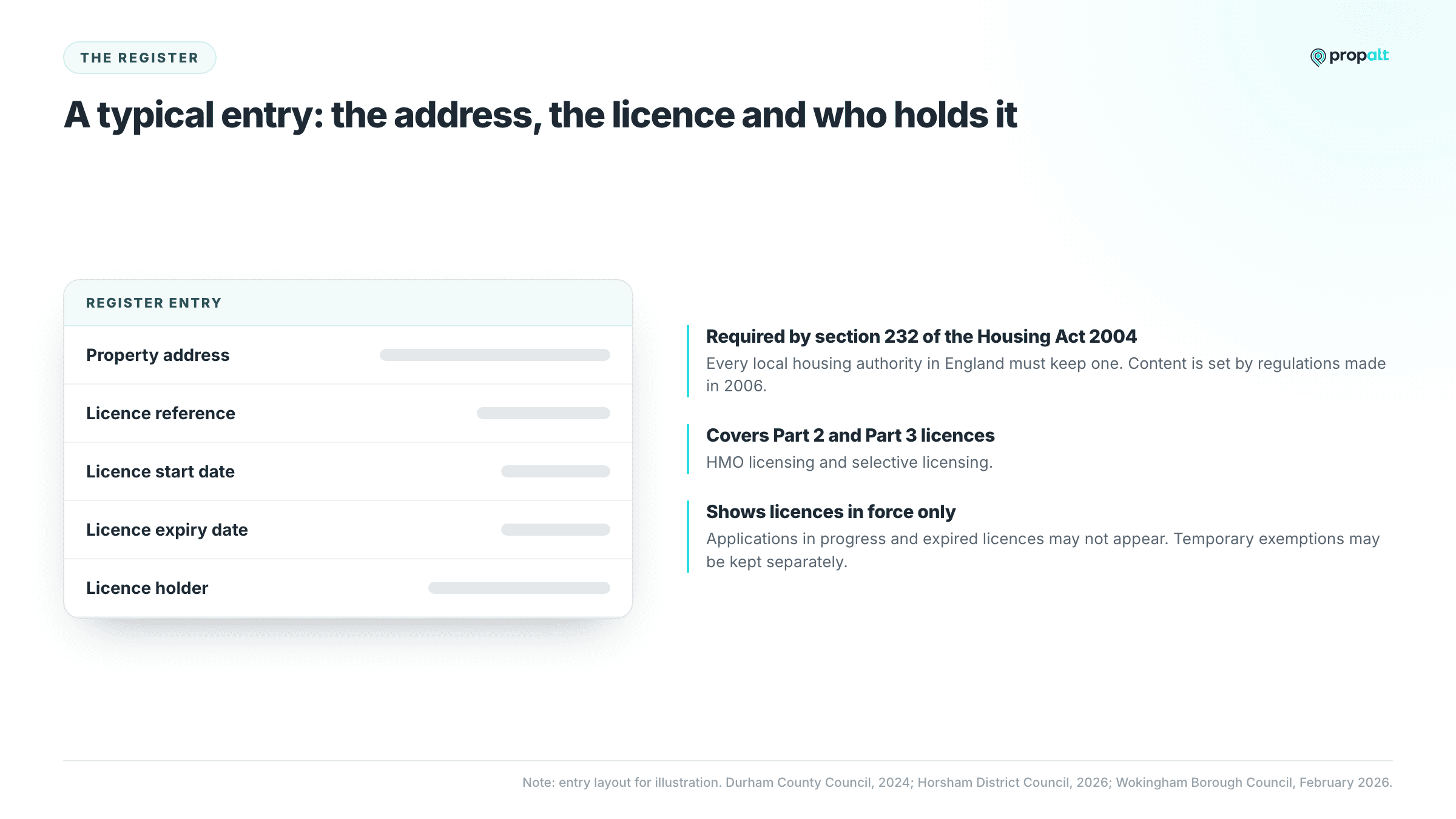
The register only shows licences that are in force. Applications still being processed and licences that have expired may not appear, and some councils keep separate records of properties given a temporary exemption from licensing.
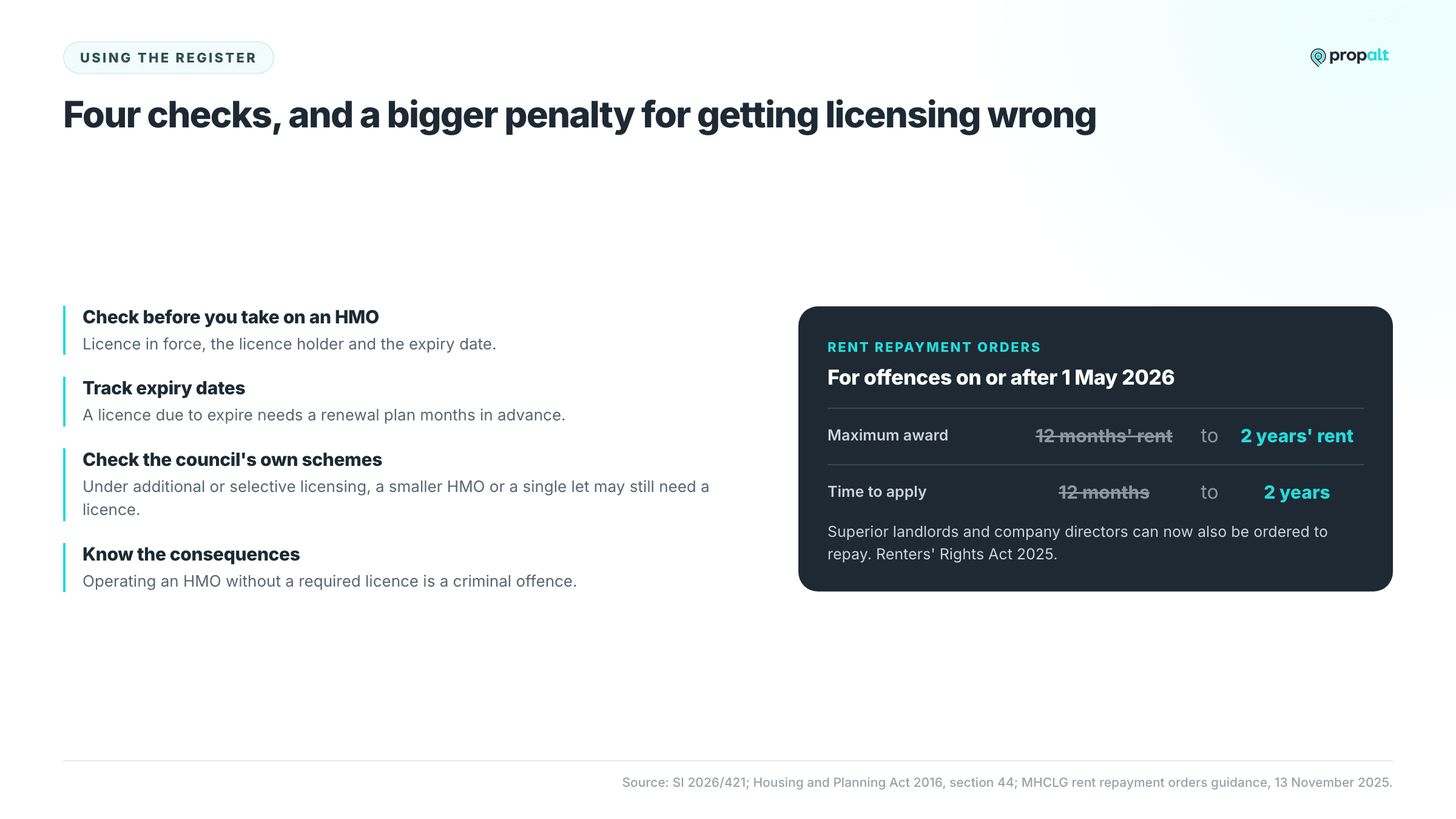
Mandatory licensing applies to any HMO occupied by five or more people forming two or more households who share basic amenities such as a kitchen, bathroom or toilet. Since 1 October 2018, that applies regardless of how many storeys the building has. Before then, mandatory licensing only covered HMOs of three or more storeys.
Councils can go further with their own schemes.
| Type of licensing | What it covers | Set by |
|---|---|---|
| Mandatory HMO licensing | HMOs with 5 or more people in 2 or more households sharing amenities | National rule, applies everywhere in England |
| Additional HMO licensing | Smaller HMOs in a designated area | Individual council scheme |
| Selective licensing | Other privately rented homes in a designated area | Individual council scheme |
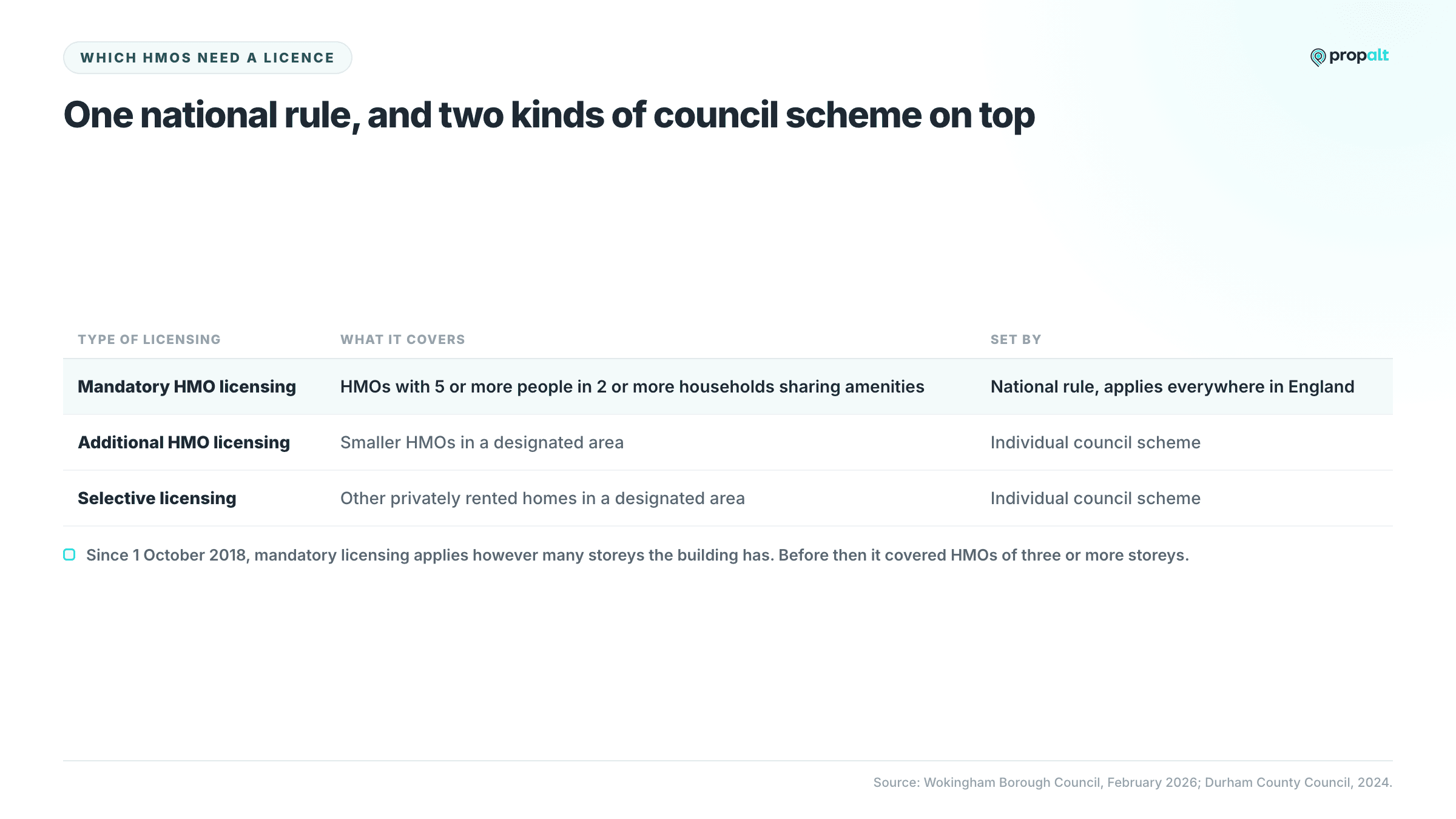
Because additional and selective schemes vary by council, a property that needs no licence in one borough may need one in the next. The register for that council tells you which licences have been granted. It does not tell you which properties should have one and do not.
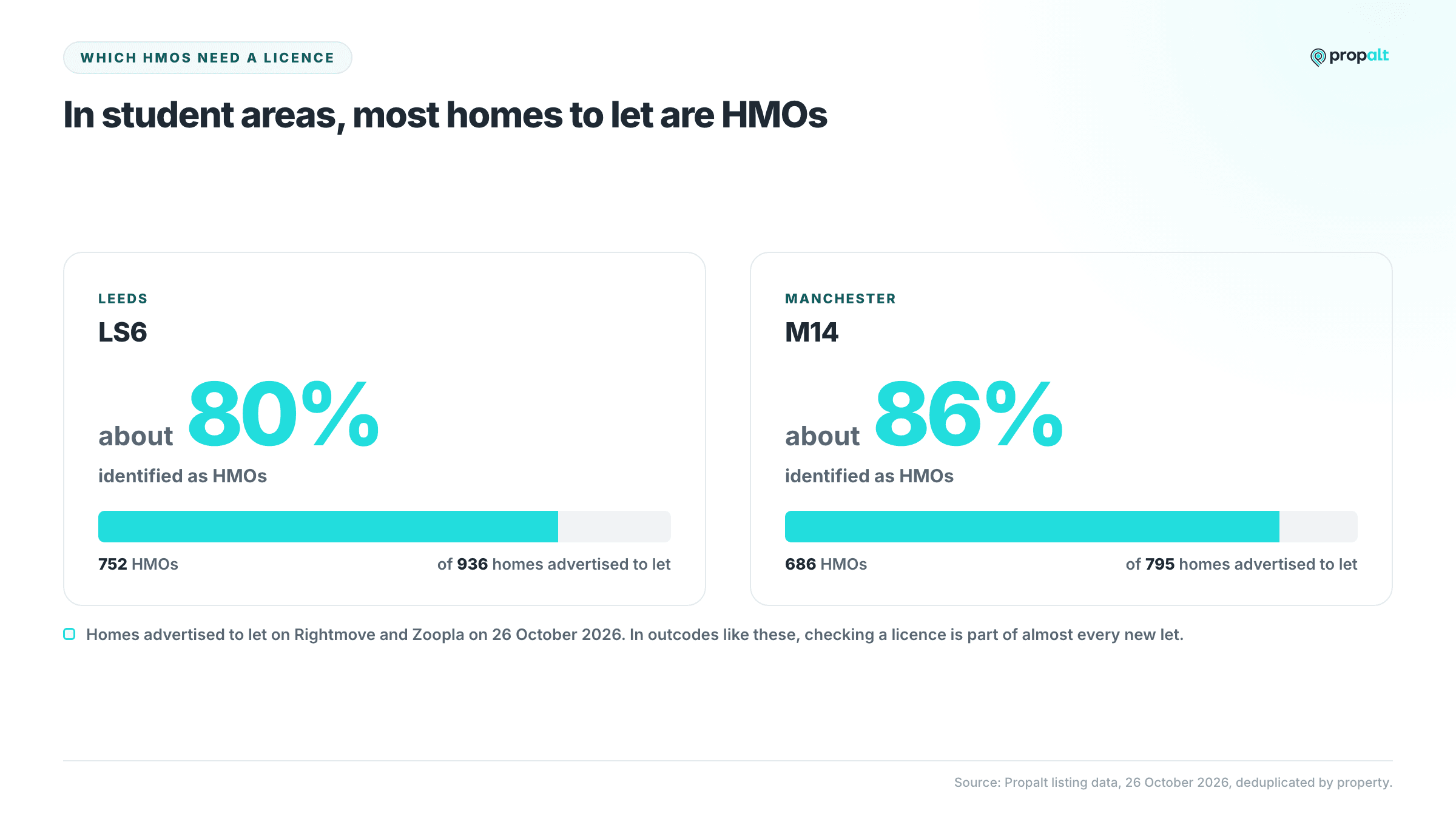
In student areas the checking job is constant. On 26 October 2026, Propalt's listing data identified 752 of the 936 homes advertised to let on Rightmove and Zoopla in Leeds LS6 as HMOs, about 80%, and 686 of the 795 in Manchester M14, about 86%. In outcodes like these, checking a licence is part of almost every new let.
Planning is a separate check. Where a council has made an Article 4 direction, turning a family home into a small HMO needs planning permission as well as any licence. Our guide to underwriting an HMO in an Article 4 area covers that side of the decision.
"The register shows which HMOs are licensed. It cannot show which ones should be and are not."
Start with the council's website and search for "HMO register" or "public register of licences". Formats differ widely:
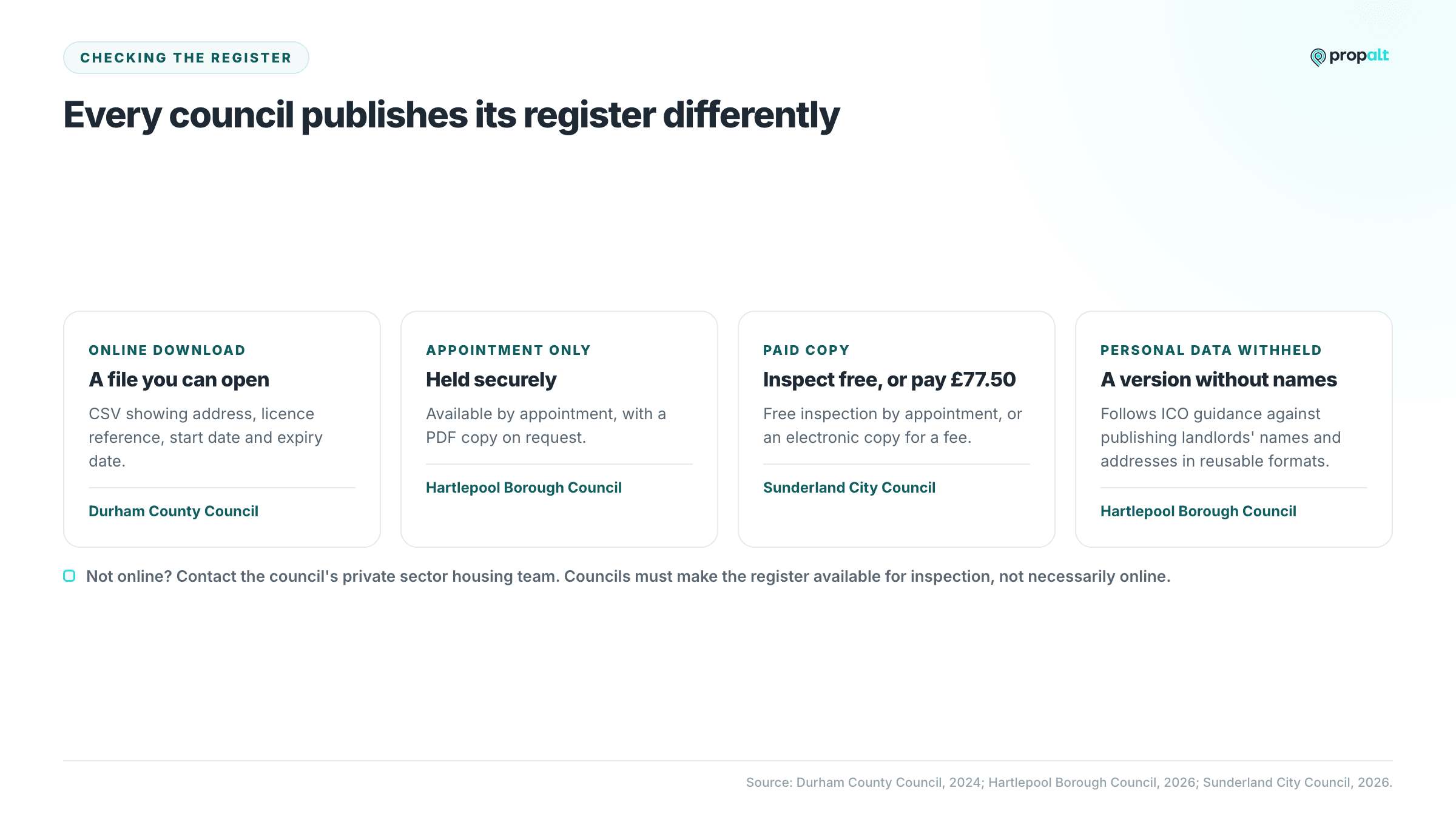
If you cannot find the register online, contact the council's private sector housing team. Councils are not required to publish the register online, only to make it available for inspection.
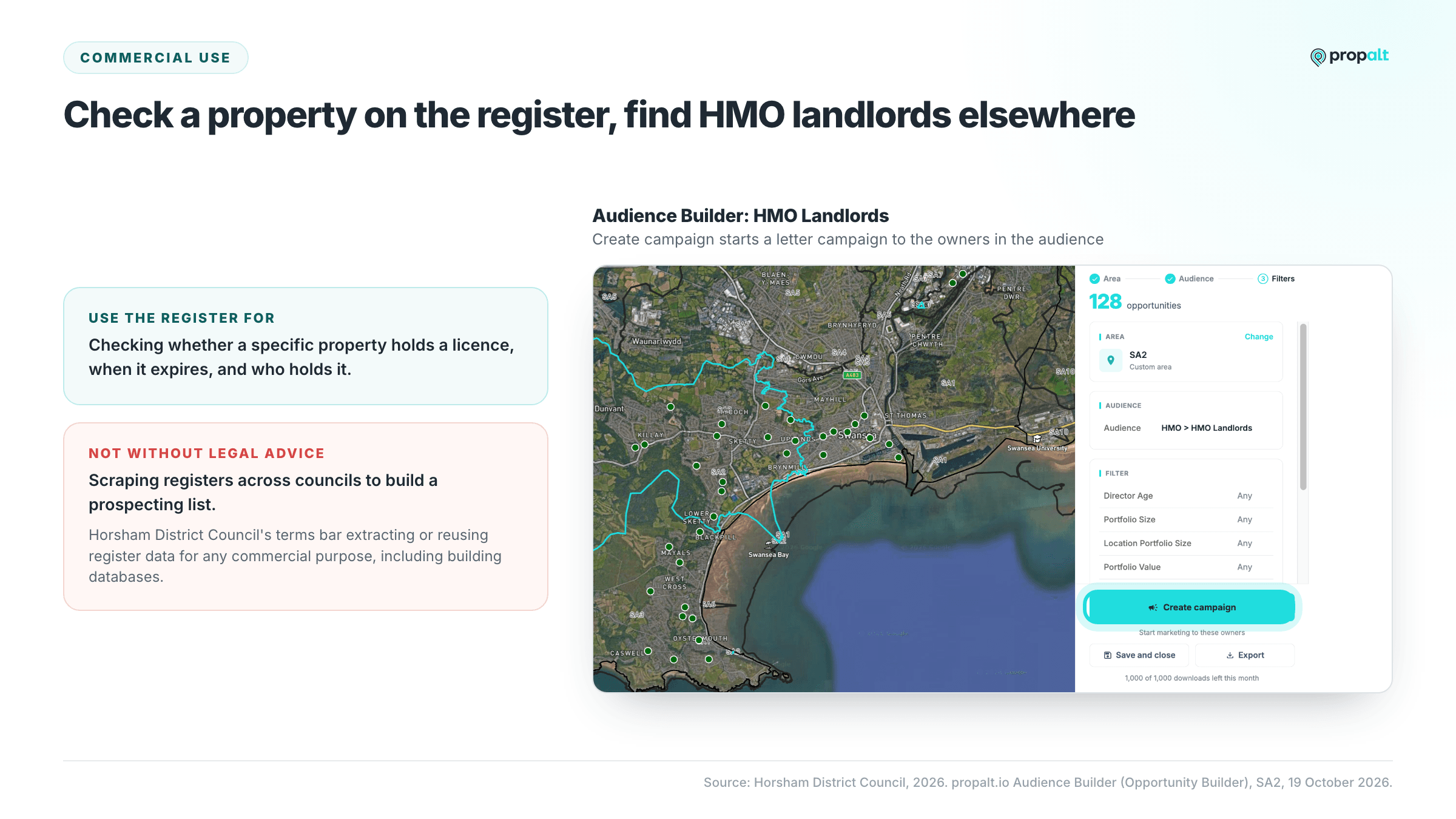
Often not. This is the limit agents most often overlook. Horsham District Council's terms, for example, state that information from the register may not be extracted or reused for any commercial purpose, including building databases or reselling the data, and that misuse can be reported to the ICO.
That does not stop an agent using the register for its purpose: checking whether a specific property holds a licence, when it expires, and who holds it. It does mean scraping registers across councils to build a prospecting list is a risk you should not take without legal advice.
If you want to find HMO landlords to approach, use data that was collected for that purpose. Propalt's Audience Builder includes HMO Landlords, Existing HMO and Potential HMO audiences, and its Create campaign option starts a letter campaign to the owners in an audience.
Used properly, the register answers practical questions before they become problems.
For agents building a lettings book, licensed HMO landlords are often portfolio landlords. Our guide on how to find new landlords covers how to approach them through the right channels.
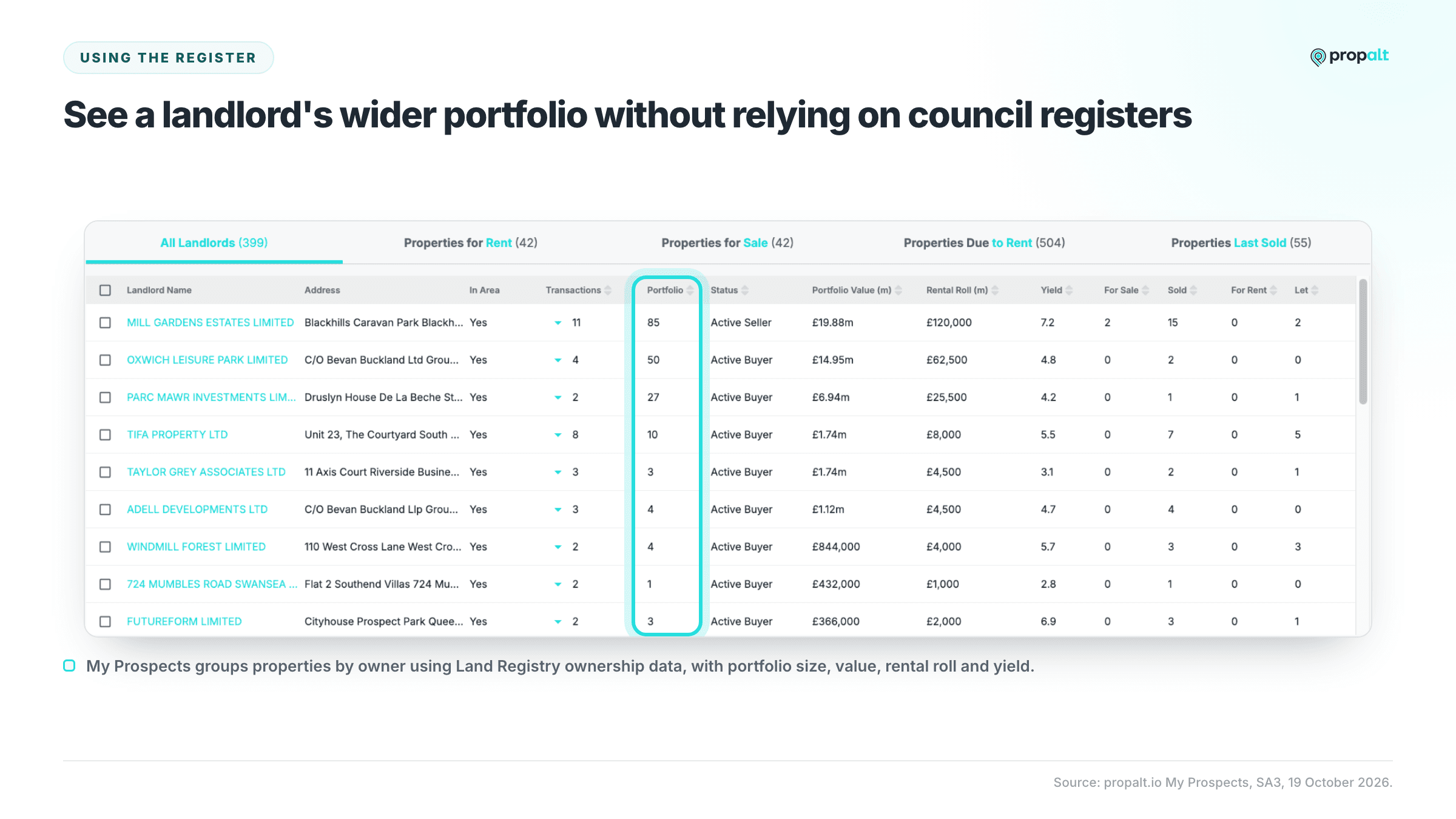
Propalt's My Prospects groups properties by owner using Land Registry ownership data, so you can see a landlord's wider portfolio without relying on council registers for a purpose they were not published for.
Is the HMO register public?
Yes. Every council in England must keep a public register of the HMO licences it has granted, and anyone can ask to inspect it.
How do I check if a house is a licensed HMO?
Search the HMO register on the website of the council where the property is. Some publish it online; others provide it on request.
Does the register show every HMO?
No. It lists licensed HMOs only. Smaller HMOs outside mandatory or additional licensing will not appear.
Key takeaway. Every council must keep a public HMO licence register under section 232 of the Housing Act 2004, showing licensed properties, licence dates and licence holders. Formats and access vary by council, and many restrict commercial reuse of the data, so use the register to check a specific property rather than to build a list. Propalt is built on the principle that public registers are a check on the record, used for the purpose they were published for.
Sources and data references
Propalt data. Propalt (October 2026). Homes advertised to let on Rightmove and Zoopla in outcodes LS6 and M14 on 26 October 2026 (deduplicated by property), and the number identified as HMOs in Propalt's listing data.

Are you a landlord in England grappling with the latest market shifts? Discover in our article how the decrease in Houses in Multiple Occupation (HMOs) and the surge in demand for upmarket properties are reshaping the rental landscape. This is your opportunity to turn these challenges into profitable opportunities.

Small landlord companies took 57% of property charges at Companies House in early 2026. Which buy-to-let mortgage lenders grew, what it means for agents.

How to start an estate agency in the UK: redress, HMRC AML and ICO registration, current fees, start-up costs, choosing a patch and your first 90 days.