Estate Agency Marketing
Material Information Reports Explained: Parts A, B and C for Estate Agents

October 28, 2026

Material information is anything a buyer or tenant would need to make an informed decision about a property. Since 6 April 2025 the duty to disclose it has sat in the Digital Markets, Competition and Consumers Act 2024 (DMCC Act), which repealed and replaced the Consumer Protection from Unfair Trading Regulations 2008 (CPRs).
The structure most agents still work to is older. National Trading Standards' Estate and Letting Agency Team (NTSELAT) published its guidance in three parts: Part A in 2022 and Parts B and C on 30 November 2023. The portals built their listing fields around it.
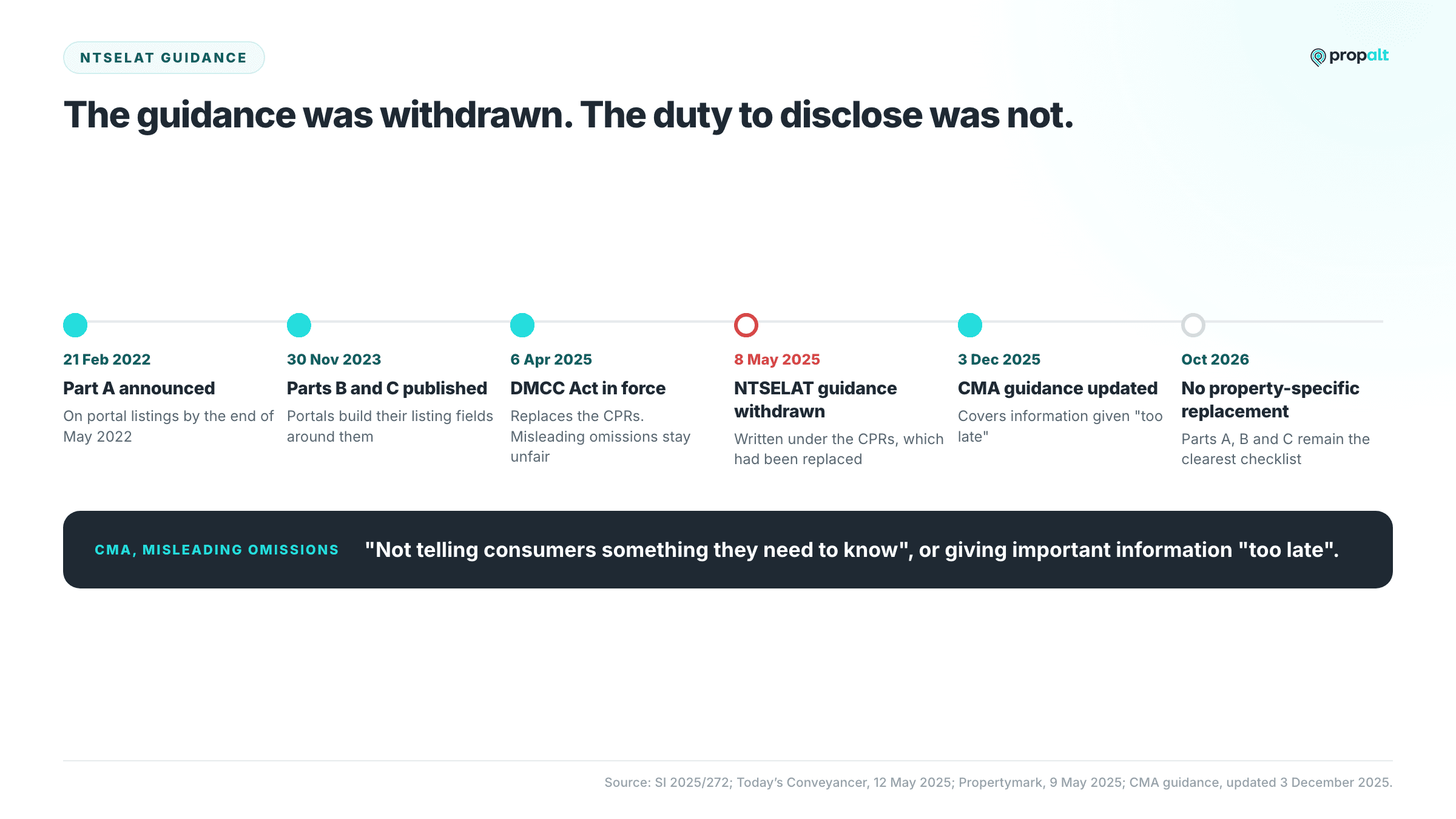
That guidance was withdrawn on 8 May 2025. The duty to disclose was not. So what should a material information report contain as of October 2026, and how do you build one before a property goes live?
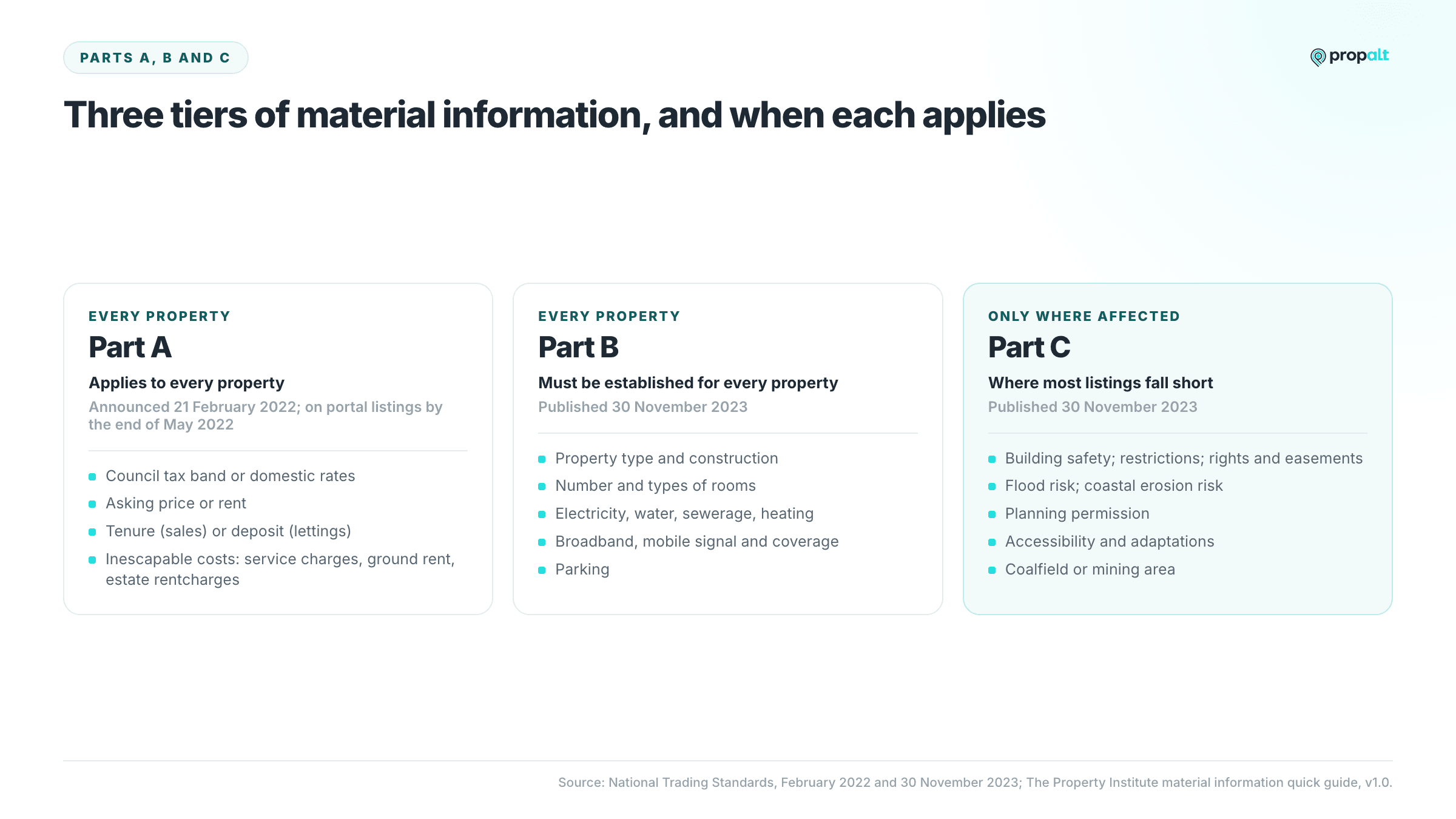
Parts A, B and C are the three tiers NTSELAT used to group material information. Part A applies to every property. Part B must be established for every property. Part C applies only where the property is affected by the issue.
| Part | Introduced | What it covers |
|---|---|---|
| Part A | Announced 21 February 2022; required on portal listings by the end of May 2022 | Council tax band or domestic rates; asking price or rent; tenure (sales) or deposit (lettings), including inescapable costs such as service charges, ground rent and estate rentcharges |
| Part B | Published 30 November 2023 | Property type; construction; number and types of rooms; electricity supply; water supply; sewerage; heating; broadband; mobile signal and coverage; parking |
| Part C | Published 30 November 2023 | Building safety; restrictions; rights and easements; flood risk; coastal erosion risk; planning permission; accessibility and adaptations; coalfield or mining area |
Part C is where most listings fall short. A restrictive covenant against running a business, a right of way across the garden, or a planning application for the field behind the house will all change some buyers' decisions. None of them shows up on a floor plan.
No. NTSELAT withdrew the guidance with effect from 8 May 2025. Its webpage said the CPRs it was written under had been replaced by the Digital Markets, Competition and Consumers Act 2024.
The duty itself carried over. Chapter 1 of Part 4 of the DMCC Act, in force from 6 April 2025, keeps misleading omissions as an unfair commercial practice. The Competition and Markets Authority's (CMA) guidance for businesses, last updated on 3 December 2025, describes them as "not telling consumers something they need to know" or giving important information "too late or in a way that means a consumer is unlikely to see it".
We could find no property-specific replacement as of October 2026. Propertymark said in May 2025 that it was pressing the CMA for sector guidance.
The guidance was withdrawn. The duty to tell buyers what they need to know was not.
In practice, Parts A, B and C remain the clearest checklist available. The portals built their listing fields around them, and the withdrawal did not change what a buyer needs to know about a property.
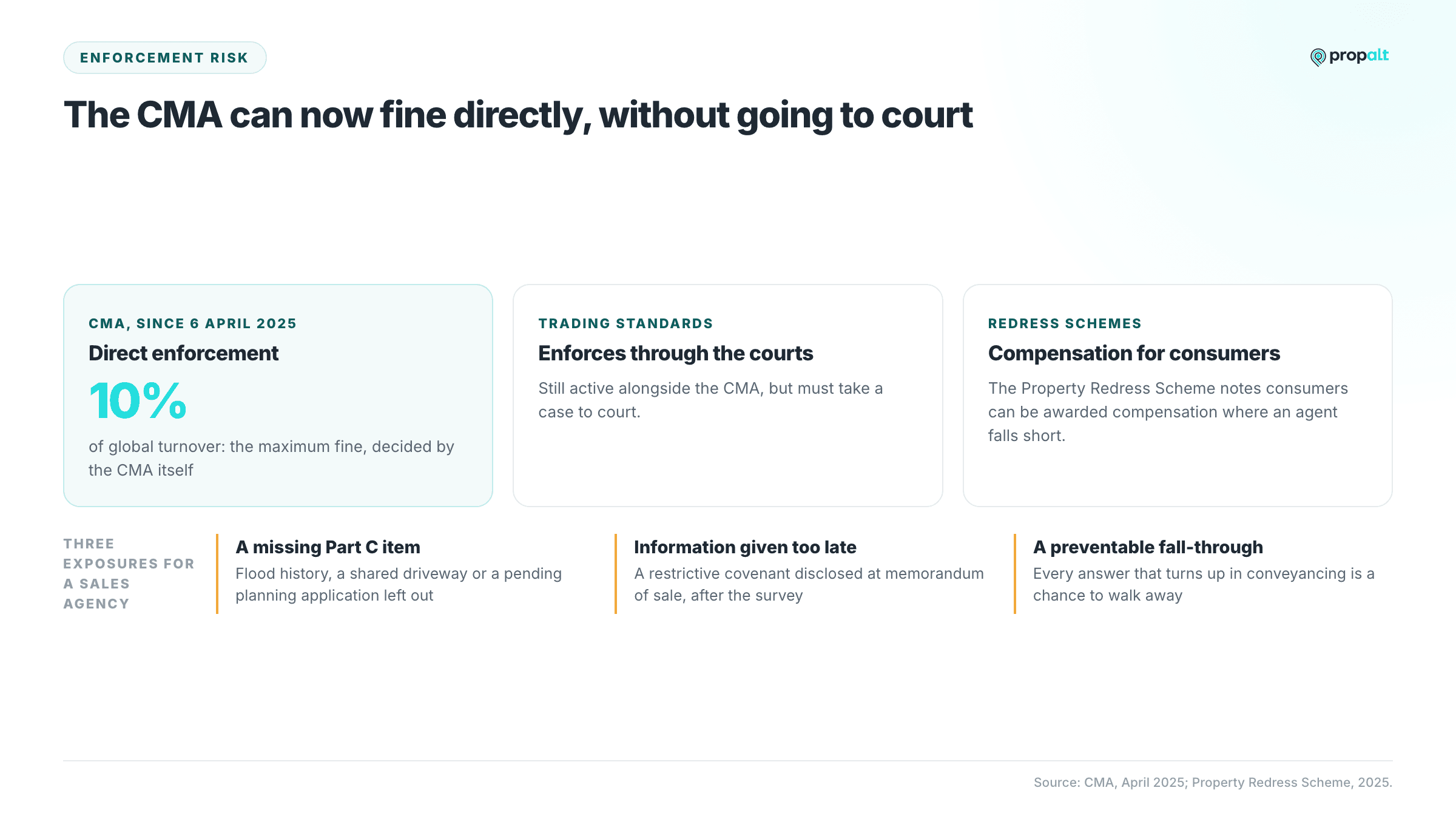
The risk is higher than it was under the CPRs. The DMCC Act gave the CMA direct enforcement powers from 6 April 2025. It can decide for itself whether consumer law has been broken and fine a business up to 10% of global turnover, without first going to court.
Trading Standards still enforces too, but through the courts. Redress schemes sit alongside both. The Property Redress Scheme notes that consumers can be awarded compensation where an agent's conduct falls short.
Three practical exposures for a sales agency:
For a large agency group, a cap set at 10% of turnover is a serious number.
A usable material information checklist matches each item to a source and a point in the instruction when you collect it. This is the version to copy into your onboarding pack.
| Item | Part | Where to get it | Collect at |
|---|---|---|---|
| Council tax band | A | VOA council tax band search (England and Wales) | Appraisal |
| Tenure and title number | A | HMLR title register | Before listing |
| Lease length, service charge, ground rent | A | HMLR register, lease, managing agent | Before listing |
| Property type and construction | B | Vendor PIQ, EPC, your inspection | Appraisal |
| Rooms and floor area | B | Your measurements, EPC floor area | Photography visit |
| Utilities, sewerage, heating | B | Vendor PIQ, EPC | Before listing |
| Broadband and mobile coverage | B | Ofcom broadband and mobile checker | Before listing |
| Parking | B | Vendor PIQ, title plan | Appraisal |
| Restrictions and rights | C | HMLR register and title plan | Before listing |
| Flood and coastal erosion risk | C | Environment Agency long-term flood risk service (England); vendor history | Before listing |
| Planning permission and applications | C | Local planning authority portal | Before listing |
| Building safety | C | Vendor, managing agent, EWS1 where held | Before listing |
| Accessibility and adaptations | C | Vendor PIQ, your inspection | Appraisal |
| Coalfield or mining area | C | Mining Remediation Authority (formerly the Coal Authority) interactive map | Before listing |
Propertymark's Property Information Questionnaire was reworked in March 2024 to cover Parts B and C. If you are a member, it is the quickest way to capture what only the vendor knows.
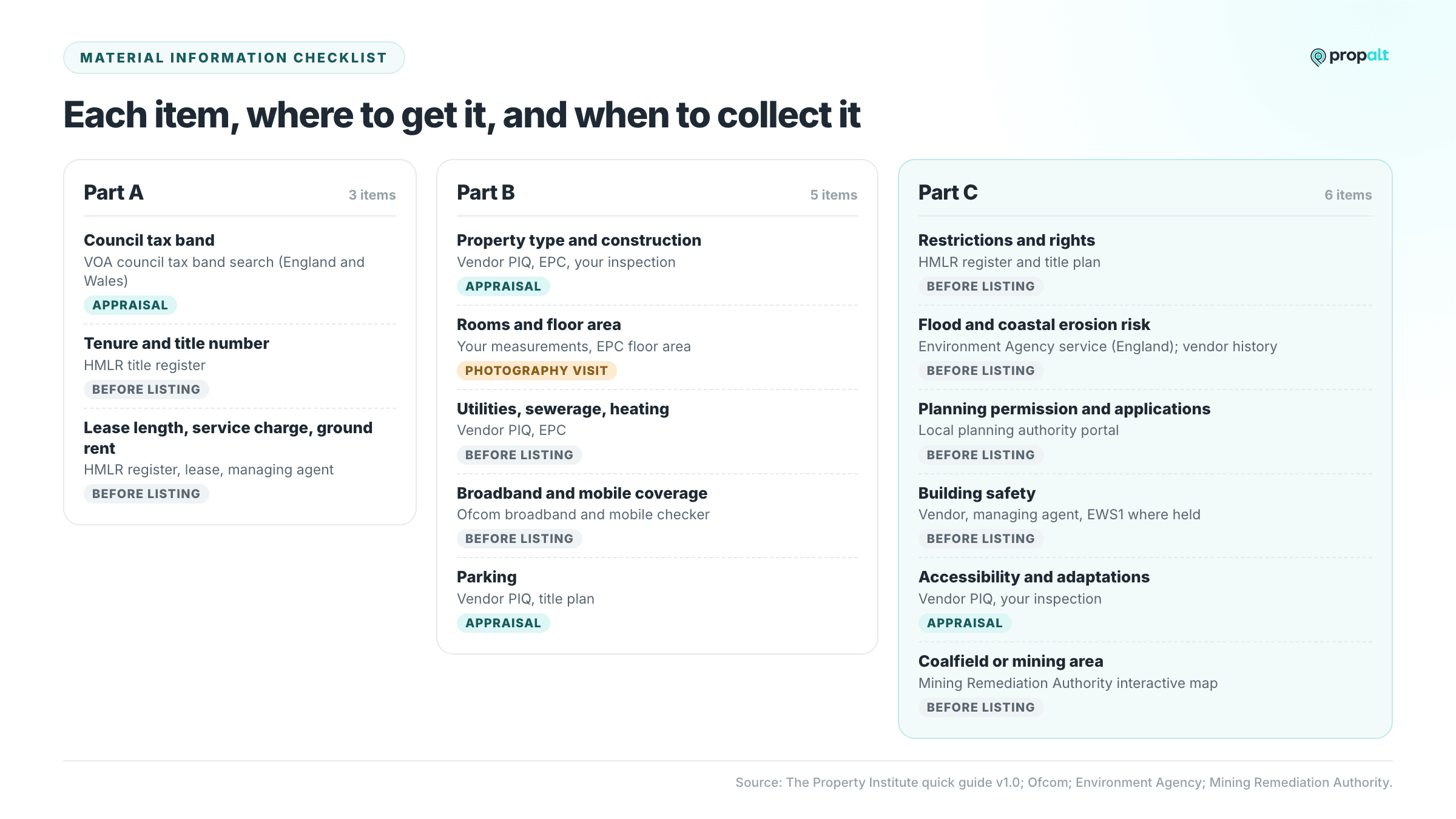
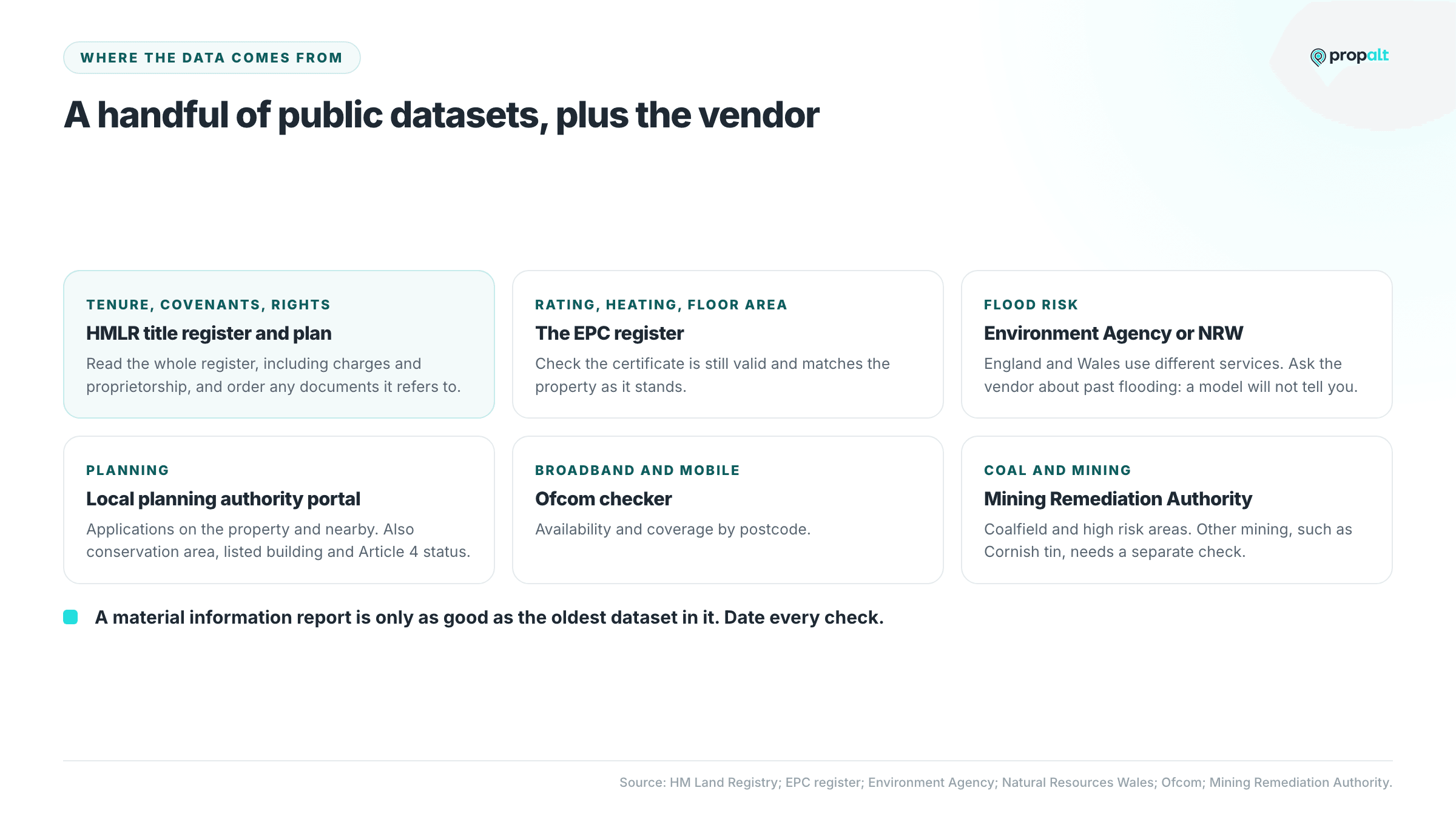
Most of it comes from a handful of public datasets, plus the vendor.
A material information report is only as good as the oldest dataset in it. Date every check.
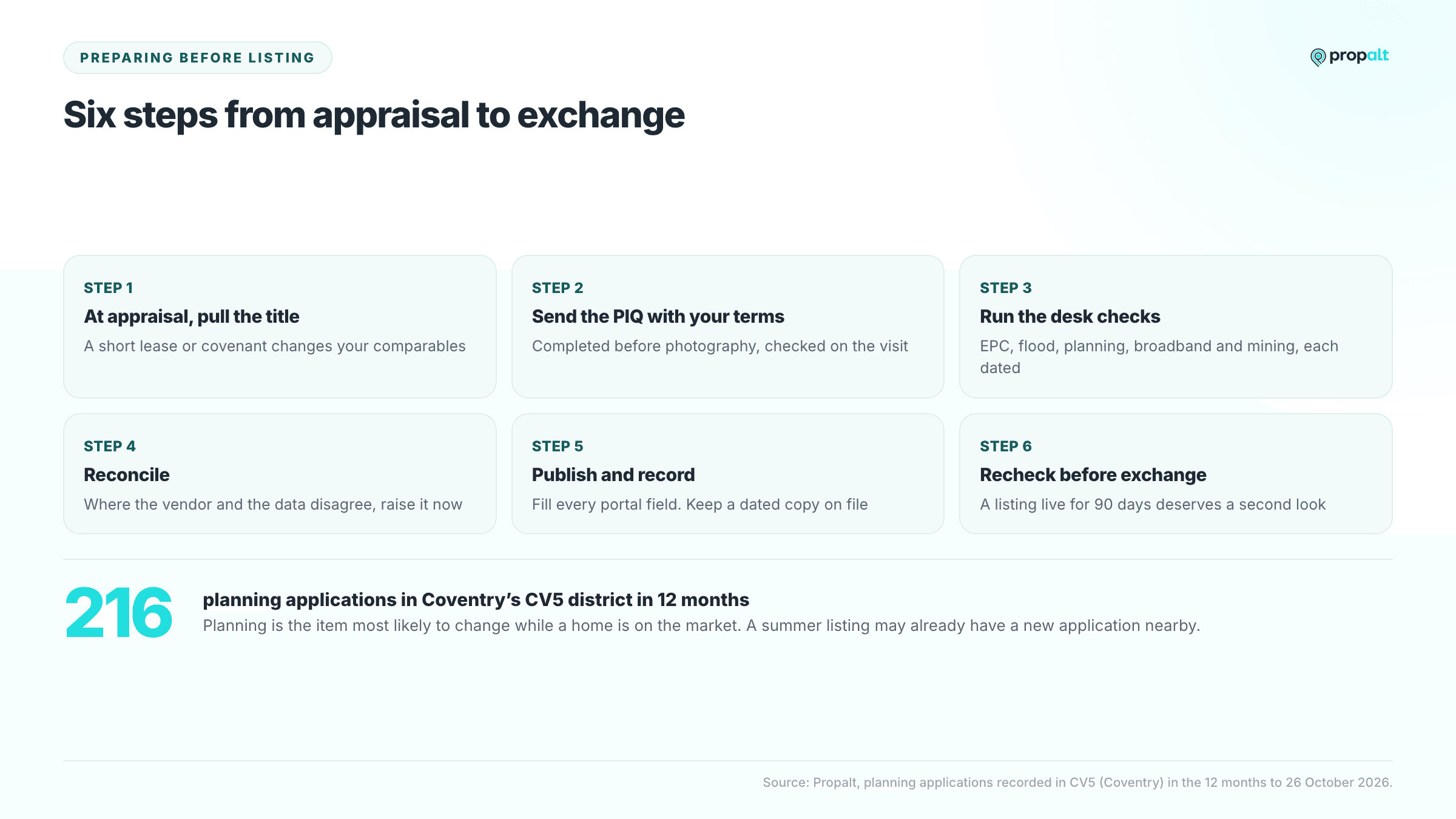
Start at the market appraisal. The earlier you find a Part C issue, the more options you have for handling it.
Planning is the item most likely to change while a property is on the market. Propalt records 216 planning applications in Coventry's CV5 postcode district in the 12 months to 26 October 2026, so a listing that went live in the summer may already have a new application nearby.
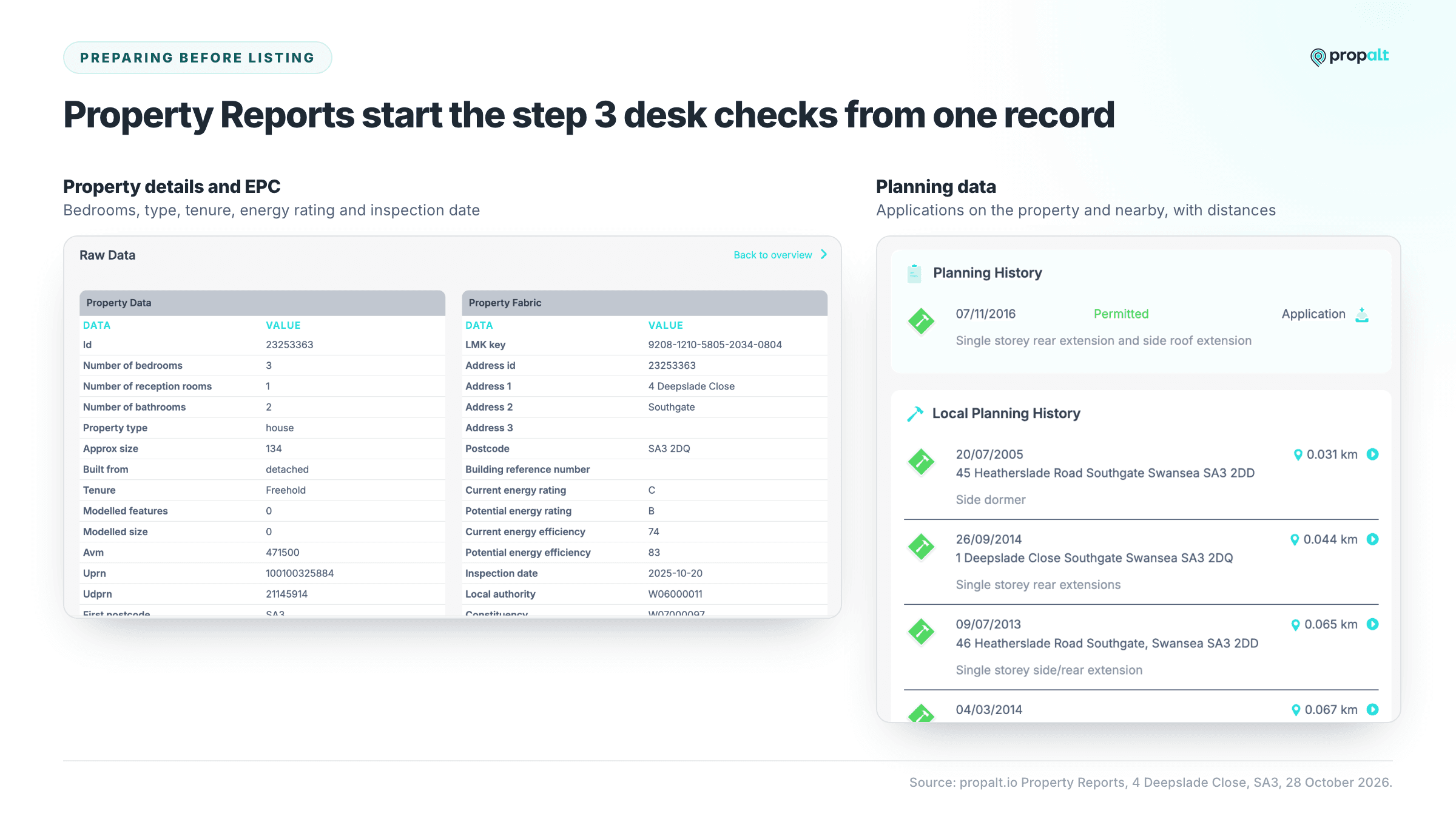
In Propalt, Property Reports auto-fill property details, planning data and comparables into a branded seller report, so the step 3 desk checks start from the same record at appraisal.
This is not legal advice. Take advice from your redress scheme, Propertymark or a solicitor on any specific disclosure question.
NTSELAT's Parts A, B and C guidance was withdrawn on 8 May 2025, but the DMCC Act has required traders to disclose material information since 6 April 2025, and the CMA can now fine businesses up to 10% of global turnover without going to court. Parts A, B and C remain the most practical checklist. Build the material information report at appraisal, source each item from the title register, the EPC, flood, planning, broadband and mining data, and date every check. Property Reports auto-fill property details and planning data into a branded seller report, so the groundwork starts before you walk through the door.

Dormant Marketing Strategy ...If you’re attending a valuation with one of these sellers, there’s a risk: you leave without an instruction, only a vague promise of “we’ll be in touch once we’ve found something.” Even if they’re sincere, you’re now in a follow-up loop. And meanwhile, another agent could win their trust, find their next home, and take the listing.

During the summer, some listings stall. Some agents go on holiday. And some vendors get fed up. That’s where you come in. Here are six practical tips for improving your on-market canvassing strategy.

Discover the latest on UK mortgage approvals and house price trends in our article, providing essential insights for homebuyers, sellers, and market enthusiasts.