Estate Agency Marketing
Property Comparables: How Estate Agents Choose Comparables for a Valuation

October 28, 2026

Your recommended asking price is only as strong as the comparables behind it. The Property Ombudsman's Code of Practice expects any recommended asking price or possible selling price to be given in good faith, to reflect current market conditions and to be "supported by comparable evidence" (paragraph 4b).
Vendors are told to ask for that evidence. The government's How to sell a home guide tells sellers to "ask the estate agent for evidence to support their valuation; for example, similar properties they have recently sold".
So which comparable properties belong in that evidence, and which should you leave out?
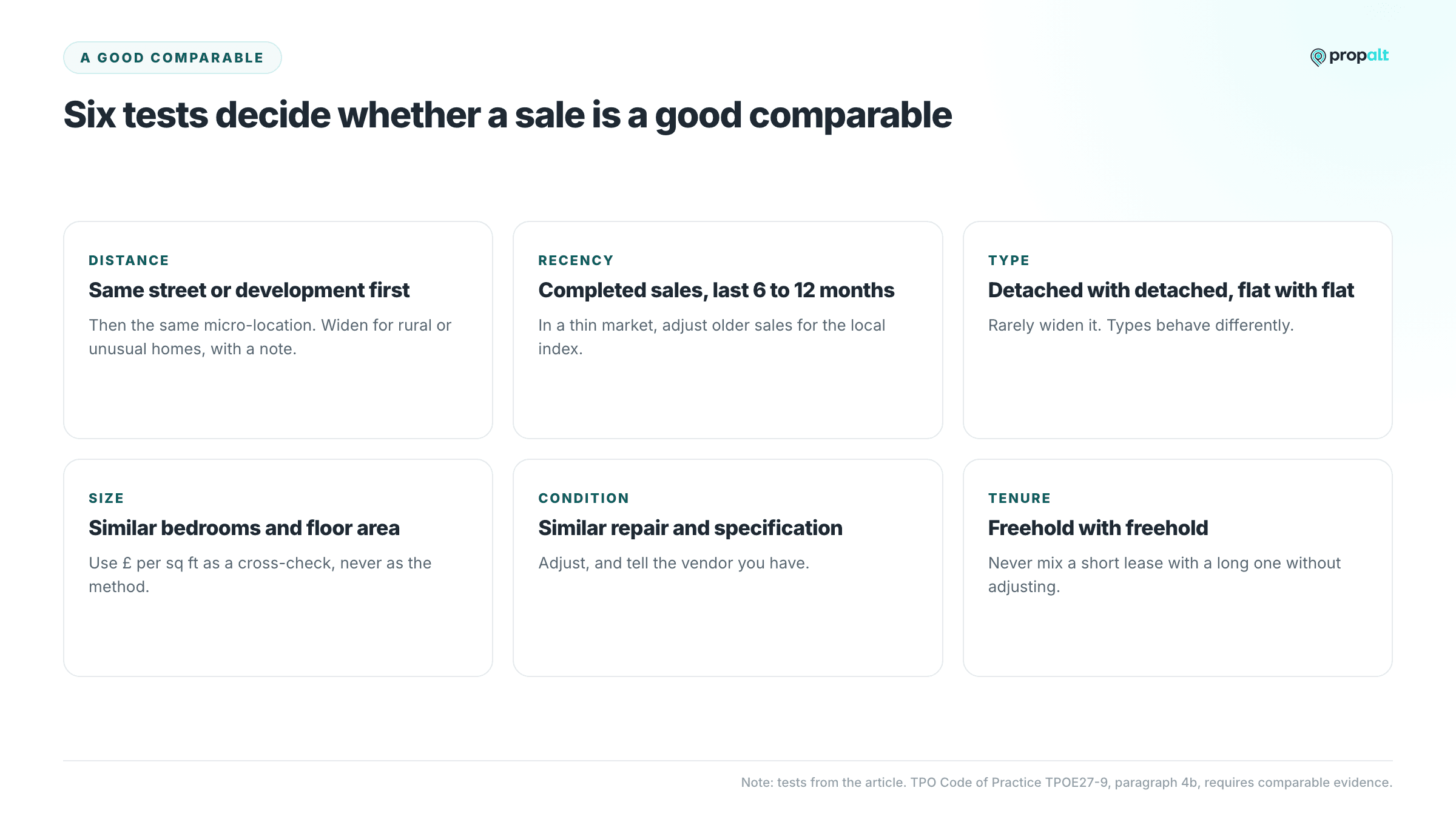
A good comparable is a recent sale of a similar home, close by, that a buyer for your vendor's property would also have considered. Six tests decide it.
| Test | What to look for | When to widen it |
|---|---|---|
| Distance | Same street or development first, then the same micro-location (same school catchment, same side of the main road) | Rural or unusual homes, with a note explaining why |
| Recency | Completed sales from the last 6 to 12 months | A thin market; adjust older sales for movement in the local index |
| Type | Same type: detached with detached, flat with flat | Rarely. Types behave differently (see below) |
| Size | Similar bedroom count and floor area | Use £ per sq ft as a cross-check, never as the method |
| Condition | Similar state of repair and specification | Adjust, and tell the vendor you have |
| Tenure | Freehold with freehold; leases of similar length | Never mix a short lease with a long one without adjusting |
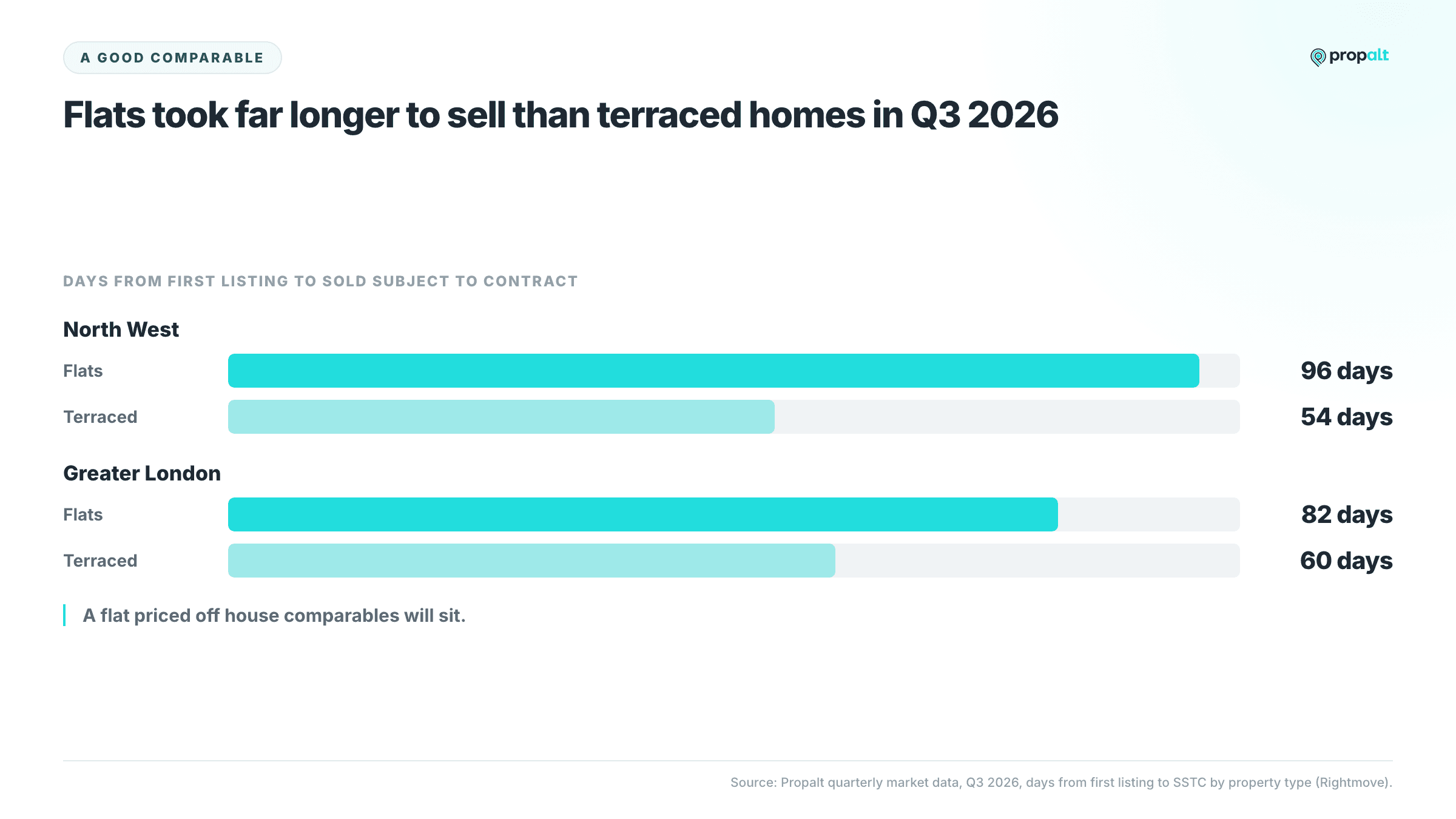
Property type matters more than many vendors expect. In the North West in Q3 2026, flats took 96 days from first listing to sold subject to contract, against 54 days for terraced houses (Propalt, Q3 2026). In Greater London the gap was 82 days for flats against 60 for terraced homes. A flat priced off house comparables will sit.
Use completed sold prices as your evidence, asking prices to show the competition, and sold STC listings as a signal of where the market is moving.
The Propalt data shows why asking prices make weak comparables. In Q3 2026, 17.3% of new Rightmove listings nationally in the quarter (83,212 of 480,766, counted per listing) were reduced below their first listed price. In Greater London the figure was 19.1% (11,650 of 60,840); in the North West, 14.0% (7,190 of 51,417).
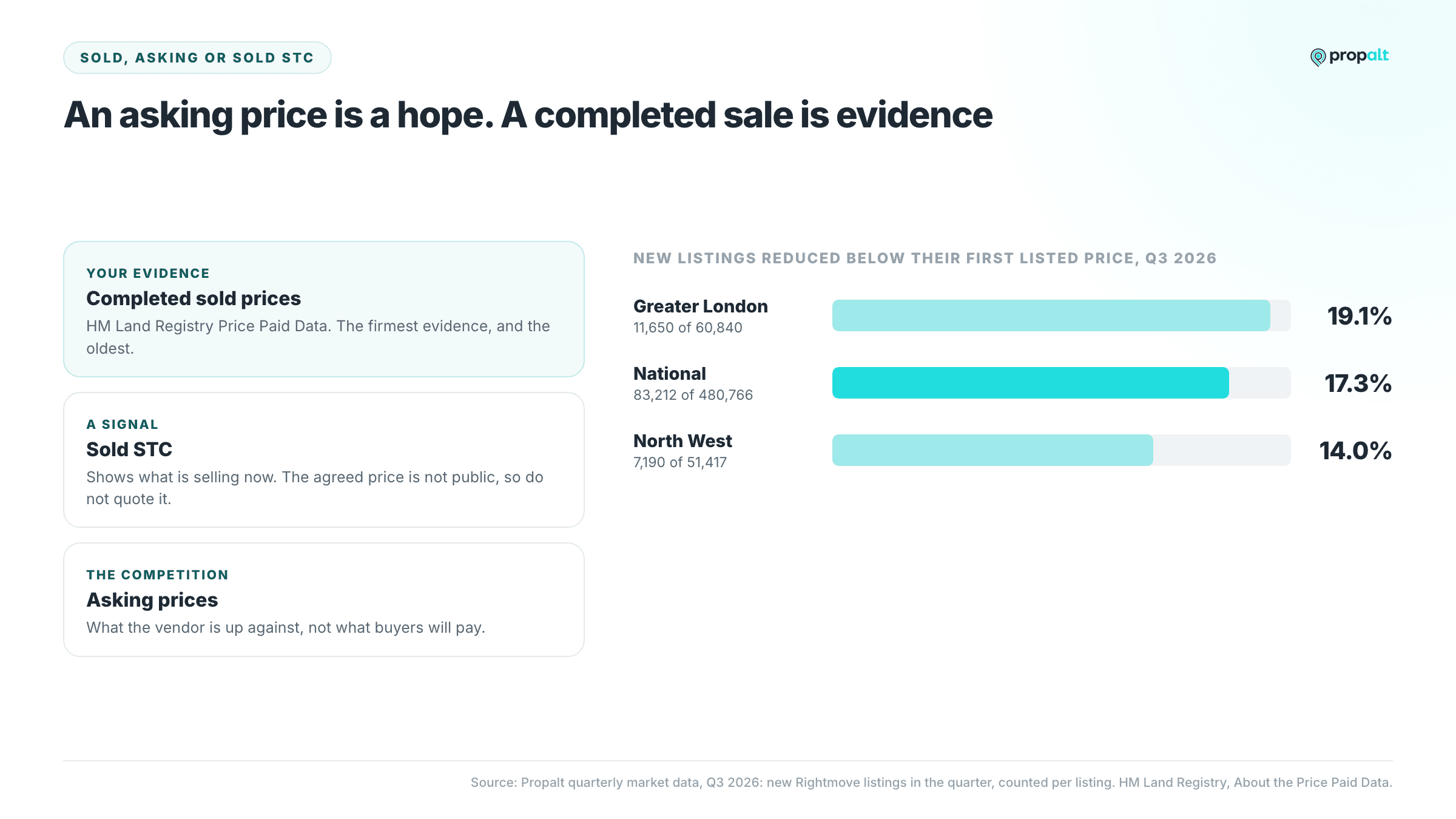
An asking price is a hope. A completed sale is evidence. Present them as different things.
Adjust for each material difference between the comparable and the subject property, in pounds, and write down why. The aim is to show your workings so the vendor can follow them.
Common adjustments:
Use the index for the same property type, because types can move in opposite directions. In Manchester, the UK House Price Index for semi-detached homes rose 2.9% in the 12 months to July 2026, while the index for flats fell 0.9% (HM Land Registry UK House Price Index, via Propalt). A year-old flat sale and a year-old semi sale need adjusting in different directions.
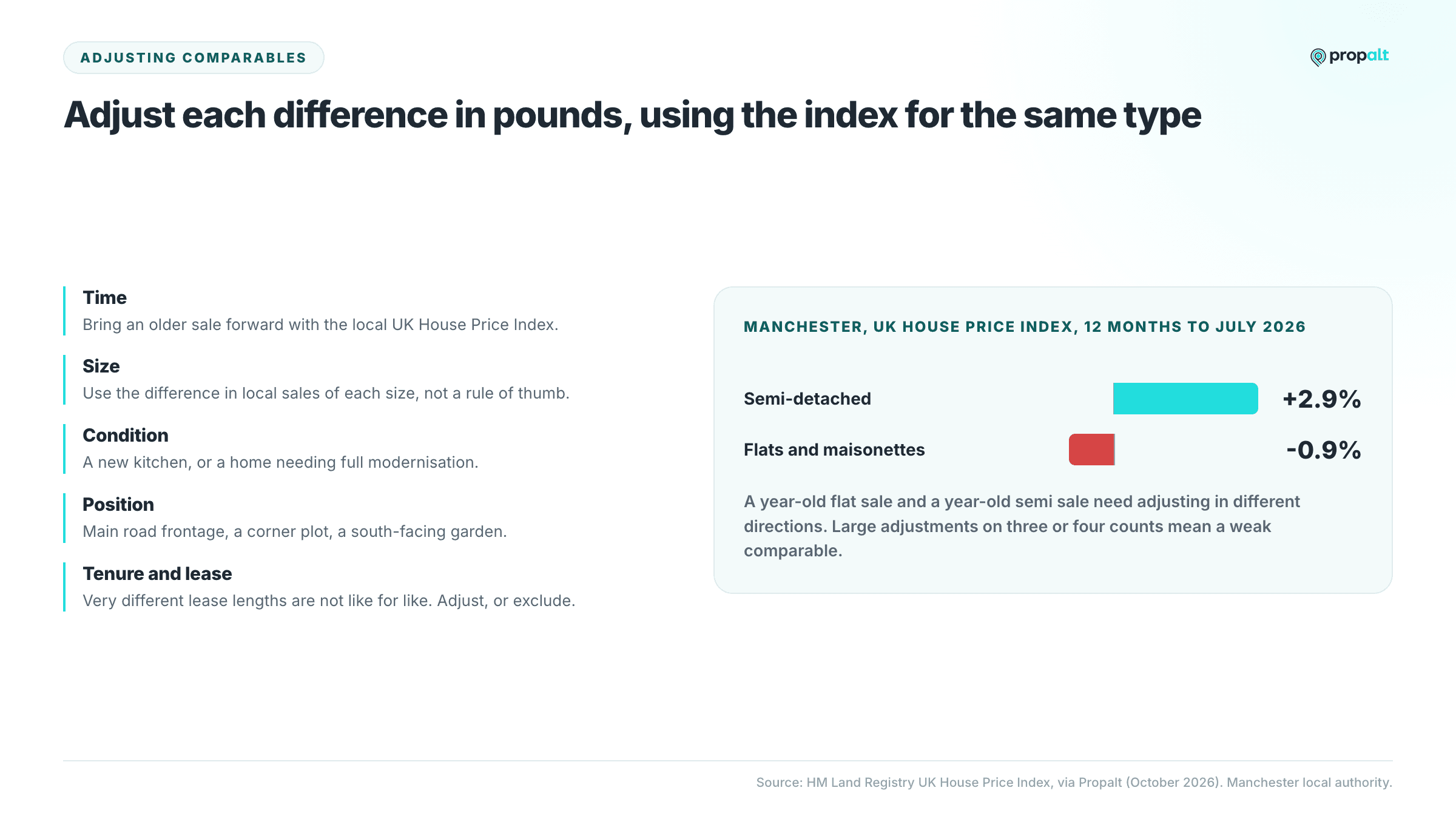
If a comparable needs large adjustments on three or four counts, it is a weak comparable. Drop it and find a closer one.
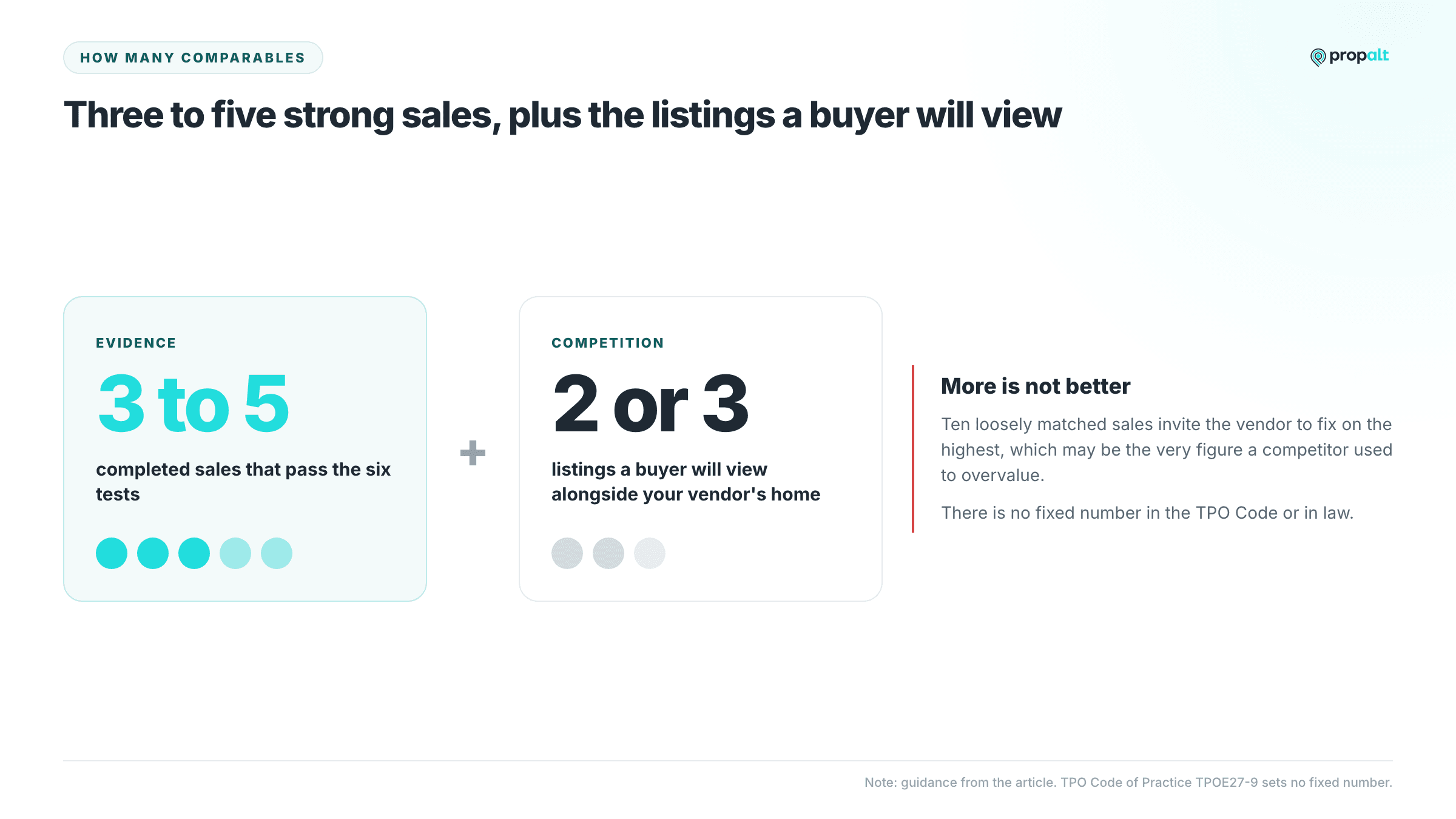
There is no fixed number in the TPO Code or in law. Three to five completed sales that pass the tests above, plus the two or three listings a buyer will view alongside your vendor's home, gives a vendor enough to understand the price without burying the point.
More is not better. Ten loosely matched sales invite the vendor to fix on the highest, which may be the very figure a competitor used to overvalue.
Our tutorial on researching a property before a market appraisal shows how to combine current and past comparables in one report.
It is a useful cross-check and a poor method on its own. £ per sq ft works best on similar homes in a uniform stock, such as a development of near-identical flats.
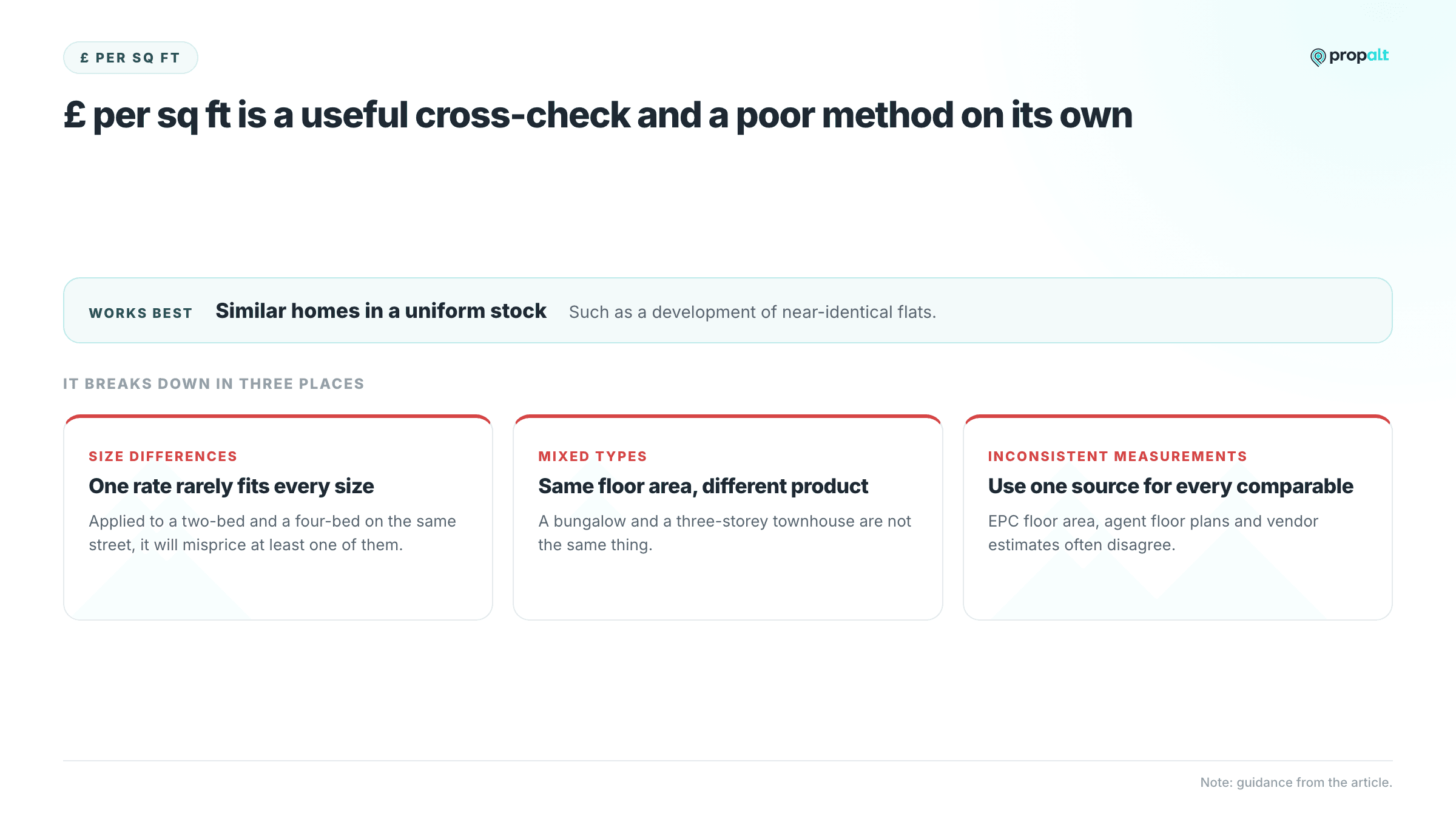
It breaks down in three places:
Lead with the three best sold comparables, show the adjustments, then show the current competition. Keep the format consistent so the vendor can compare like with like.
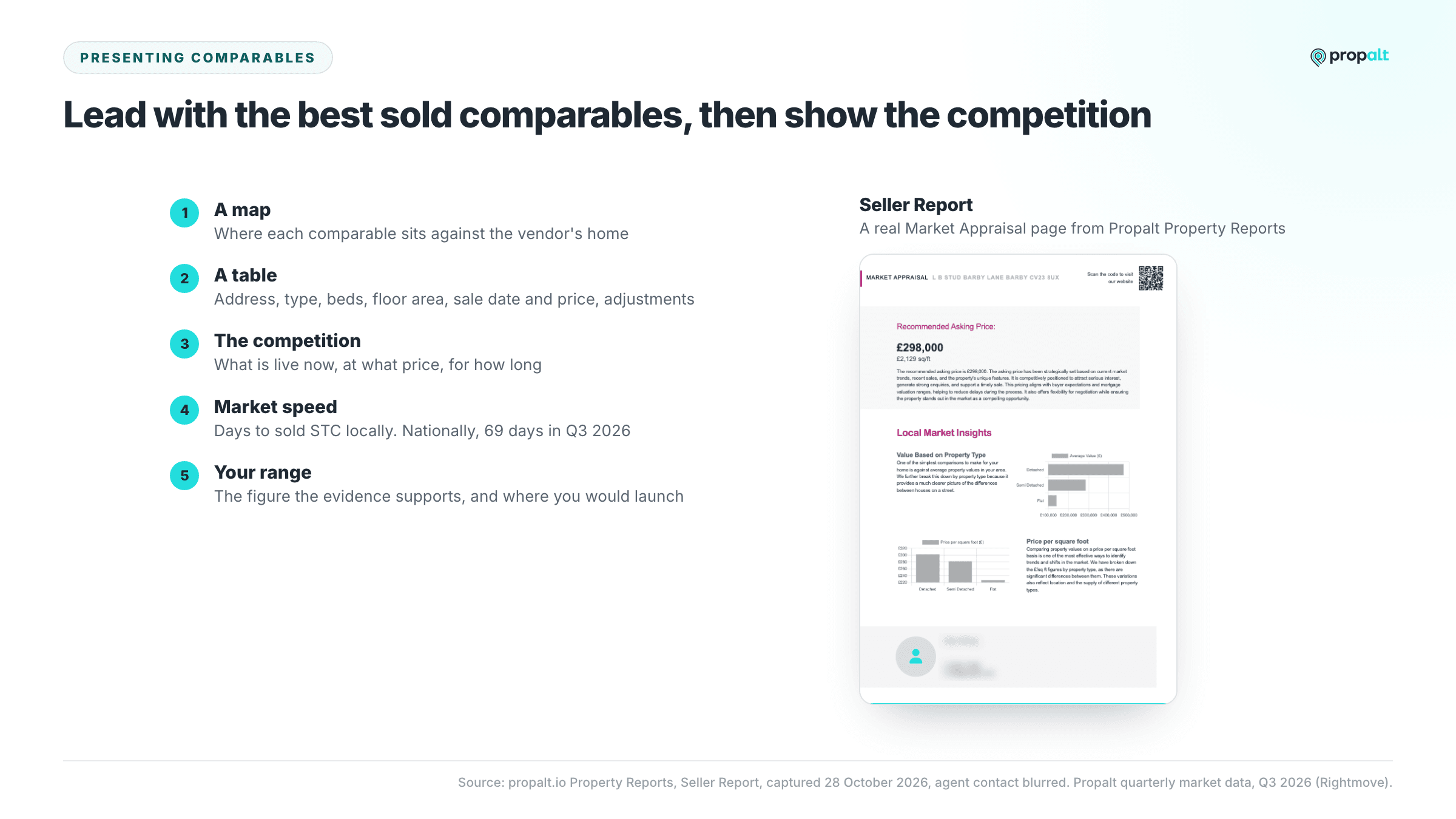
Leave the property report with the vendor. If a competitor quotes 10% more, the vendor now has your evidence to test theirs against.
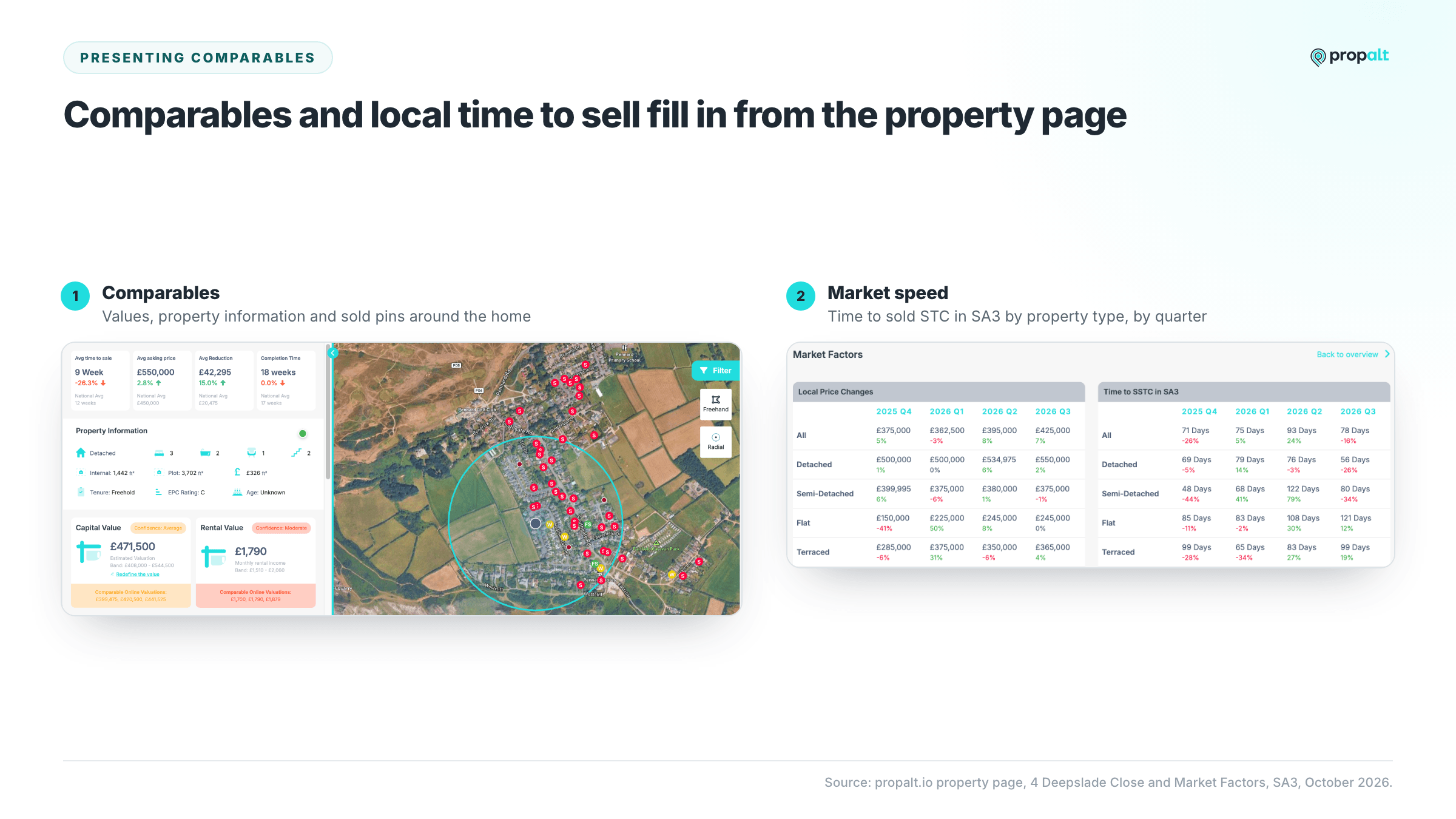
In Property Reports, comparables and planning data fill in automatically, and you can personalise each section before you print the report or share it as a link. Our tutorial on how to create a seller report walks through it. For where comparables sit in the full document, see our market appraisal template.
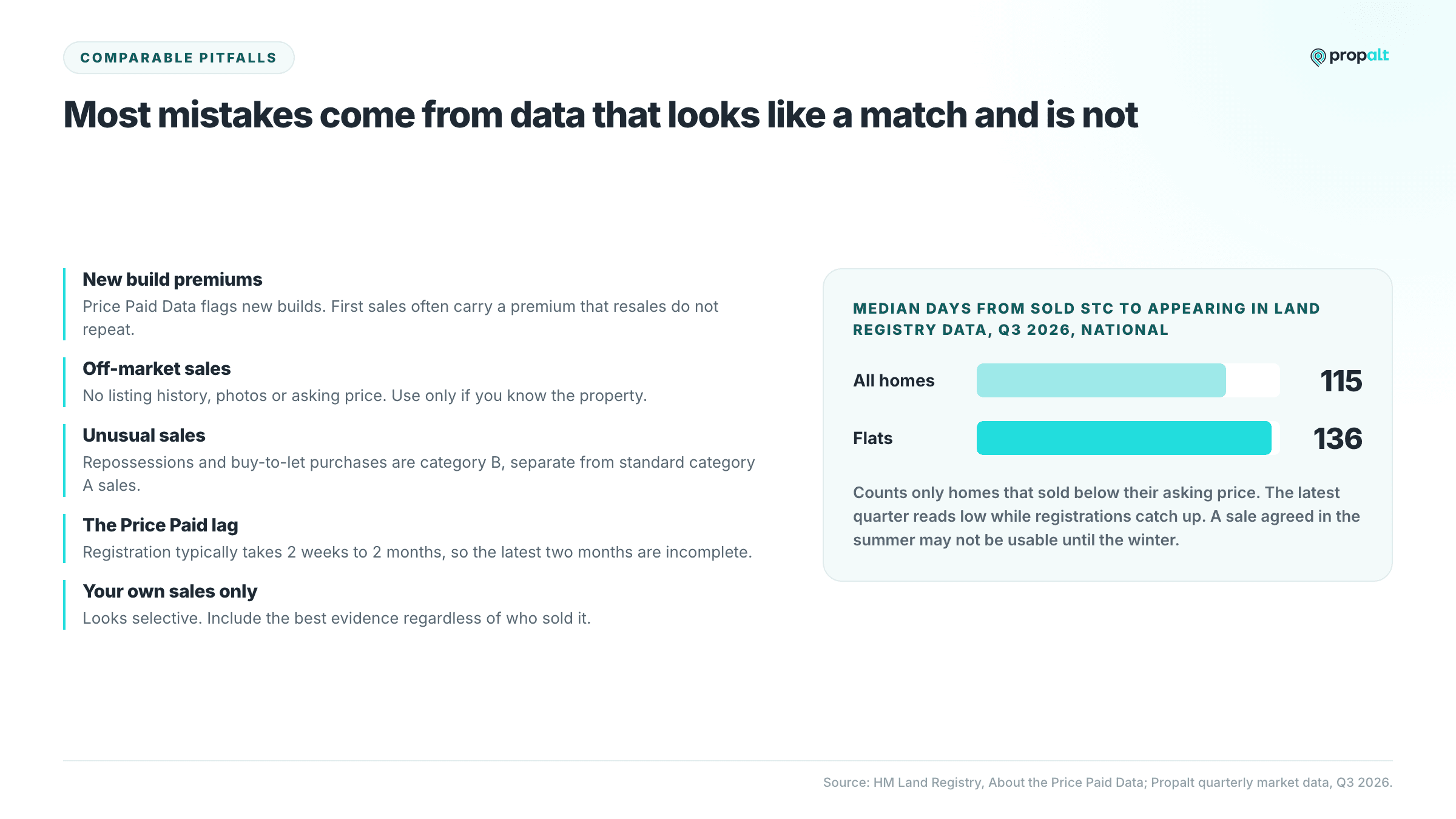
Most mistakes come from data that looks like a match and is not.
The wait is longer when you count from the day a sale is agreed. In Q3 2026, the median time nationally from sold STC to appearing in Land Registry data was 115 days, and 136 days for flats (Propalt, Q3 2026). It counts only homes that sold below their asking price, and the latest quarter reads low while registrations catch up. A sale agreed in the summer may not be a usable comparable until the winter.
Comparables should be recent completed sales of the same type, size, condition and tenure, as close as possible to the subject property, with written adjustments for every difference. Use asking prices to show the competition and never as evidence: in Q3 2026, 17.3% of new Rightmove listings nationally were below their first listed price. Allow for the Price Paid lag, typically two weeks to two months after completion, strip out new build premiums and category B sales, and present three to five strong comparables in a consistent format the vendor can keep. Property Reports auto-fill comparables into a branded seller report.
For the wider pipeline that gets you to the market appraisal in the first place, see our guide to estate agent lead generation.
Contains HM Land Registry data © Crown copyright and database right 2026. This data is licensed under the Open Government Licence v3.0.
Dormant Marketing Strategy ...If you’re attending a valuation with one of these sellers, there’s a risk: you leave without an instruction, only a vague promise of “we’ll be in touch once we’ve found something.” Even if they’re sincere, you’re now in a follow-up loop. And meanwhile, another agent could win their trust, find their next home, and take the listing.

During the summer, some listings stall. Some agents go on holiday. And some vendors get fed up. That’s where you come in. Here are six practical tips for improving your on-market canvassing strategy.

Discover the latest on UK mortgage approvals and house price trends in our article, providing essential insights for homebuyers, sellers, and market enthusiasts.