Estate Agency Marketing
Market Appraisal: What to Include, With a Free Template

October 28, 2026
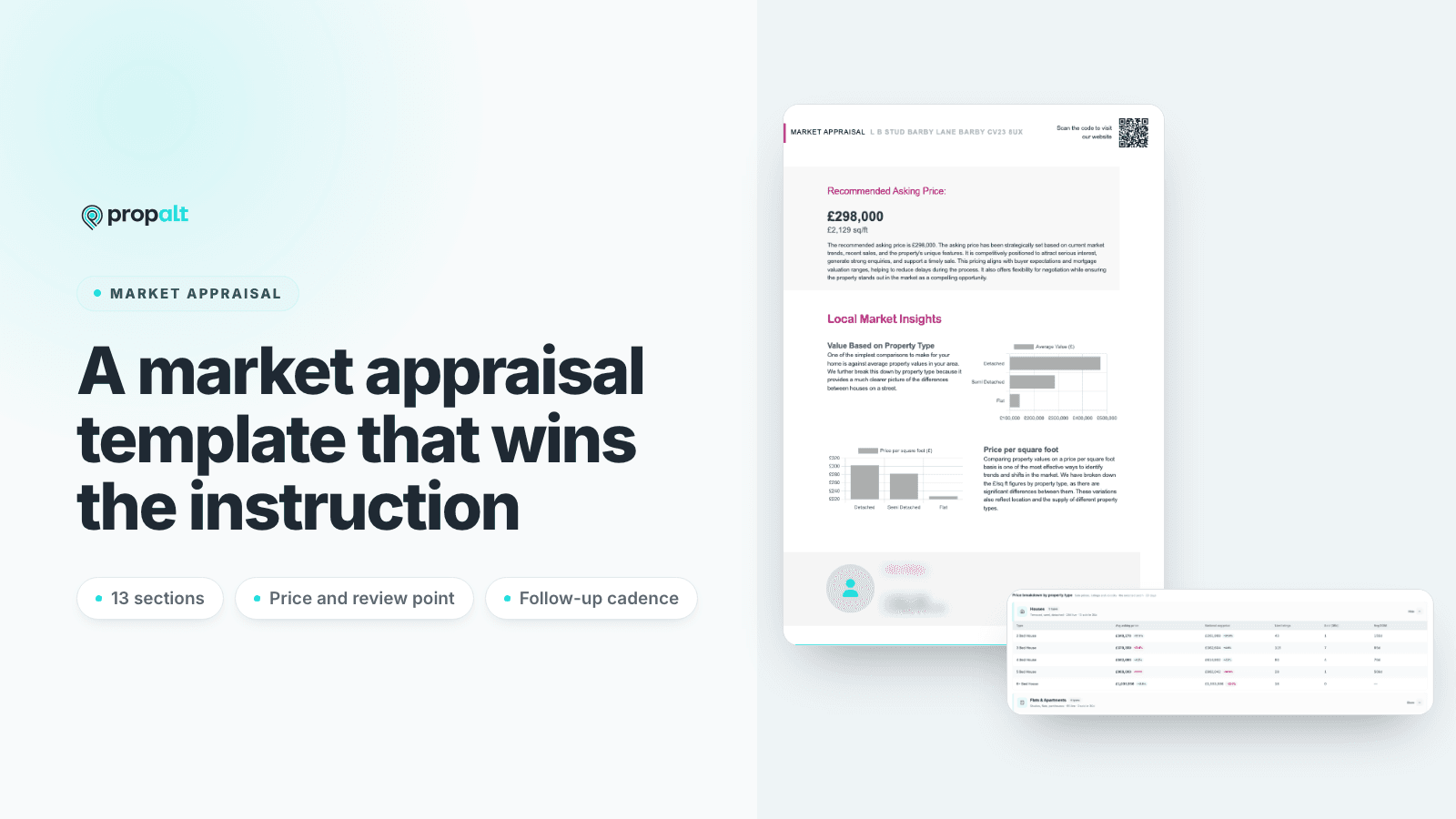
This guide is for estate agents preparing a market appraisal for a vendor. If you are a homeowner looking for a valuation, the government's How to sell a home guide is the better starting point.
Your market appraisal does two jobs at once. It gives the vendor a recommended asking price backed by evidence, and it is the document they will hold up against the other agents. According to a YouGov survey for Zoopla of 1,000 homeowners who sold in the past five years, published in August 2025, 49% invited three agents to value their home.
So what should an estate agent's market appraisal include, and how should it be laid out so it wins the instruction without overpricing the property?
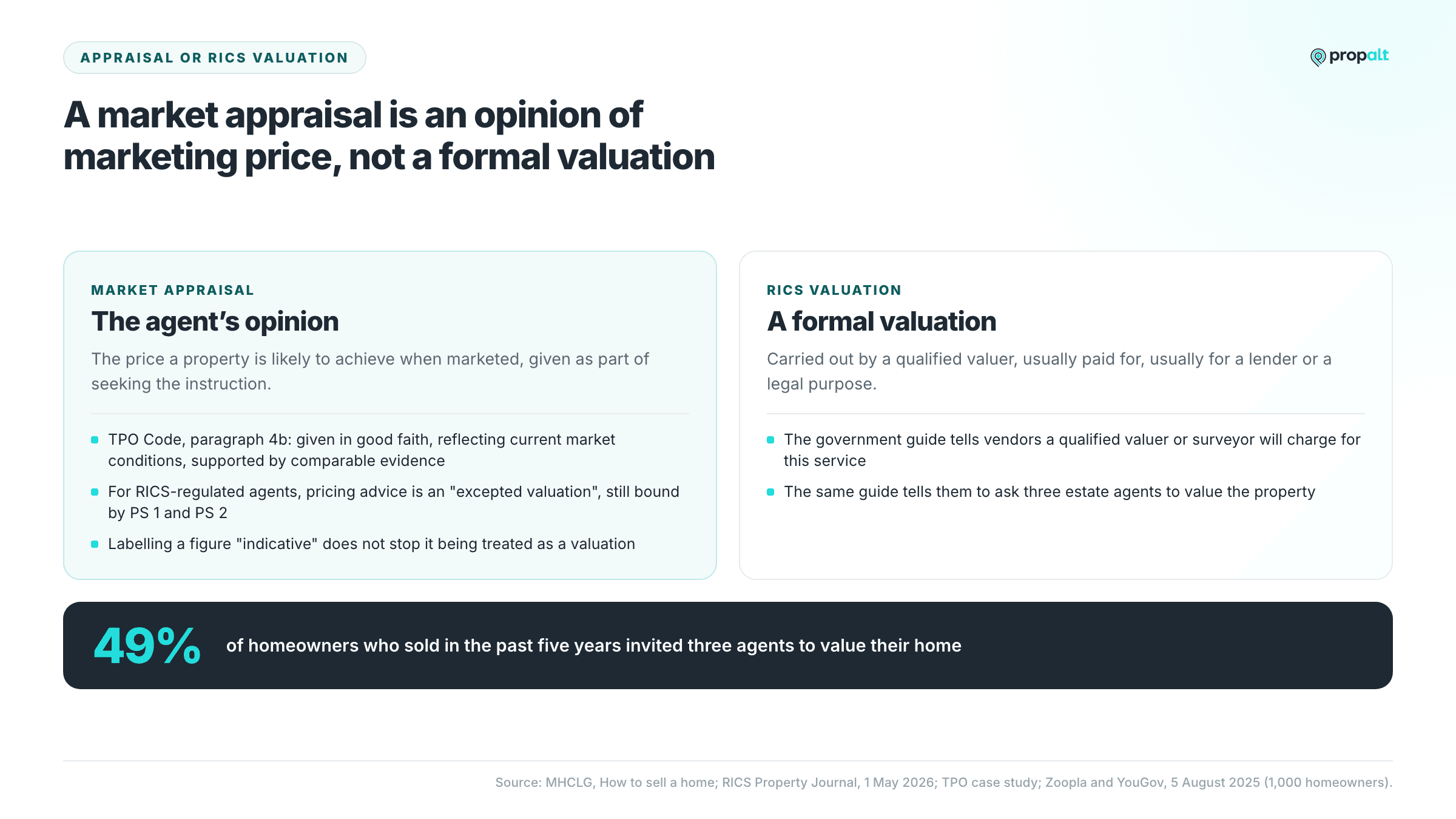
No. A market appraisal is an agent's opinion of the price a property is likely to achieve when marketed, given as part of seeking the instruction. A RICS valuation is a formal valuation by a qualified valuer, usually paid for and usually for a lender or a legal purpose.
The government's guide to selling makes the distinction for vendors: ask three estate agents to value the property, while "a qualified valuer or surveyor will charge you for this service".
If you are RICS-regulated, the Red Book still reaches you. A May 2026 RICS Property Journal article explains that pricing advice for a sales strategy is an "excepted valuation", bound by Professional Standards 1 and 2 even though it is excepted from VPS 1 to 6. It also warns that labelling a figure "indicative" does not stop it being treated as a valuation.
For agents registered with The Property Ombudsman, its Code expects a recommended asking price to be given in good faith, to reflect current market conditions and to be supported by comparable evidence (paragraph 4b, as quoted in a TPO case study).
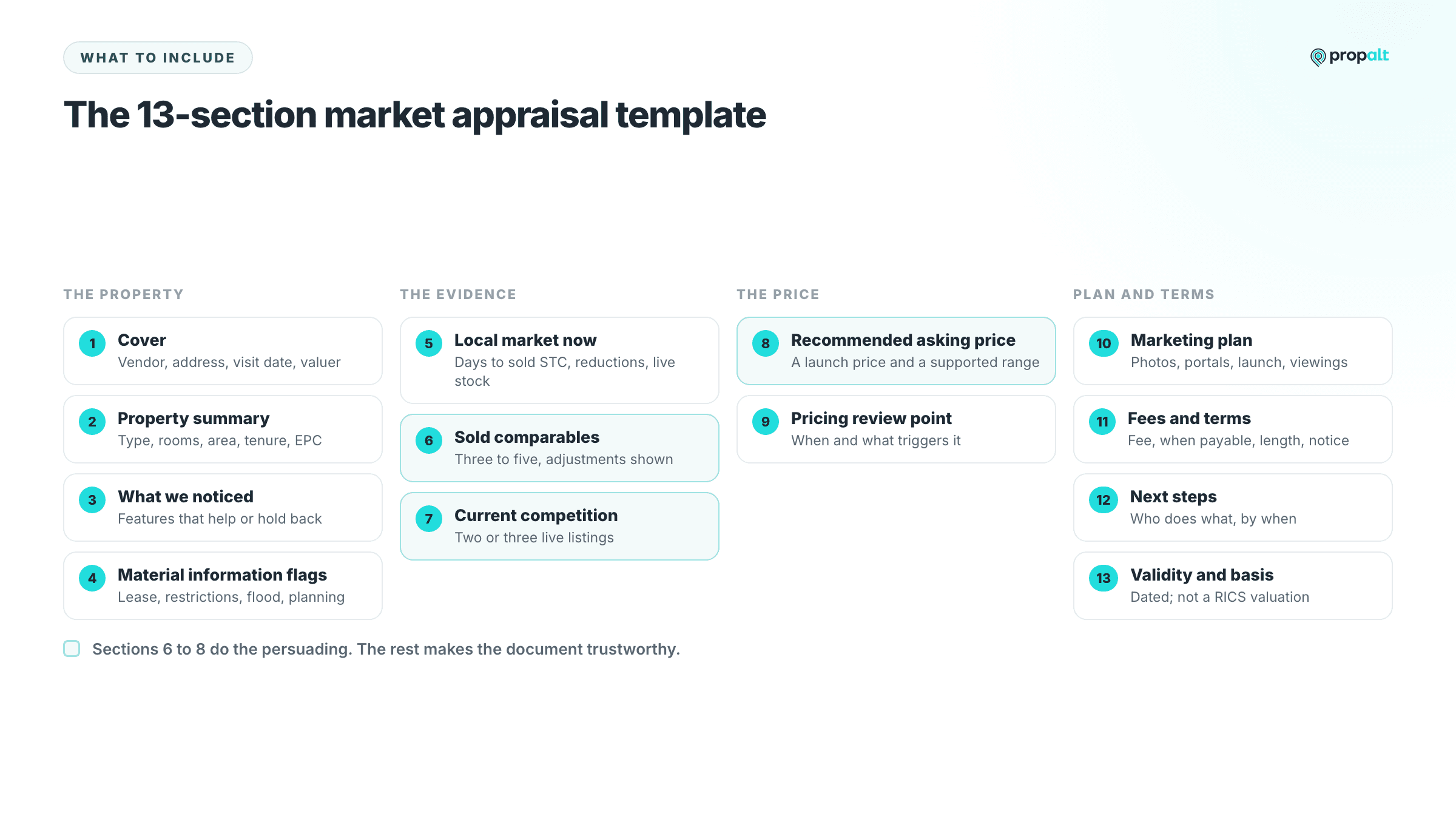
A market appraisal should include the property facts, the market evidence, a recommended asking price with a range, the marketing plan, your fees and terms, and the next steps. Copy the template below into your own branded document.
The market appraisal template (valuation report template for agents)
| # | Section | What to include | Where it comes from |
|---|---|---|---|
| 1 | Cover | Vendor name, property address, date of visit, valuer's name and branch contact | Your CRM |
| 2 | Property summary | Type, bedrooms, bathrooms, floor area, tenure, title number, council tax band, EPC rating | Your inspection, HMLR title register, EPC register, VOA |
| 3 | What we noticed | Three to five features that help the price, and any that hold it back | Your inspection |
| 4 | Material information flags | Lease length, restrictions, flood risk, planning nearby, anything that needs resolving before listing | Title register, flood and planning data, vendor |
| 5 | Local market now | Days to sold STC, share of listings reduced, live competing stock | Portal and market data, dated |
| 6 | Sold comparables | Three to five completed sales with adjustments shown | HMLR Price Paid Data, your own completions |
| 7 | Current competition | Two or three live listings a buyer will view alongside this one | Portals |
| 8 | Recommended asking price | A single launch price and a supported range | Sections 5 to 7 |
| 9 | Pricing review point | When you will review the price if there is no sale agreed, and what will trigger it | Local days to sold STC |
| 10 | Marketing plan | Photography, floor plan, portals, launch date, viewings approach, buyer database | Your process |
| 11 | Fees and terms | Fee, when it becomes payable, contract length, notice period, any other charges | Your terms of business |
| 12 | Next steps | What the vendor needs to do, what you will do, and by when | Agreed at the visit |
| 13 | Validity and basis | Date of the opinion, that it is a marketing opinion and not a RICS valuation, review date | Your standard wording |
Keep it to a length a vendor will read. Sections 6 to 8 do the persuading. The rest makes the document trustworthy.
Our guide to material information reports covers what to check for section 4.
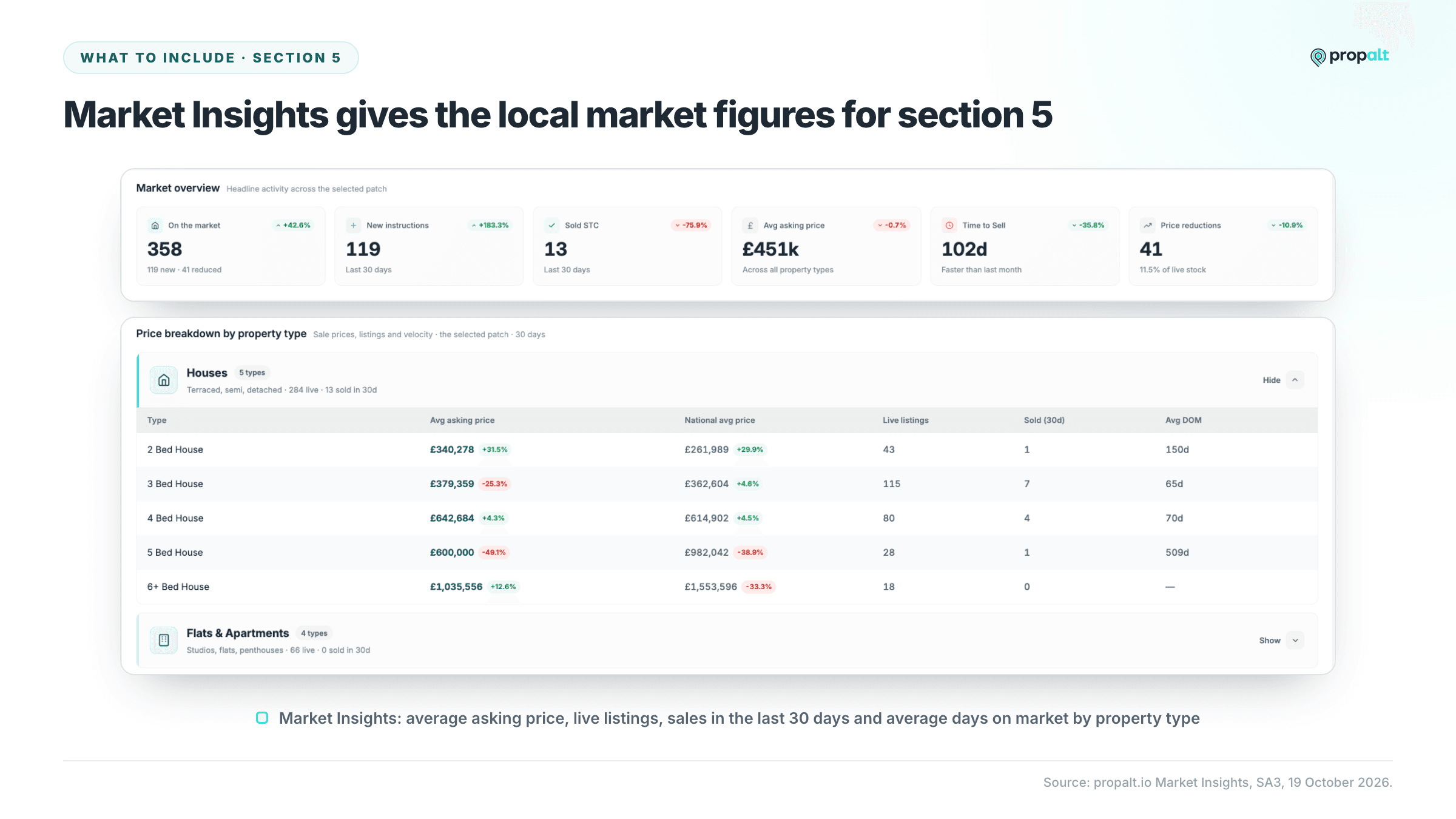
For section 5, Market Insights in the Propalt platform gives average asking price, live listings, sales in the last 30 days and average days on market by property type for your area. For section 6, our guide to choosing property comparables covers distance, recency, adjustments and the Price Paid lag.
Set the range from your adjusted comparables, then choose the launch price within it based on the current competition and market speed. Give the vendor one number to launch at and a range to negotiate within.
A workable method:
Market speed varies by property type, so set the review point for the type you are pricing. Nationally in Q3 2026, semi-detached homes took 59 days from first listing to sold STC, terraced homes 61 days, flats 77 days and detached homes 80 days (Propalt, Q3 2026).
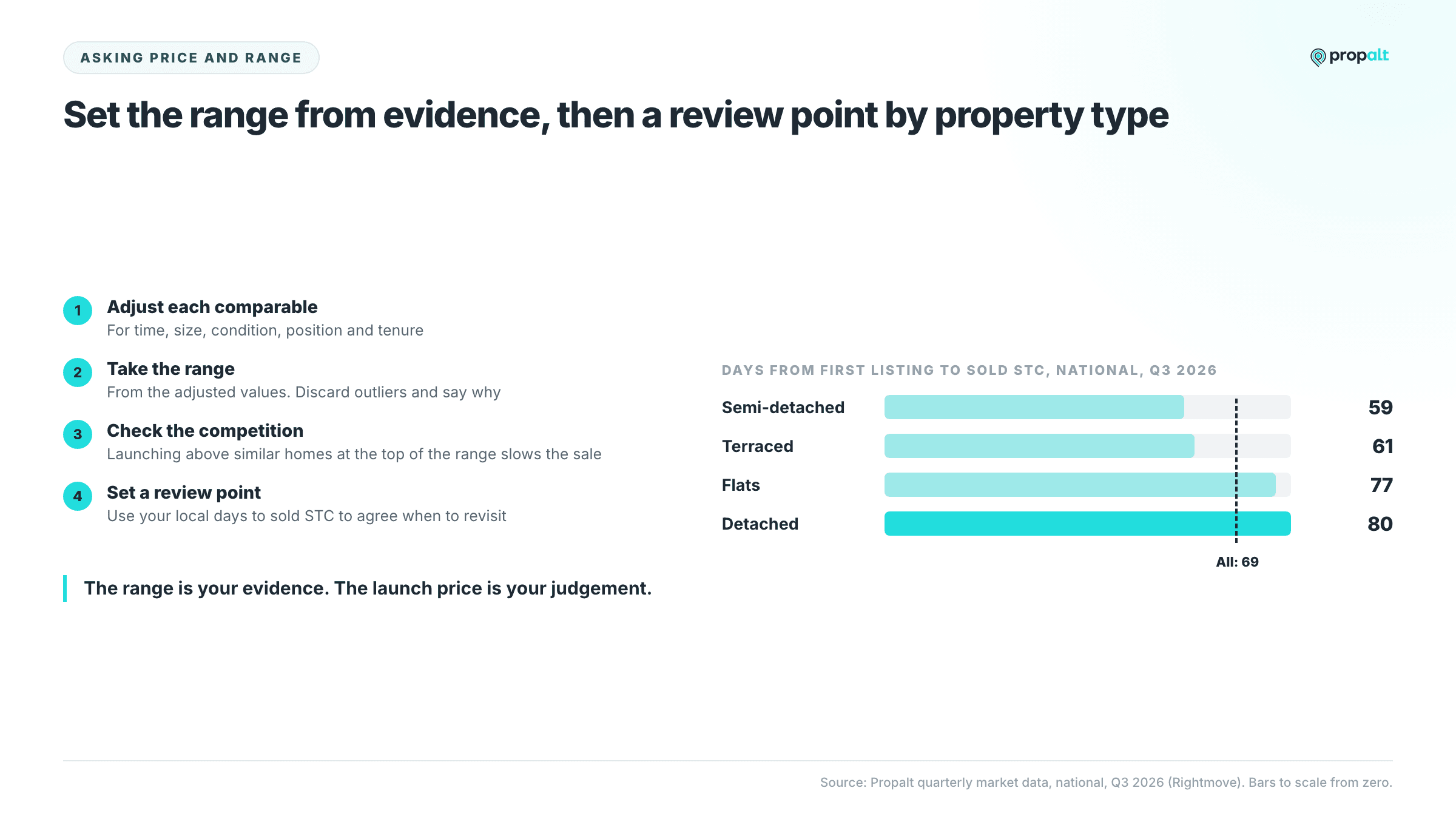
The range is your evidence. The launch price is your judgement. Show the vendor both.
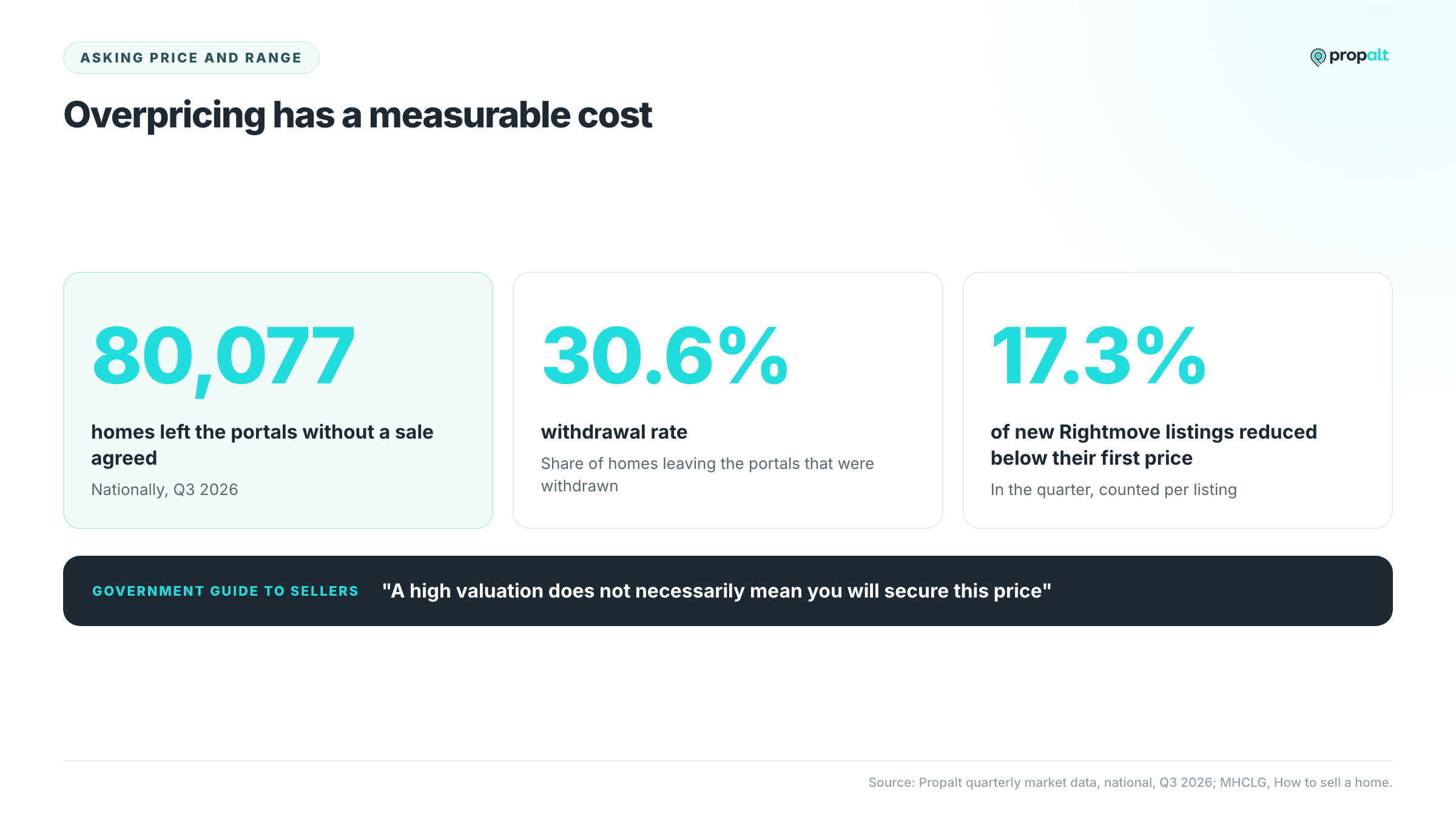
Overpricing has a measurable cost. In Q3 2026, 80,077 homes left the portals nationally without a sale agreed, a withdrawal rate of 30.6%, and 17.3% of new Rightmove listings in the quarter were reduced below their first listed price, counted per listing (Propalt, Q3 2026). The government guide warns sellers that "a high valuation does not necessarily mean you will secure this price". Quote that to a vendor comparing your figure with a higher one.
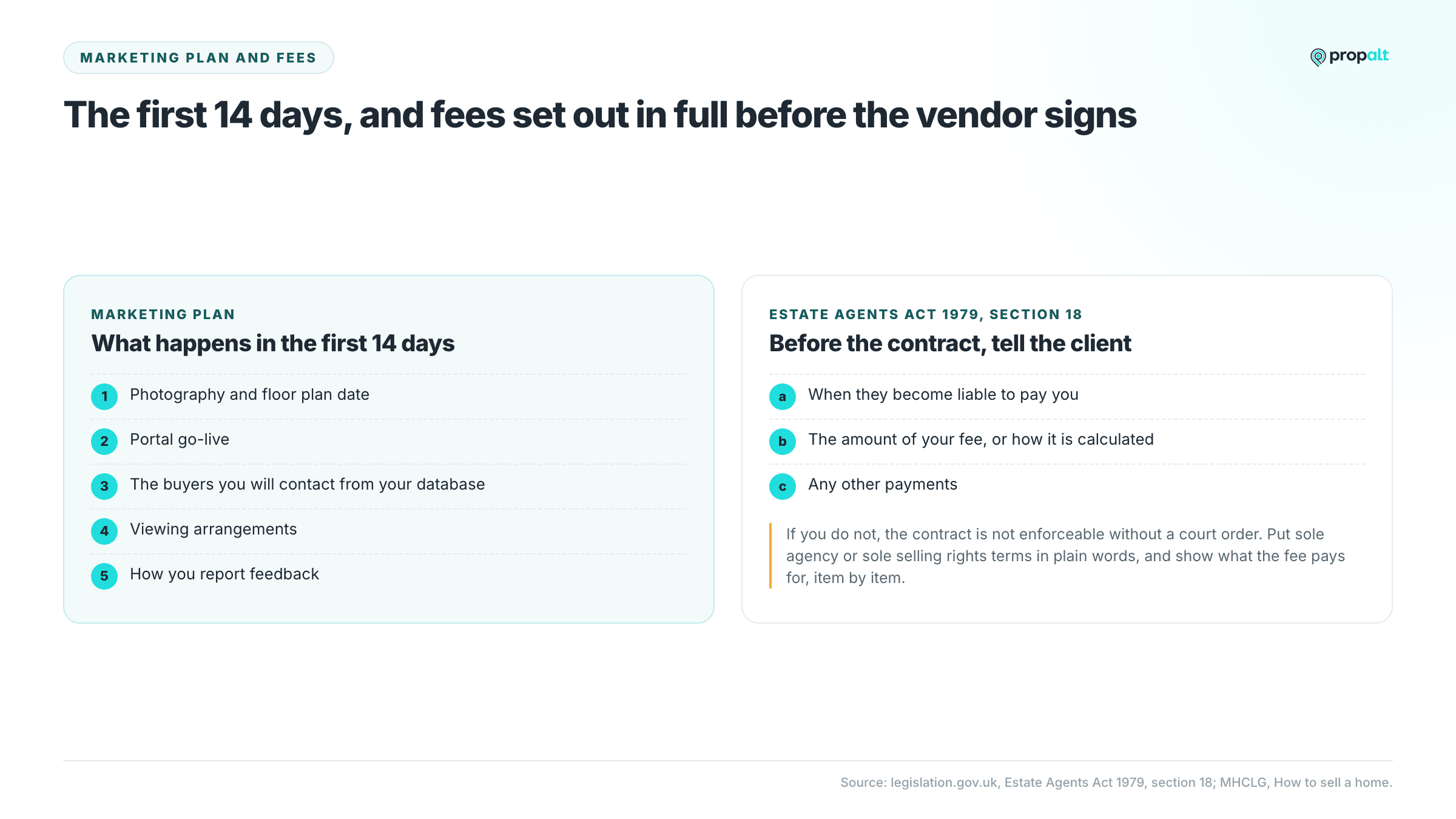
The marketing plan should tell the vendor what will happen in the first 14 days and who does it. Fees should be set out in full, in writing, before the vendor signs.
For the marketing plan, list the launch sequence: photography and floor plan date, portal go-live, the buyers you will contact from your database, viewing arrangements and how you report feedback.
For fees, section 18 of the Estate Agents Act 1979 requires you to give the client, before they enter the contract, the circumstances in which they become liable to pay you, the amount of your fee (or how it will be calculated) and any other payments. If you do not, the contract is not enforceable without a court order. Include sole agency or sole selling rights terms in plain words. The government guide warns vendors that under sole selling rights "you will pay the estate agent even if you find your own buyer".
Vendors are told to negotiate. The same guide says "don't be afraid to try and negotiate on the fee". Show what the fee pays for, item by item, before the vendor raises it.
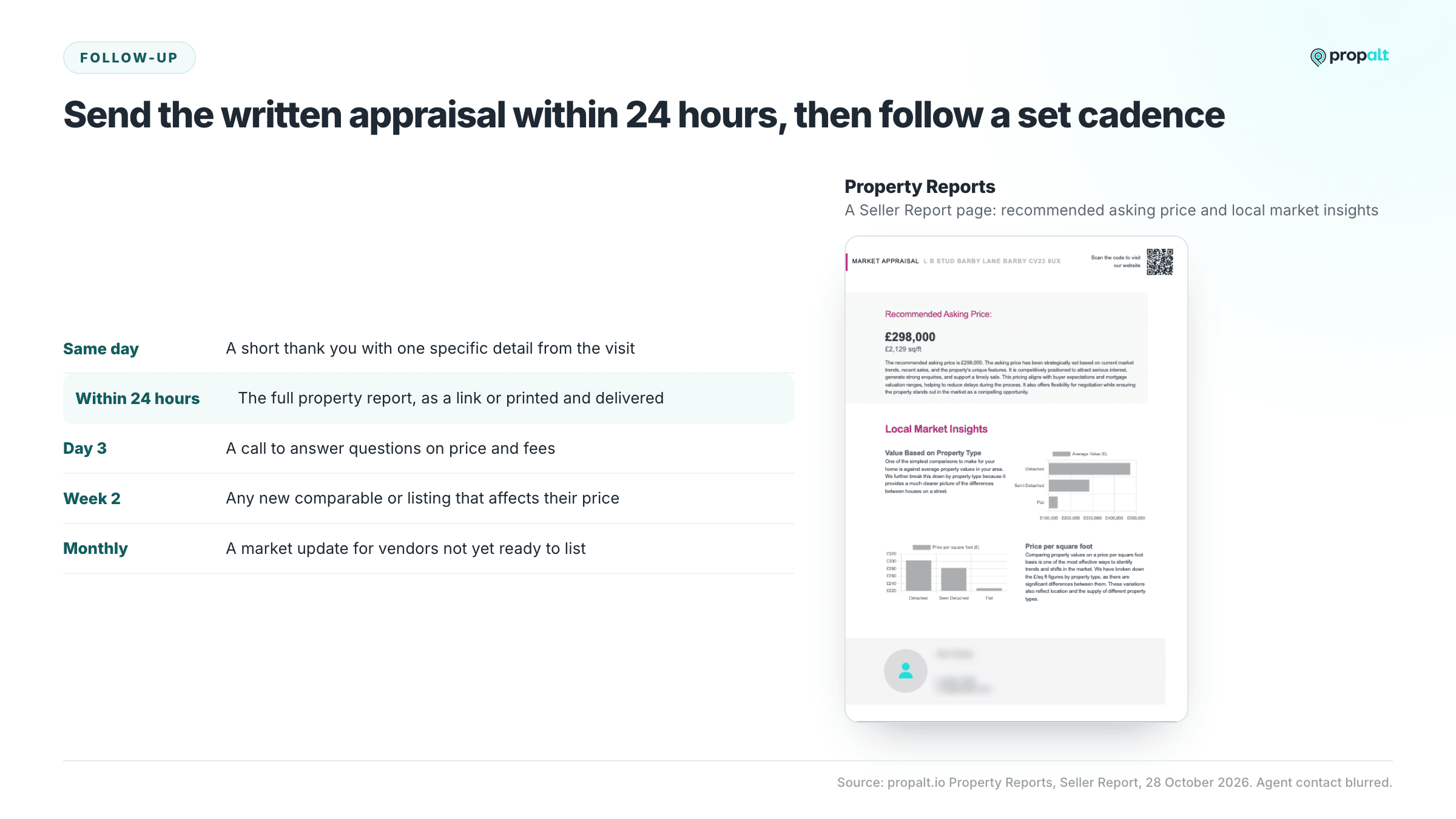
Send the written market appraisal within 24 hours, while you are still fresh in the vendor's mind and before the third agent visits. Then follow a set cadence.
Our tutorial on how to create a seller report shows how to personalise and share the report you send within 24 hours. For vendors who are not ready to sell, our guide to winning the instruction before the vendor is ready sets out a dormant marketing approach, and our guide to estate agent lead generation covers how to keep them warm without chasing.
A market appraisal is an agent's evidenced opinion of marketing price, not a RICS valuation, and the TPO Code expects it to be supported by comparable evidence. Use the 13-section template above: property facts, material information flags, local market data, three to five sold comparables, current competition, a launch price within a supported range, a review point, the marketing plan, fees set out as the Estate Agents Act requires, and next steps. Send it within 24 hours. Property Reports produce the branded version with property details, planning data and comparables filled in.
Contains HM Land Registry data © Crown copyright and database right 2026. This data is licensed under the Open Government Licence v3.0.
Dormant Marketing Strategy ...If you’re attending a valuation with one of these sellers, there’s a risk: you leave without an instruction, only a vague promise of “we’ll be in touch once we’ve found something.” Even if they’re sincere, you’re now in a follow-up loop. And meanwhile, another agent could win their trust, find their next home, and take the listing.

During the summer, some listings stall. Some agents go on holiday. And some vendors get fed up. That’s where you come in. Here are six practical tips for improving your on-market canvassing strategy.

Discover the latest on UK mortgage approvals and house price trends in our article, providing essential insights for homebuyers, sellers, and market enthusiasts.