Estate Agency Marketing
Email Marketing for Estate Agents: Consent, the Soft Opt-in and What to Send

October 28, 2026

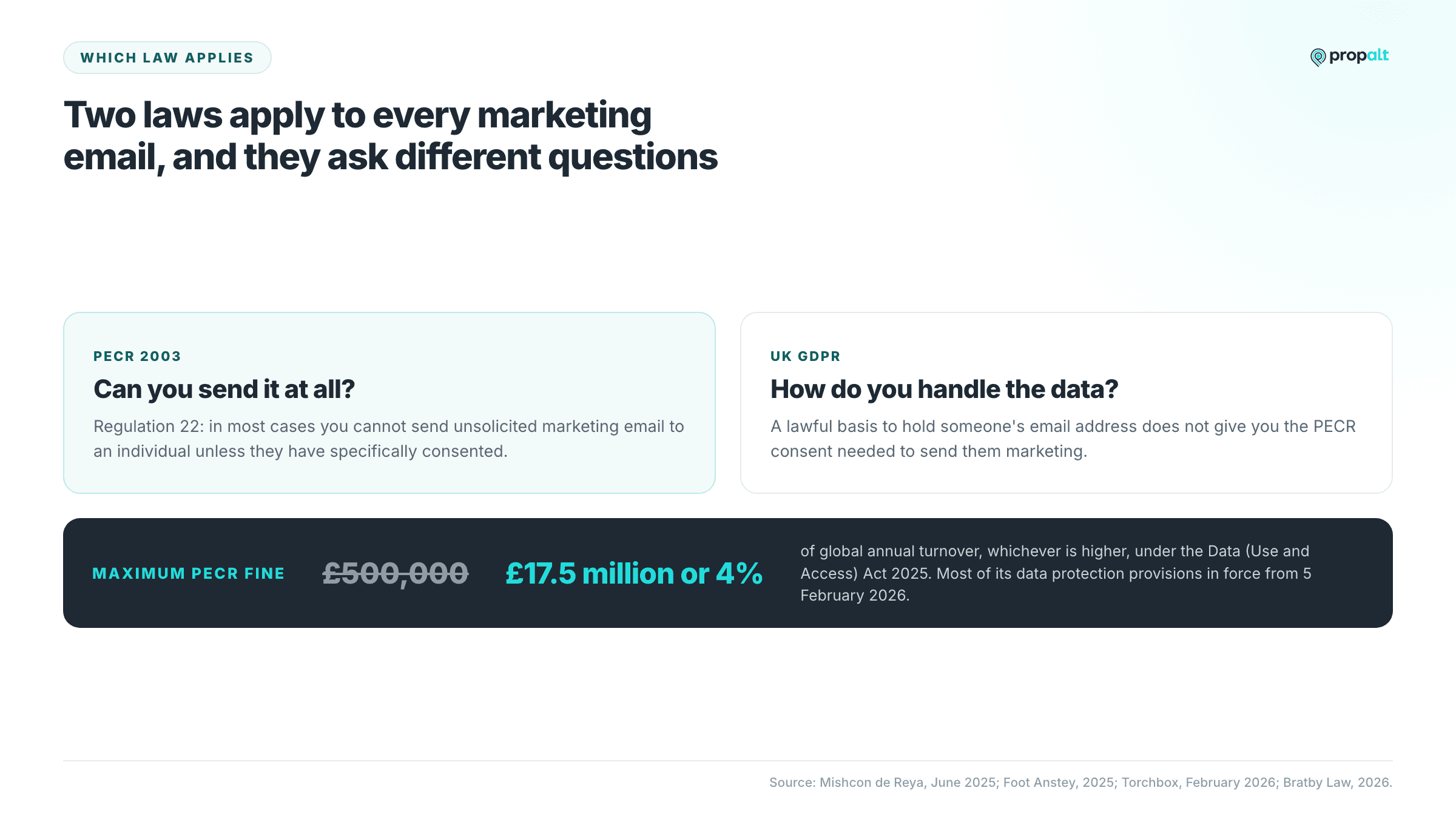
The maximum fine for breaking the UK's email marketing rules is now £17.5 million or 4% of global annual turnover, whichever is higher. Until the Data (Use and Access) Act 2025, it was £500,000. Most of the Act's data protection provisions came into force on 5 February 2026, and the ICO issued £4.63 million in fines under the same rules during 2025 alone.
For estate agents, the rules themselves have not changed much. What has changed is the cost of getting them wrong. An agency's database is full of applicants, vendors, landlords and past clients, and each of them sits in a different place under the law.
So who can an estate agent email for marketing, when is consent needed, and what is worth sending?
Two laws apply at once. The Privacy and Electronic Communications Regulations 2003 (PECR) decide whether you can send a marketing email at all. UK GDPR decides how you handle the personal data behind it.
The point most agencies miss is that the two are separate. You can have a valid UK GDPR lawful basis to hold someone's email address and still lack the PECR consent needed to send them marketing. Regulation 22 of PECR is the one that matters: in most cases you cannot send unsolicited marketing email to an individual subscriber unless they have specifically consented.
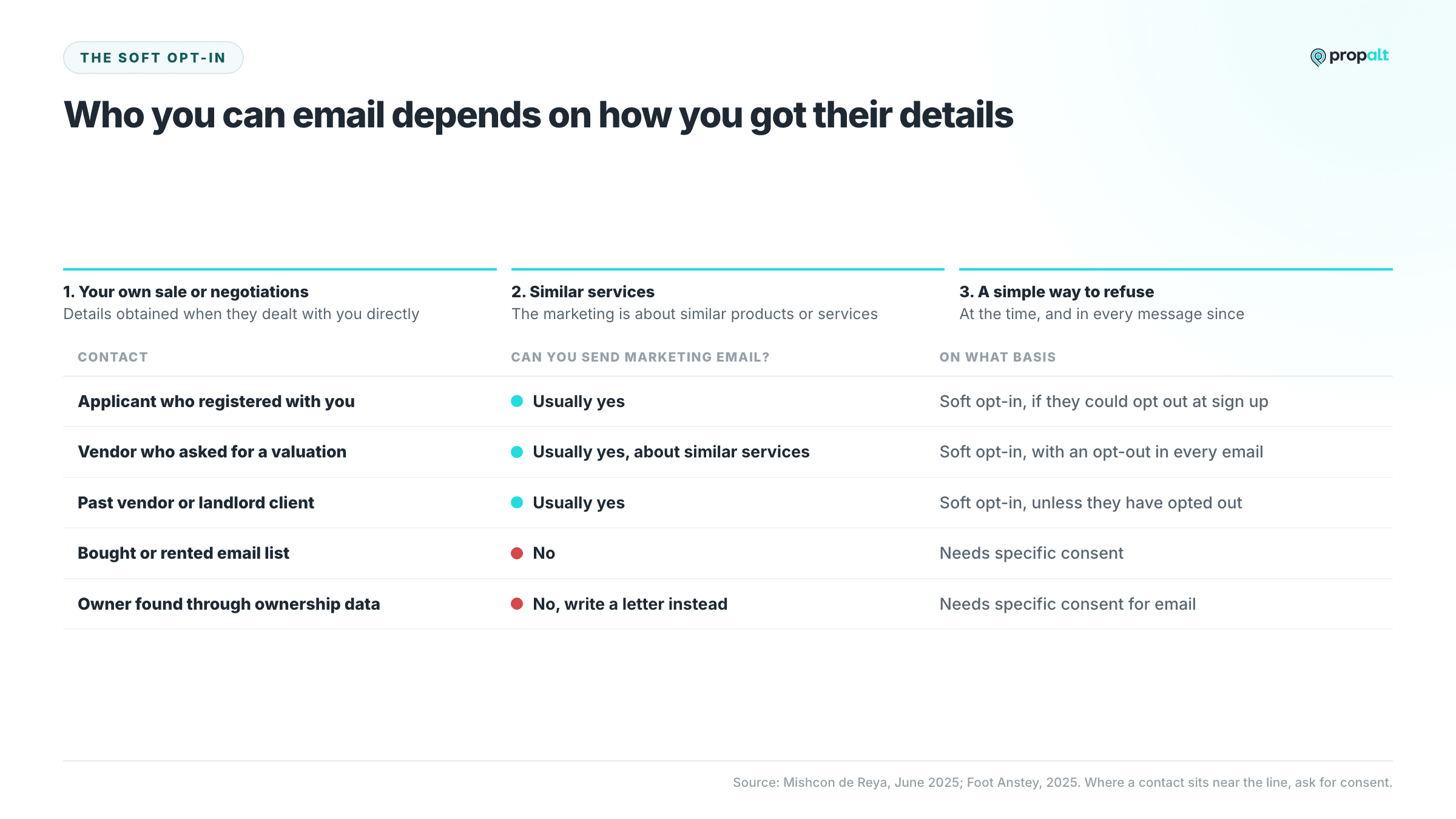
The soft opt-in is the main exception to the consent rule. It lets a business email someone without separate consent where it obtained their details in the course of a sale, or negotiations for a sale, of its own products or services, the marketing is about similar products or services, and the person was given a simple way to refuse at the time and in every message since.
For an agency, that usually covers people who have dealt with you directly: an applicant who registered for property alerts, a vendor who requested a valuation, a landlord whose property you let. It does not cover a list you bought, contacts scraped from a website, or owners you identified from ownership data.
The concession: the ICO has been updating its direct marketing guidance to reflect the 2025 Act, and how far "negotiations for a sale" stretches is a judgment call. Where a contact sits near the line, ask for consent.
| Contact | Can you send marketing email? | On what basis |
|---|---|---|
| Applicant who registered with you | Usually yes | Soft opt-in, if they could opt out at sign up |
| Vendor who asked for a valuation | Usually yes, about similar services | Soft opt-in, with an opt-out in every email |
| Past vendor or landlord client | Usually yes | Soft opt-in, unless they have opted out |
| Bought or rented email list | No | Needs specific consent |
| Owner found through ownership data | No, write a letter instead | Needs specific consent for email |
"Holding someone's email address and being allowed to market to it are two different questions."
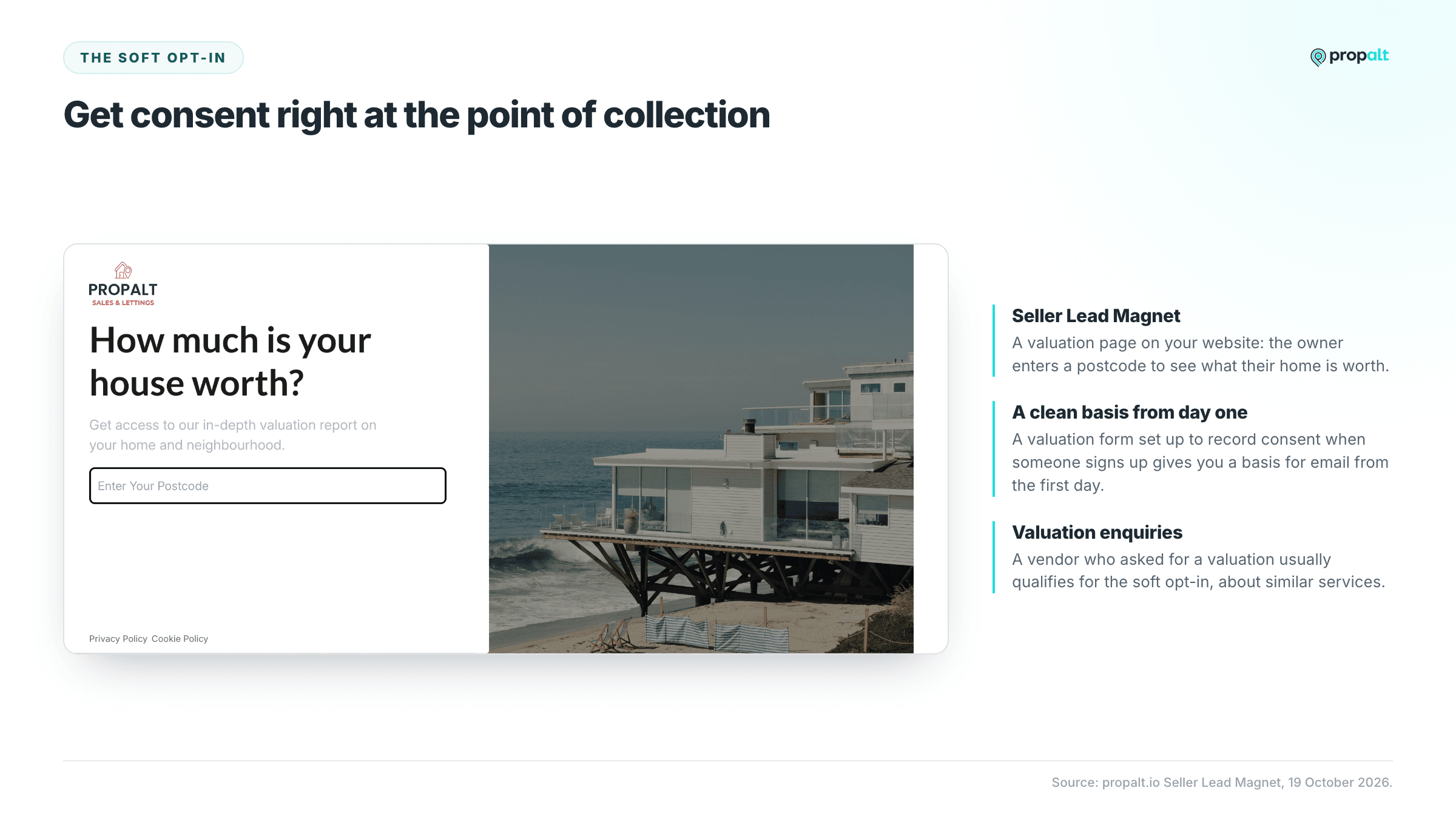
Consent is easiest to get right at the point of collection. A valuation form set up to record consent when someone signs up, such as Propalt's Seller Lead Magnet, gives you a clean basis for email from the first day. Our guide to online valuation tools for estate agents compares the options.
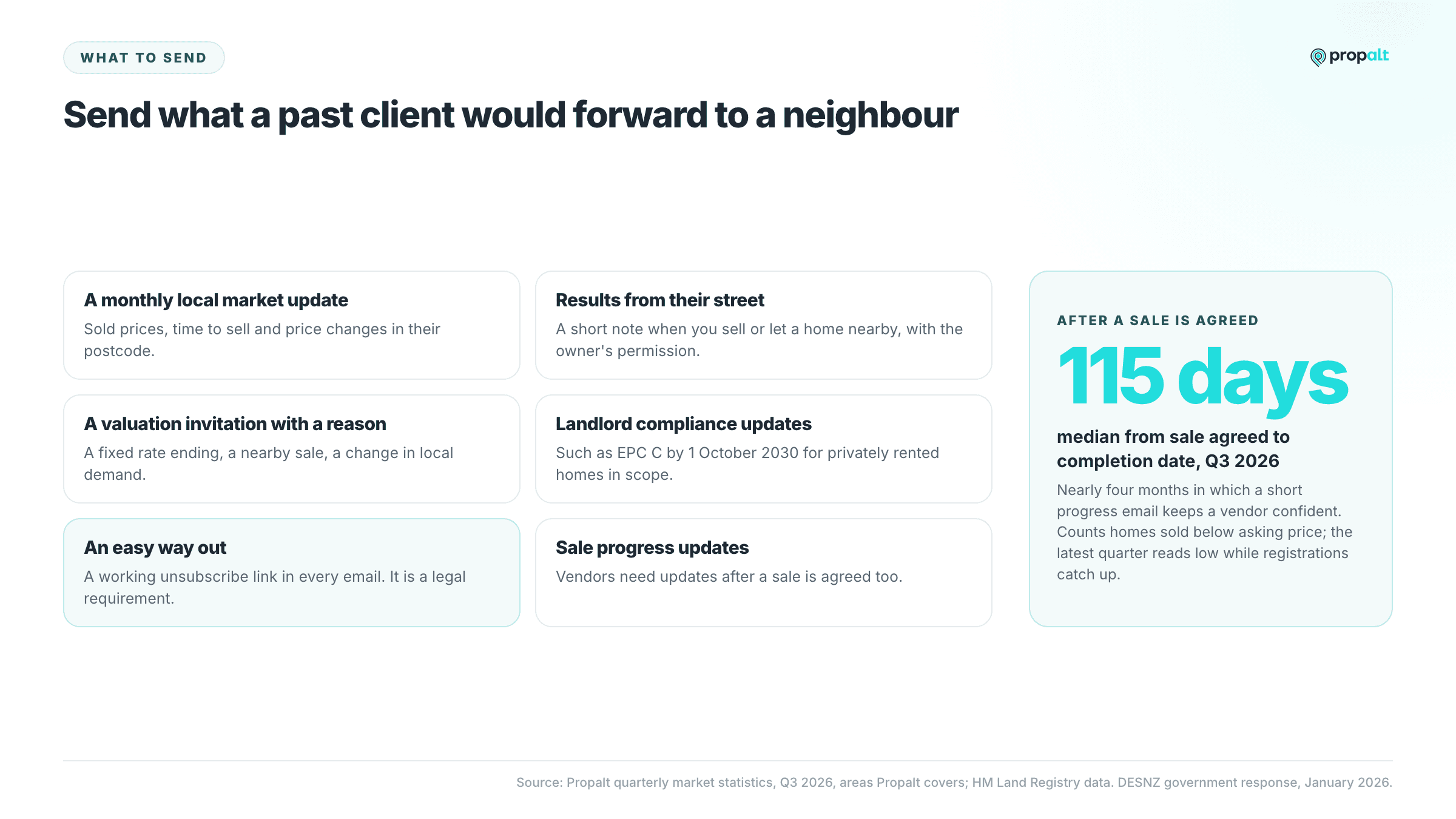
Send what a past client or applicant would forward to a neighbour. That usually means local information, not a list of your latest instructions.
Vendors need updates after a sale is agreed too. In Q3 2026, the median time from sale agreed to the completion date recorded by HM Land Registry was 115 days, across the areas Propalt covers. It counts homes that sold below their asking price, and the latest quarter reads low while registrations catch up. That is nearly four months in which a short progress email keeps a vendor confident in their agent.
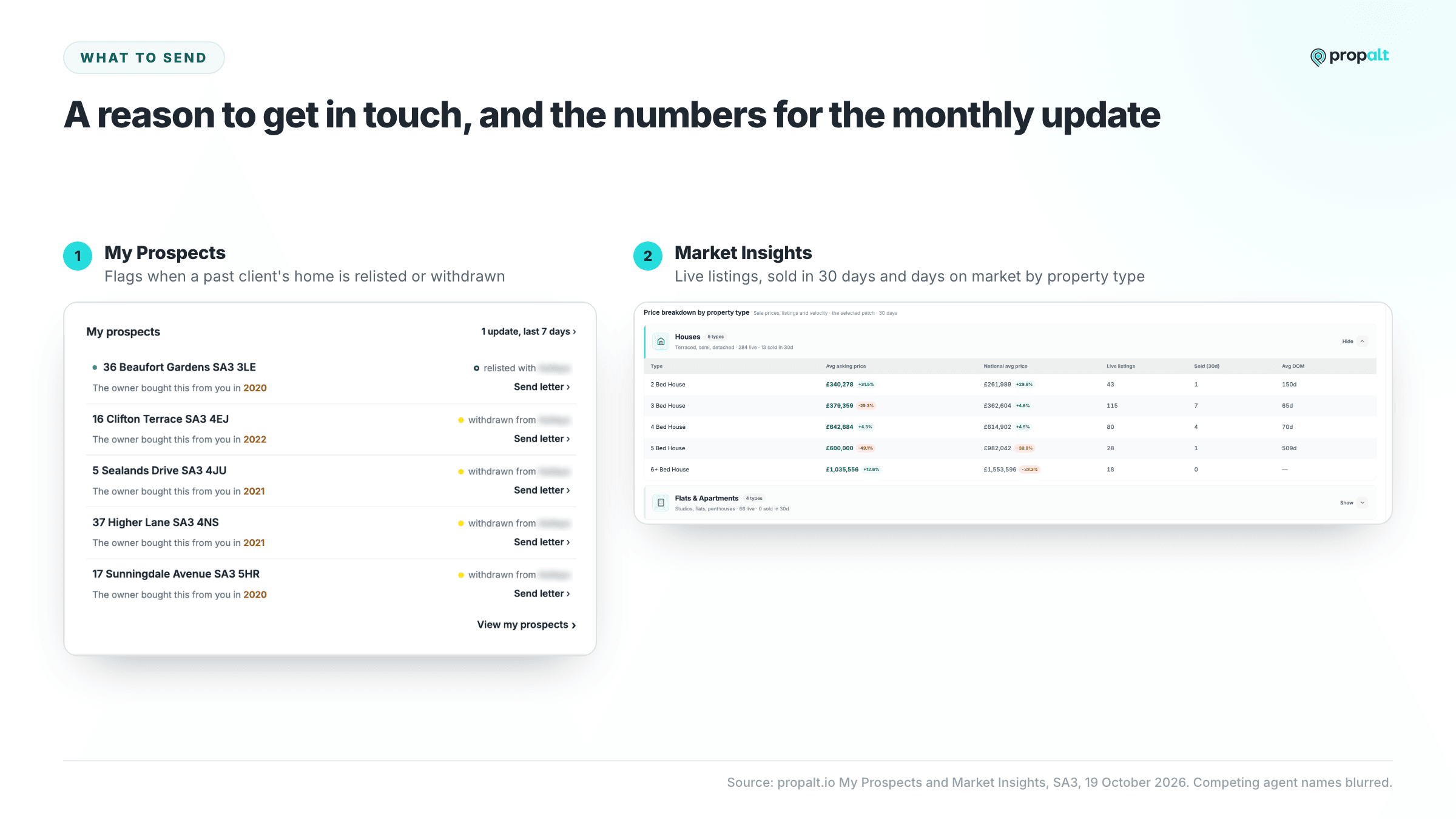
Propalt's My Prospects flags when a past client's home is relisted or withdrawn, which is a reason to get in touch that the client will recognise. For the monthly update, Market Insights in the platform shows live listings, sales in the last 30 days, average days on market and the 12-month trend for each property type in your area.
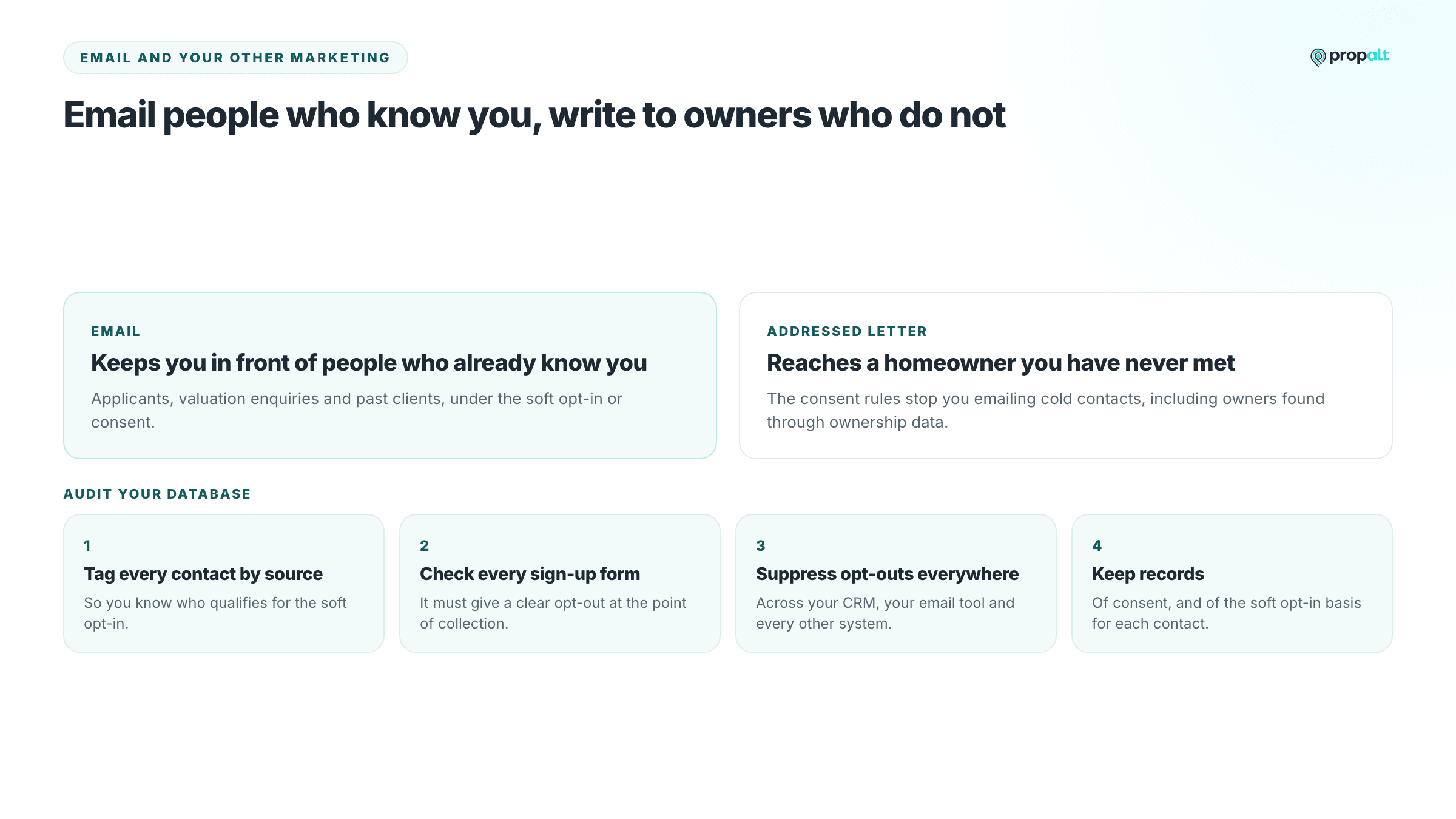
Email keeps you in front of people who already know you. It cannot reach a homeowner you have never met, because the consent rules stop you emailing cold contacts. That is the job of addressed direct mail, covered in our guide to direct mail for estate agents, and of the prospecting methods in our estate agent lead generation guide.
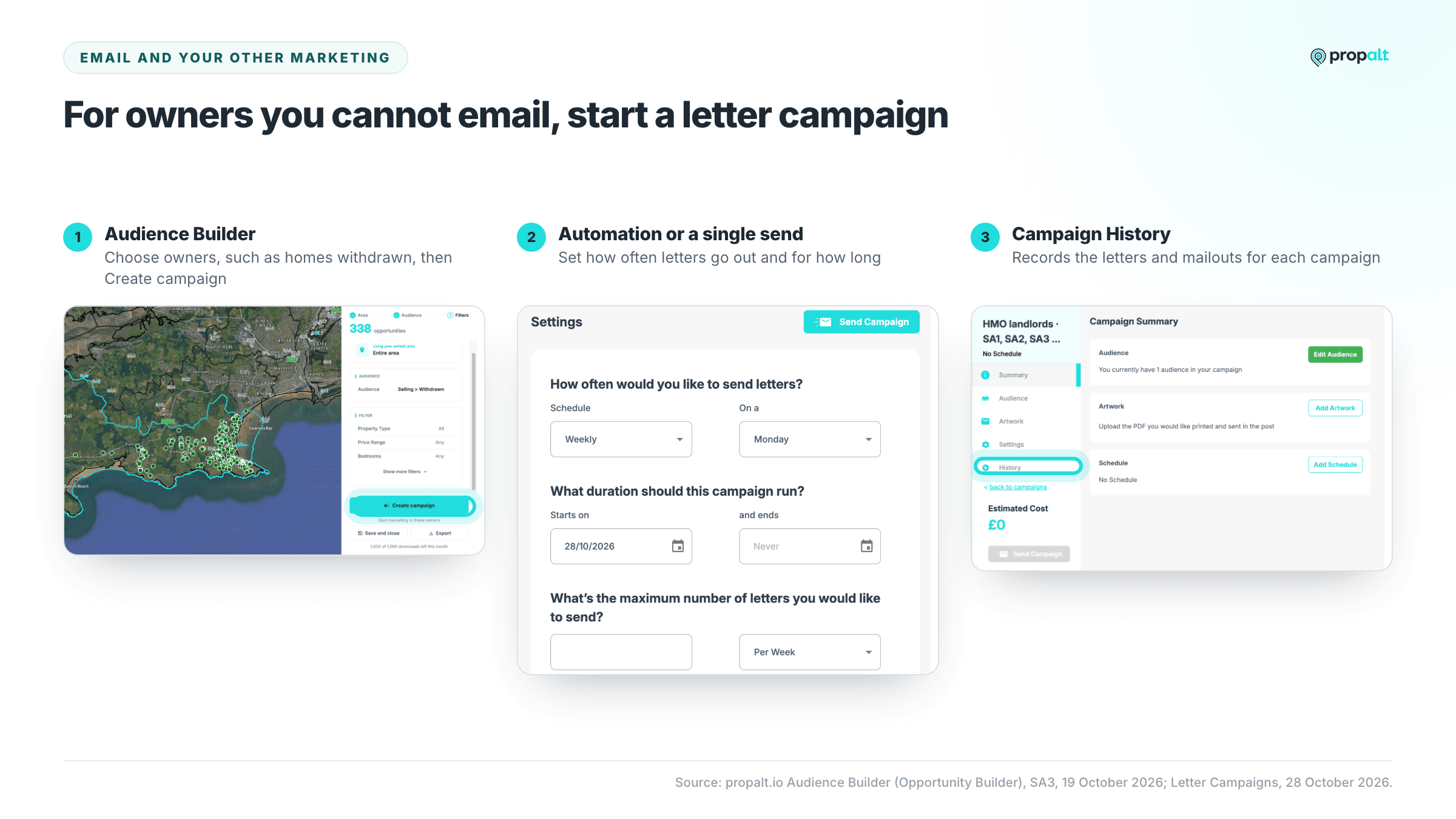
For owners you cannot email, Propalt's Audience Builder starts a letter campaign to the owners in an audience, run as an automation or a single send, and Campaign History records the letters and mailouts for each campaign.
Key takeaway. Email marketing for estate agents is governed by PECR and UK GDPR together, and since the Data (Use and Access) Act 2025 PECR breaches can cost up to £17.5 million. Applicants, valuation enquiries and past clients usually qualify for the soft opt-in; bought lists and owners found through ownership data do not, so reach them by letter. Propalt is built on the principle that the right channel for each contact matters as much as the message.
Sources and data references
Propalt data. Propalt (21 October 2026). Quarterly market statistics, Q3 2026 (July to September): median days from sale agreed to HM Land Registry registration, counting only properties whose asking price was above the sold price; the latest quarter is biased low by registration lag.
Contains HM Land Registry data © Crown copyright and database right 2026. This data is licensed under the Open Government Licence v3.0.
Dormant Marketing Strategy ...If you’re attending a valuation with one of these sellers, there’s a risk: you leave without an instruction, only a vague promise of “we’ll be in touch once we’ve found something.” Even if they’re sincere, you’re now in a follow-up loop. And meanwhile, another agent could win their trust, find their next home, and take the listing.

During the summer, some listings stall. Some agents go on holiday. And some vendors get fed up. That’s where you come in. Here are six practical tips for improving your on-market canvassing strategy.

Discover the latest on UK mortgage approvals and house price trends in our article, providing essential insights for homebuyers, sellers, and market enthusiasts.