Estate Agency Marketing
Social Media for Estate Agents: What to Post and the Rules That Apply

October 28, 2026

Most estate agent social media feeds are a second shop window: new listings, price reductions, the occasional team photo. That makes them easy to run and easy to ignore. Buyers already have the portals, and a vendor deciding which agent to instruct is not scrolling your listings for reassurance.
There is also a compliance angle that many feeds miss. Consumer protection law obliges agents not to omit material information from property adverts. Trading Standards' detailed guidance on what that means was withdrawn in May 2025, but the duty to give the information was not. A Facebook post advertising a flat for sale is still an advert.
So what should estate agents post, what rules apply to social posts, and how does social media help win instructions rather than just fill a feed?
Post what a vendor or landlord would want to see before they instruct you. That is proof that you sell and let homes on their street, at a good price, in a reasonable time.
Listings still have a place. They should not be the whole feed.
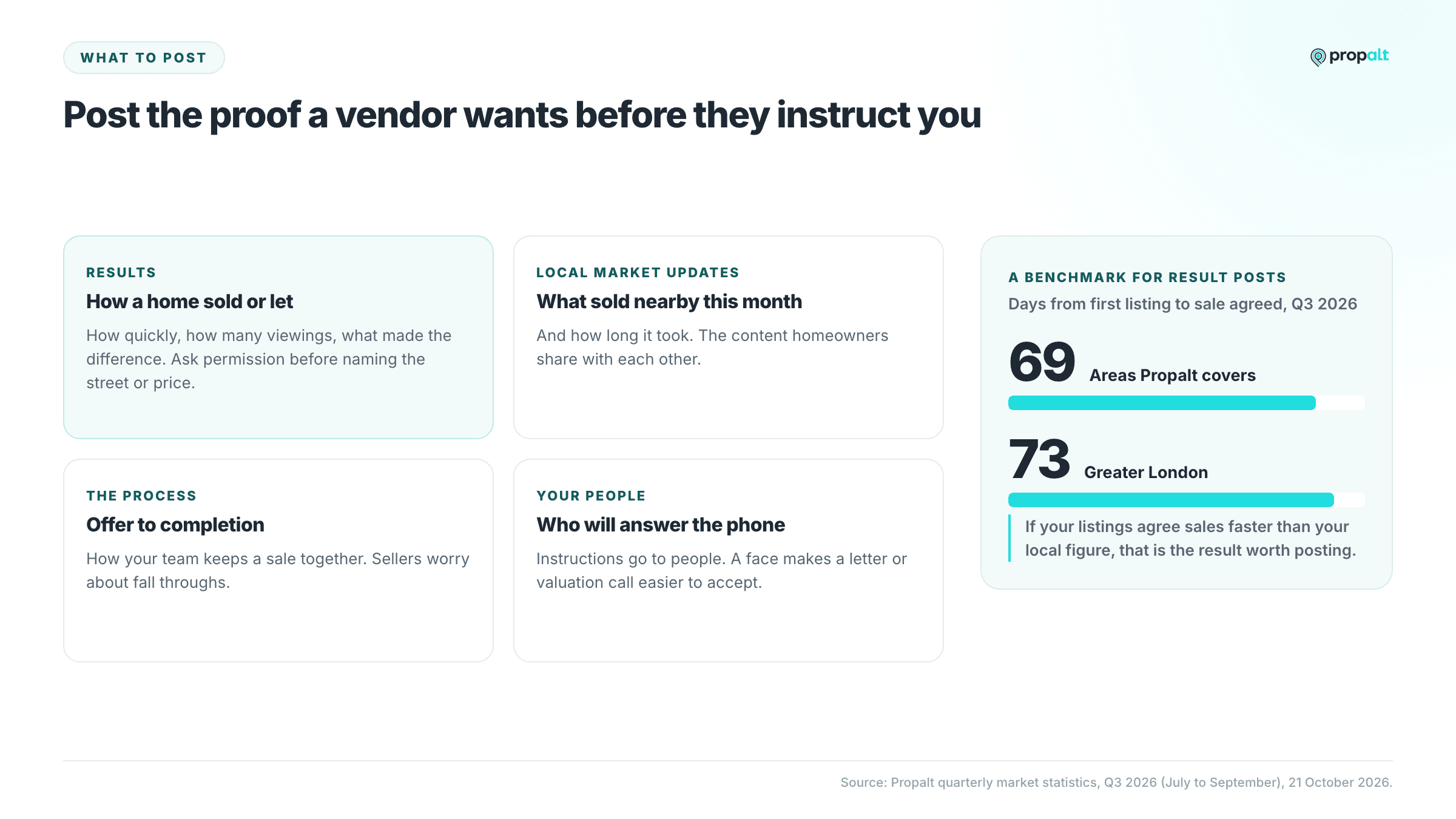
A benchmark makes a result post stronger. In Q3 2026, homes took 69 days from first listing to sale agreed across the areas Propalt covers, and 73 days in Greater London. If your listings agree sales faster than your local figure, that is the result worth posting.
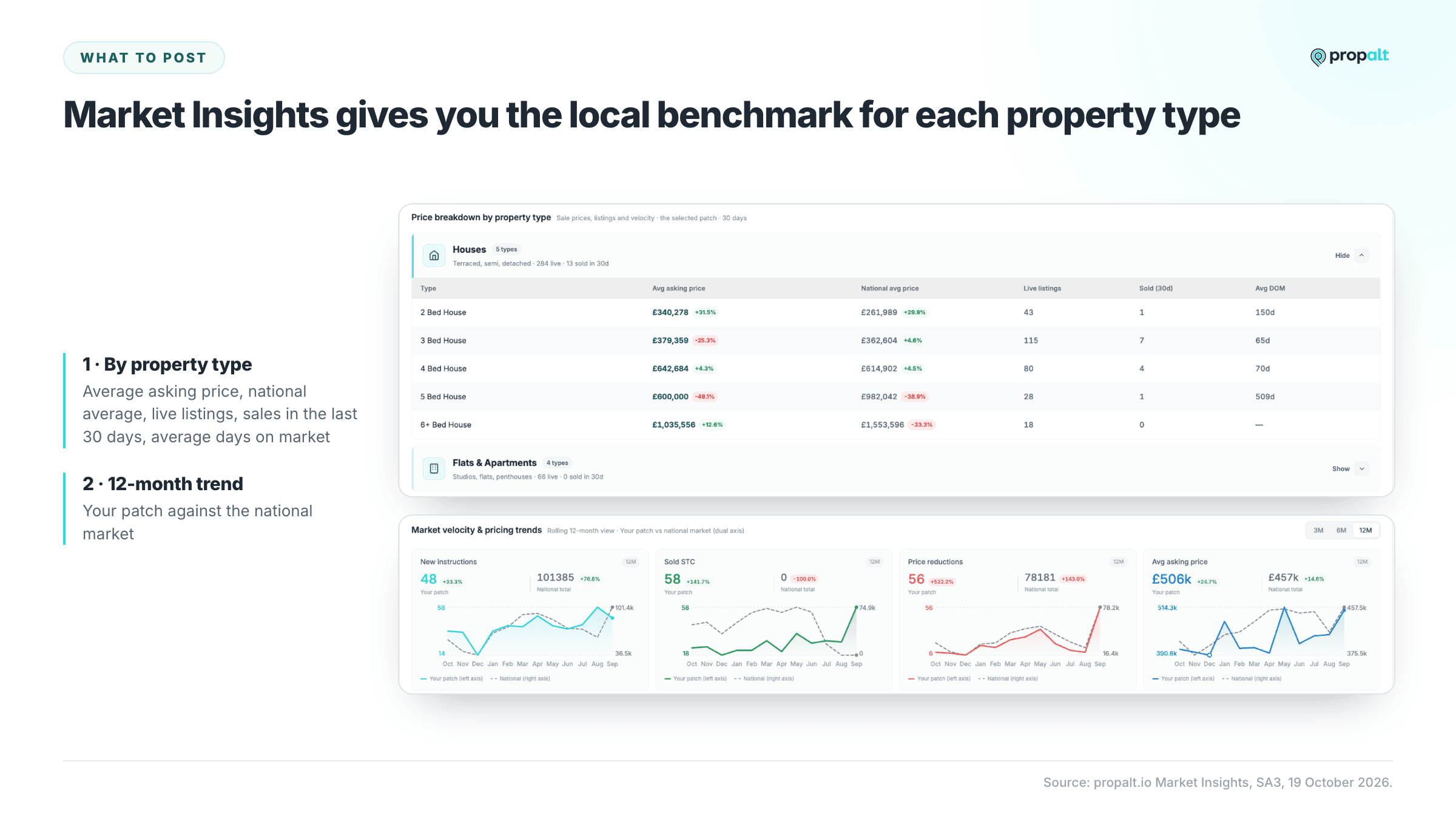
In Propalt, Market Insights shows the average asking price, live listings, sales in the last 30 days, average days on market and the 12-month trend against national for each property type in your area, which gives you that local benchmark.
"A vendor choosing an agent is looking for proof, not photos."
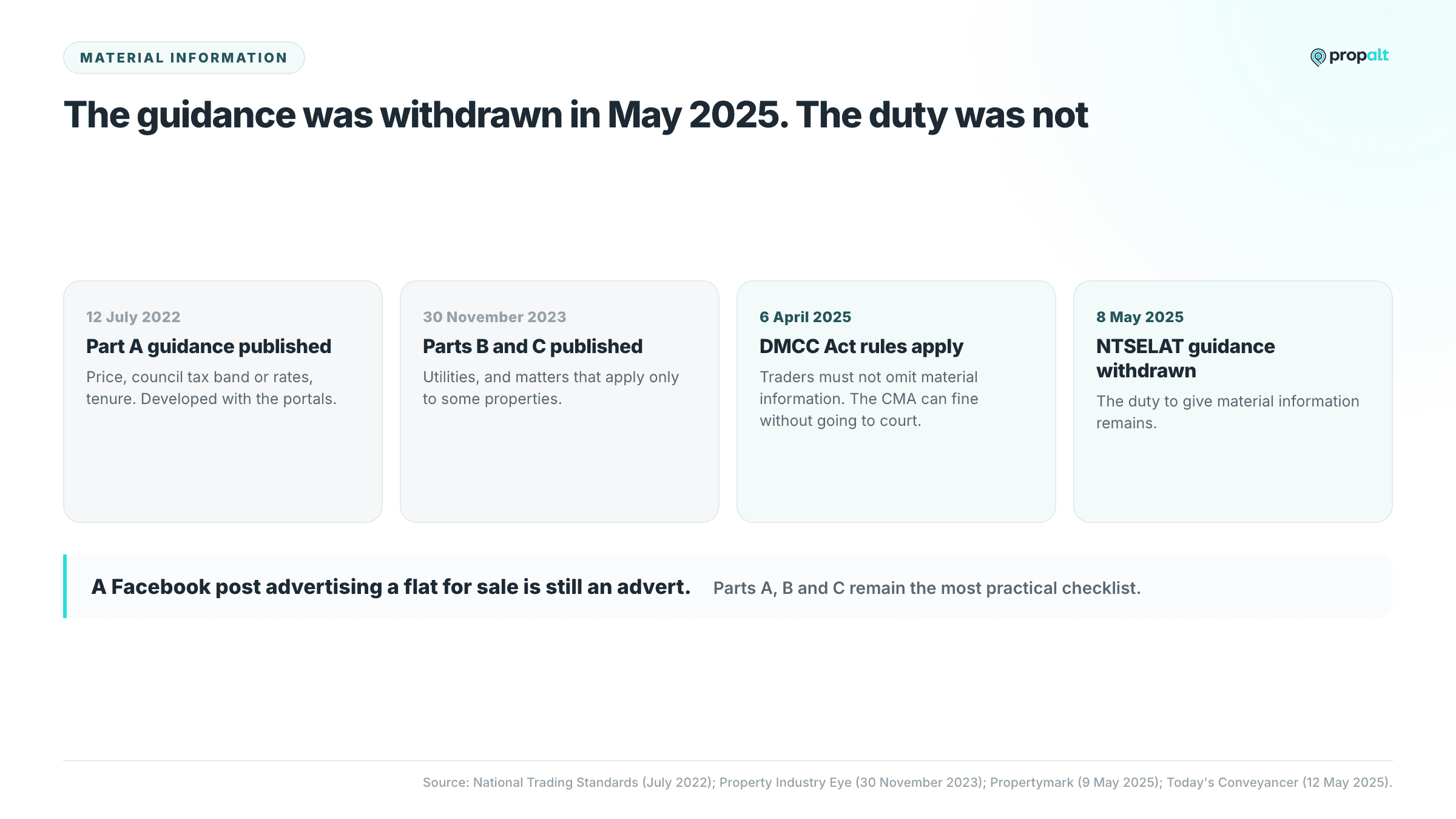
Yes, when the post advertises a specific property. Since 6 April 2025, the consumer protection rules in the Digital Markets, Competition and Consumers Act 2024 have required traders not to omit material information from property adverts. The Competition and Markets Authority can now fine businesses directly, without going to court.
The National Trading Standards Estate and Letting Agency Team's three-part guidance on what that information is was withdrawn in May 2025, but the duty remains. Parts A, B and C are still the most practical checklist. Part A covers the price or rent, the council tax band (or rates in Northern Ireland) and, for sales, the tenure. Parts B and C cover utilities and the matters that apply only to some properties.
Our guide to material information reports covers how to gather this information for each property. Propertymark members can also request a free basic Propalt material information report with each Connect referral, as set out in our Propertymark Connect announcement. The basic report does not by itself meet the agent's material information duty.
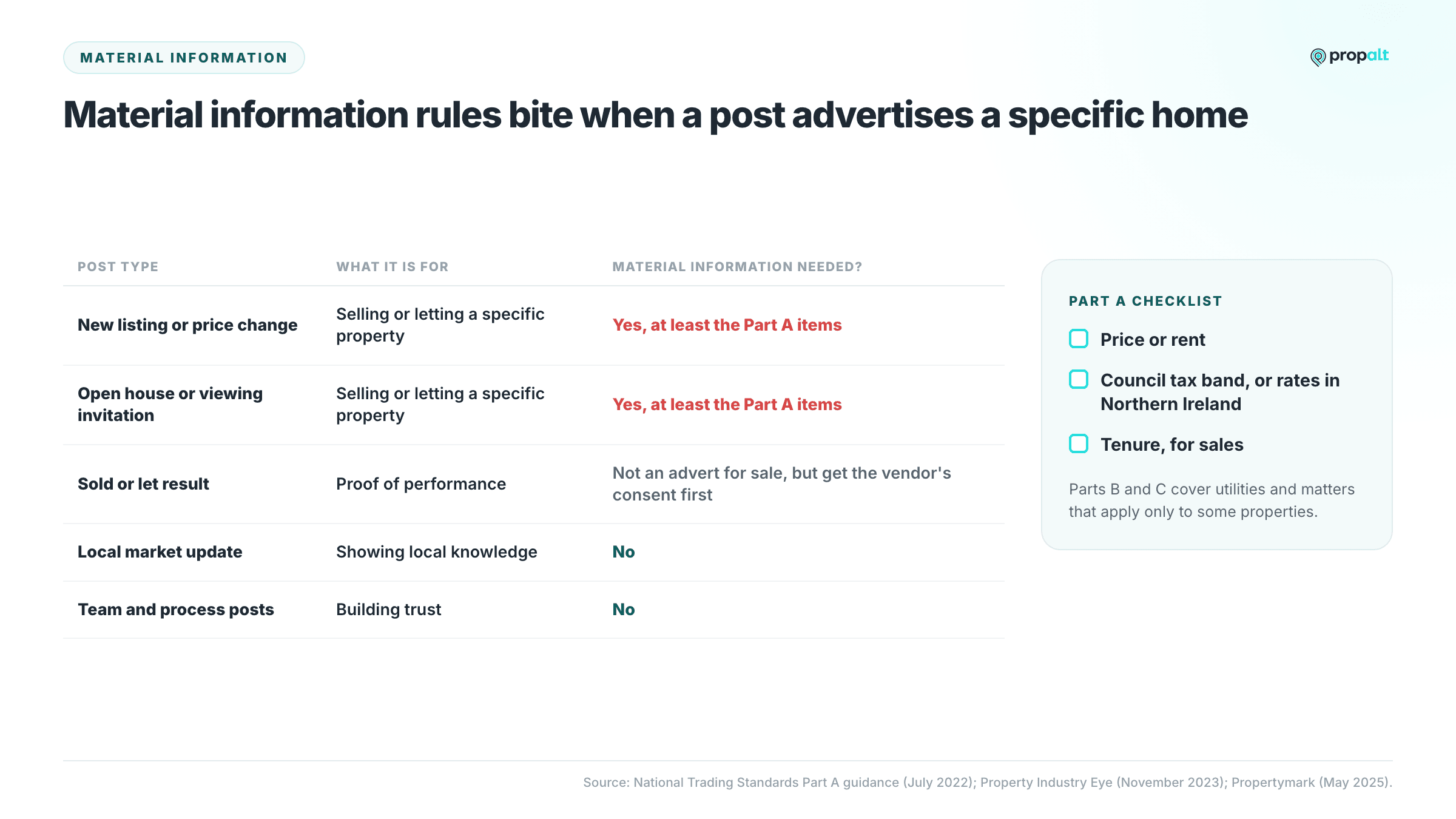
The concession: a post about your team, a local event or general market trends is not a property advert. The rules bite when a post invites people to buy or rent a particular home.
| Post type | What it is for | Material information needed? |
|---|---|---|
| New listing or price change | Selling or letting a specific property | Yes, at least the Part A checklist items |
| Open house or viewing invitation | Selling or letting a specific property | Yes, at least the Part A checklist items |
| Sold or let result | Proof of performance | Not an advert for sale, but get the vendor's consent first |
| Local market update | Showing local knowledge | No |
| Team and process posts | Building trust | No |
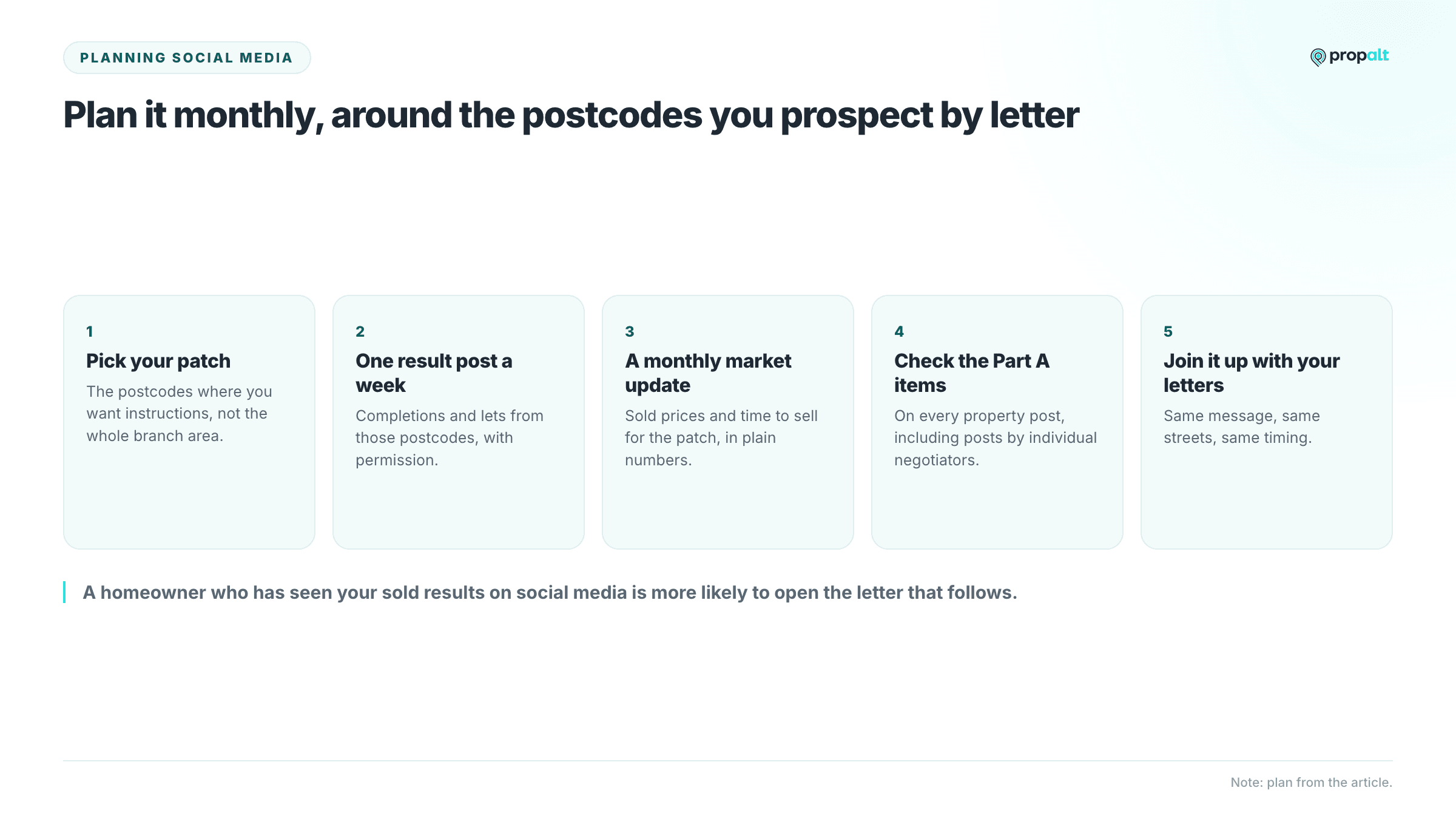
Plan it monthly, around the same postcodes you prospect by letter. A homeowner who has seen your sold results on social media is more likely to open the letter that follows.
Propalt's Location Analysis maps every property in your patch with sold prices and market activity, which gives you the numbers for step 3 and the streets for step 5.
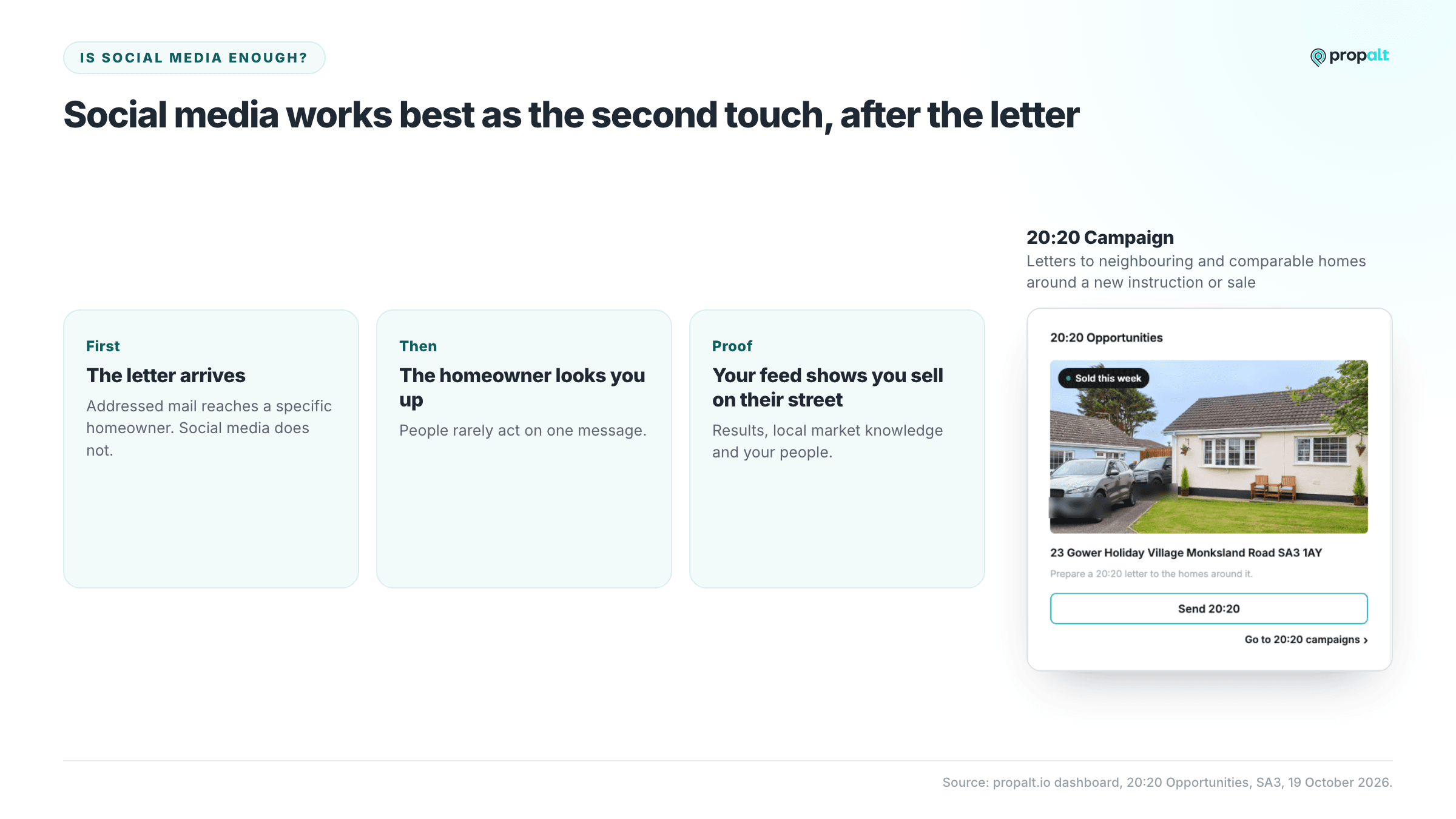
On its own, rarely. Social media builds recognition among people who already follow you or who see your paid local posts. It does not reach a specific homeowner at the moment they decide to sell. That is the job of addressed mail and direct prospecting, covered in our guide to direct mail for estate agents.
The agencies that get the most from social media use it as the second touch. The letter arrives, the homeowner looks you up, and your feed shows that you sell homes on their street.
That sequence works because people rarely act on one message, the idea behind our guide to the rule of seven. Propalt's 20:20 Campaign sends letters to neighbouring and comparable homes around a new instruction or sale, which puts the letter in place before the homeowner looks you up.
Key takeaway. Social media for estate agents works best as proof: results, local market knowledge and the people behind the agency, timed to support letters to the same streets. Any post advertising a specific property needs the same material information as a portal listing, starting with price, council tax band and tenure. Propalt is built on the principle that every channel works harder when it is aimed at the right streets.
Sources and data references
Propalt data. Propalt (21 October 2026). Quarterly market statistics, Q3 2026 (July to September): days from first listing to sale agreed, national and Greater London.
Dormant Marketing Strategy ...If you’re attending a valuation with one of these sellers, there’s a risk: you leave without an instruction, only a vague promise of “we’ll be in touch once we’ve found something.” Even if they’re sincere, you’re now in a follow-up loop. And meanwhile, another agent could win their trust, find their next home, and take the listing.

During the summer, some listings stall. Some agents go on holiday. And some vendors get fed up. That’s where you come in. Here are six practical tips for improving your on-market canvassing strategy.

Discover the latest on UK mortgage approvals and house price trends in our article, providing essential insights for homebuyers, sellers, and market enthusiasts.